
载脂蛋白 E4 增加载脂蛋白 E 同型基因 iPSC 衍生神经元的能量代谢。
APOE4 Increases Energy Metabolism in APOE-Isogenic iPSC-Derived Neurons.
机构信息
Institute for Regenerative Medicine, University of Zurich, 8952 Schlieren, Switzerland.
Neuroscience Center Zurich, University of Zurich and ETH Zurich, 8057 Zurich, Switzerland.
出版信息
Cells. 2024 Jul 17;13(14):1207. doi: 10.3390/cells13141207.
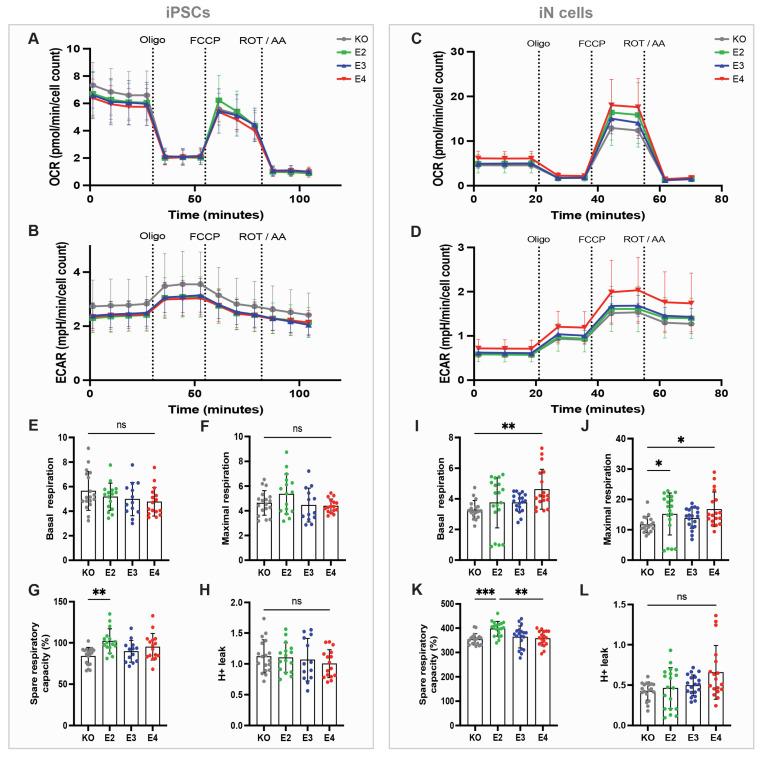
The apolipoprotein E4 () allele represents the major genetic risk factor for Alzheimer's disease (AD). In contrast, is known to lower the AD risk, while is defined as risk neutral. APOE plays a prominent role in the bioenergetic homeostasis of the brain, and early-stage metabolic changes have been detected in the brains of AD patients. Although APOE is primarily expressed by astrocytes in the brain, neurons have also been shown as source for APOE. However, the distinct roles of the three APOE isoforms in neuronal energy homeostasis remain poorly understood. In this study, we generated pure human neurons (iN cells) from -isogenic induced pluripotent stem cells (iPSCs), expressing either APOE2, APOE3, APOE4, or carrying an knockout (KO) to investigate APOE isoform-specific effects on neuronal energy metabolism. We showed that endogenously produced APOE4 enhanced mitochondrial ATP production in -isogenic iN cells but not in the corresponding iPS cell line. This effect neither correlated with the expression levels of mitochondrial fission or fusion proteins nor with the intracellular or secreted levels of APOE, which were similar for , , and iN cells. ATP production and basal respiration in iN cells strongly differed from and more closely resembled and iN cells, indicating a gain-of-function mechanism of APOE4 rather than a loss-of-function. Taken together, our findings in isogenic iN cells reveal an genotype-dependent and neuron-specific regulation of oxidative energy metabolism.
载脂蛋白 E4 () 等位基因是阿尔茨海默病 (AD) 的主要遗传风险因素。相比之下, 已知可降低 AD 风险,而 被定义为风险中性。APOE 在大脑的生物能量动态平衡中发挥着重要作用,并且已经在 AD 患者的大脑中检测到早期代谢变化。虽然 APOE 主要由大脑中的星形胶质细胞表达,但神经元也被证明是 APOE 的来源。然而,三种 APOE 同工型在神经元能量动态平衡中的独特作用仍知之甚少。在这项研究中,我们从 - 同基因诱导多能干细胞 (iPSC) 中生成纯人类神经元 (iN 细胞),表达 APOE2、APOE3、APOE4 或携带 敲除 (KO),以研究 APOE 同工型特异性对神经元能量代谢的影响。我们表明,内源性产生的 APOE4 增强了 - 同基因 iN 细胞中的线粒体 ATP 产生,但在相应的 iPSC 系中却没有。这种效应既与线粒体裂变或融合蛋白的表达水平无关,也与 APOE 的细胞内或分泌水平无关, 、 和 iN 细胞的 APOE 水平相似。 iN 细胞中的 ATP 产生和基础呼吸与 和 更相似,而与 差异较大,这表明 APOE4 具有功能获得机制,而不是功能丧失机制。总之,我们在 - 同基因 iN 细胞中的发现揭示了一种 基因型依赖性和神经元特异性的氧化能量代谢调节。


 Zotero 插件