School of Medicine, Universitat de Barcelona, 08007 Barcelona, Spain.
Institut d'Investigacions Biomèdiques August Pi i Sunyer (IDIBAPS), 08036 Barcelona, Spain.
Curr Oncol. 2024 Jun 21;31(7):3615-3629. doi: 10.3390/curroncol31070266.
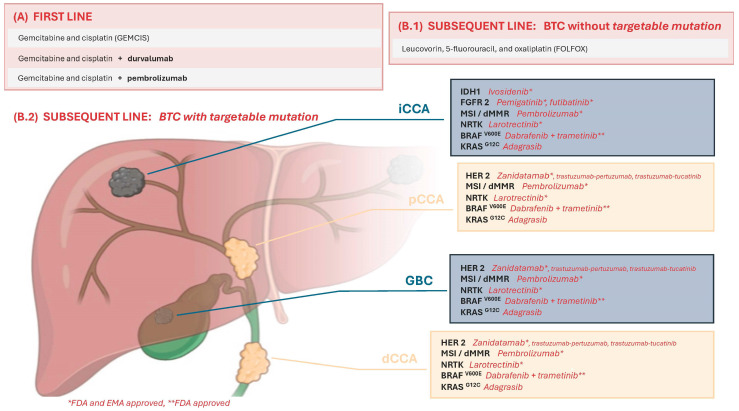
Biliary tract cancers (BTCs) are rare and aggressive malignancies with an increasing incidence and poor prognosis. The standard systemic treatment for BTCs has evolved to include immune checkpoint inhibitors associated with gemcitabine-cisplatin as first-line therapies. However, survival rates remain low, highlighting the critical need for personalized treatment strategies based on molecular profiling. Currently, significant advancements have been made in the molecular characterization of BTCs, where genetic alterations, such as mutations and fusions, provide targets for therapy. Molecular profiling is crucial early in the management process to identify potential candidates for clinical trials and guide treatment strategy. The integration of these molecular insights into clinical practice has allowed for the development of targeted therapies, although many of them are still in the phase 2 trial stage without definitive survival benefits demonstrated in phase 3 trials. This integration of comprehensive molecular profile insights with traditional treatment approaches offers a new horizon in the personalized medicine landscape for BTCs, with the aim of significantly improving patient outcomes through precision oncology.
胆道癌(BTC)是一种罕见且侵袭性强的恶性肿瘤,其发病率和预后均较差。BTC 的标准系统治疗已演变为包括免疫检查点抑制剂联合吉西他滨-顺铂作为一线治疗。然而,生存率仍然较低,这突出表明需要基于分子谱分析制定个性化的治疗策略。目前,在 BTC 的分子特征方面取得了重大进展,其中基因突变和融合等遗传改变为治疗提供了靶点。分子谱分析在管理过程的早期非常重要,可以确定潜在的临床试验候选者并指导治疗策略。将这些分子见解整合到临床实践中,已经开发出了靶向疗法,尽管其中许多仍处于 2 期临床试验阶段,在 3 期临床试验中并未证明有明确的生存获益。这种将全面的分子谱分析见解与传统治疗方法相结合,为 BTC 的个性化医学领域提供了一个新的前景,旨在通过精准肿瘤学显著改善患者的预后。