Kwon Mee-Kyoung, Congdon Eliza, Ping Raedy, Levine Susan C
Department of Child Studies, Seoul Women's University, Seoul 01797, Republic of Korea.
Department of Psychology, Williams College, Williamstown, MA 01267, USA.
J Intell. 2024 Jun 22;12(7):62. doi: 10.3390/jintelligence12070062.
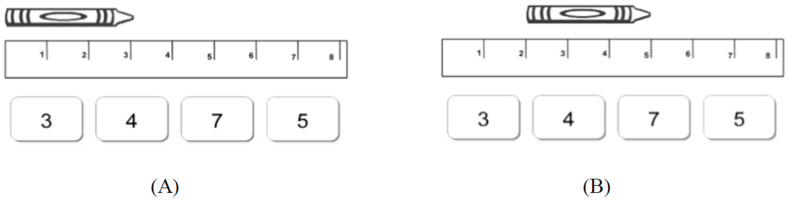
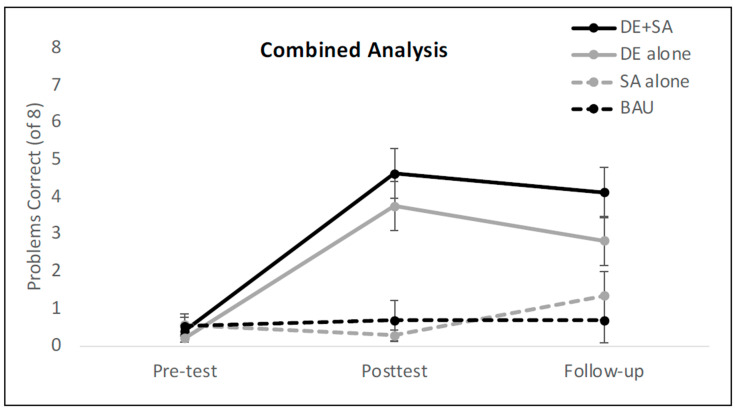
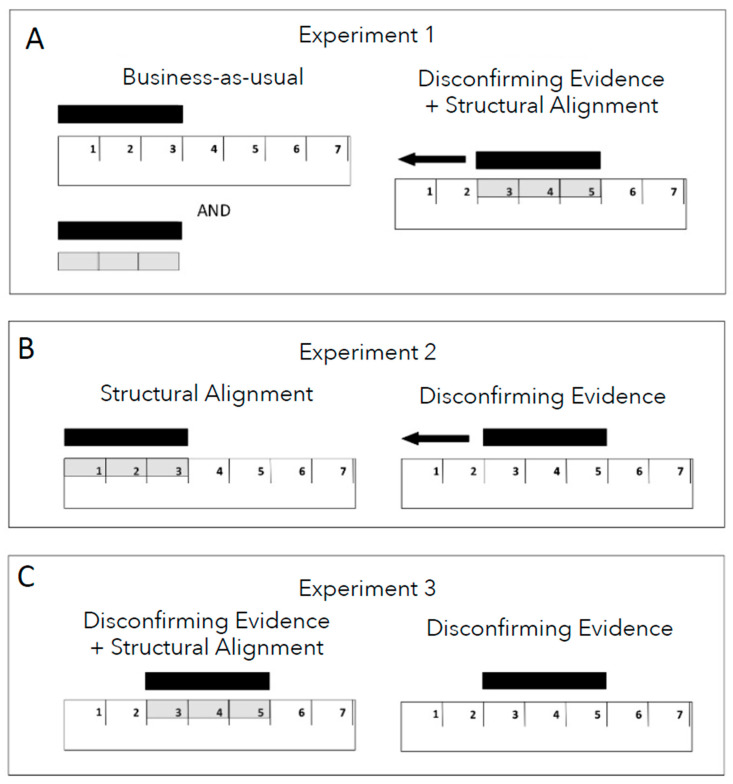
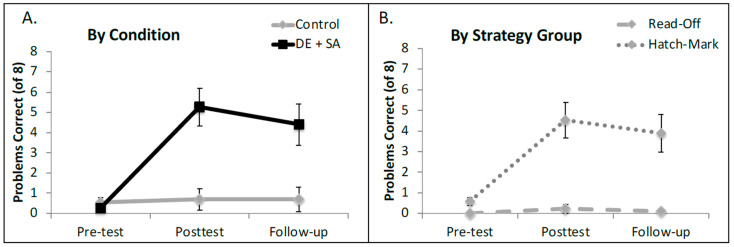
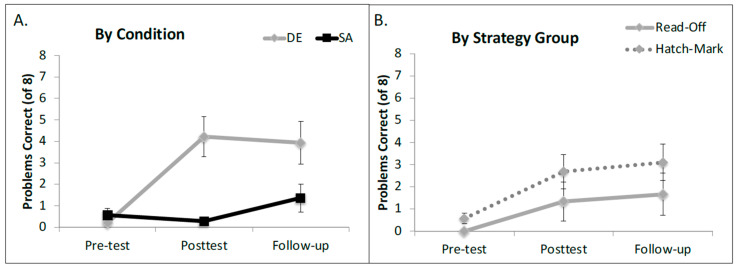
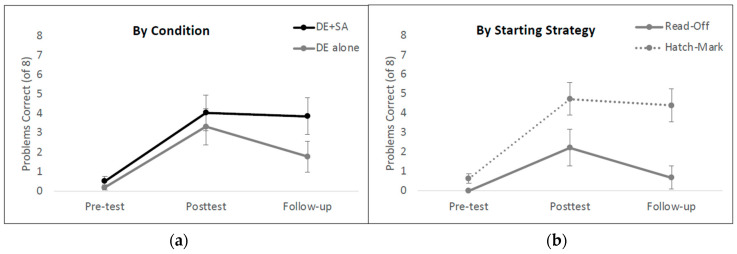
Children have persistent difficulty with foundational measurement concepts, which may be linked to the instruction they receive. Here, we focus on testing various ways to support their understanding that rulers comprise spatial interval units. We examined whether evidence-based learning tools-disconfirming evidence and/or structural alignment-enhance their understanding of ruler units. Disconfirming evidence, in this context, involves having children count the spatial interval units under an object that is not aligned with the origin of a ruler. Structural alignment, in this context, involves highlighting what a ruler unit is by overlaying plastic unit chips on top of ruler units when an object is aligned with the origin of a ruler. In three experiments employing a pre-test/training/post-test design, a total of 120 second graders were randomly assigned to one of six training conditions (two training conditions per experiment). The training conditions included different evidence-based learning principles or "business-as-usual" instruction (control), with equal allocation to each ( = 20 for each condition). In each experiment, children who did not perform above chance level on the pre-test were selected to continue with training, which resulted in a total of 88 students for the analysis of improvement. The children showed significant improvement in training conditions that included disconfirming evidence, but not in the structural alignment or control conditions. However, an exploratory analysis suggests that improvement occurred more rapidly and was retained better when structural alignment was combined with disconfirming evidence compared to disconfirming evidence alone.
儿童在基础测量概念方面存在持续的困难,这可能与他们接受的教学有关。在此,我们专注于测试各种方法,以支持他们理解尺子由空间间隔单位组成。我们研究了基于证据的学习工具——反证证据和/或结构对齐——是否能增强他们对尺子单位的理解。在这种情况下,反证证据包括让儿童数一数与尺子起点不对齐的物体下方的空间间隔单位。在这种情况下,结构对齐包括当物体与尺子起点对齐时,通过在尺子单位上覆盖塑料单位芯片来突出尺子单位是什么。在采用前测/训练/后测设计的三个实验中,总共120名二年级学生被随机分配到六个训练条件之一(每个实验两个训练条件)。训练条件包括不同的基于证据的学习原则或“照常”教学(对照),每个条件的分配人数相等(每个条件 = 20人)。在每个实验中,前测未达到随机水平的儿童被选出来继续训练,最终共有88名学生参与改进分析。在包括反证证据的训练条件下,儿童表现出显著的进步,但在结构对齐或对照条件下则没有。然而,一项探索性分析表明,与单独的反证证据相比,当结构对齐与反证证据相结合时,进步出现得更快且保持得更好。