Stahl Aimee E, Feigenson Lisa
Department of Psychological & Brain Sciences, Johns Hopkins University, Baltimore, MD 21218, USA.
Science. 2015 Apr 3;348(6230):91-4. doi: 10.1126/science.aaa3799.
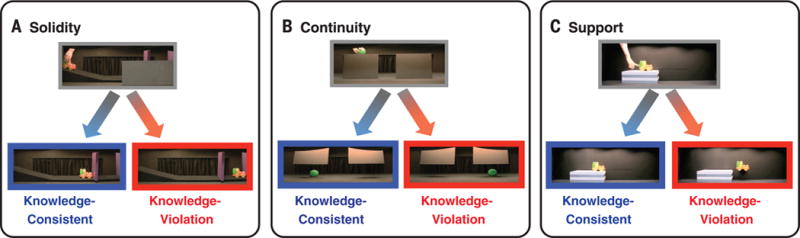
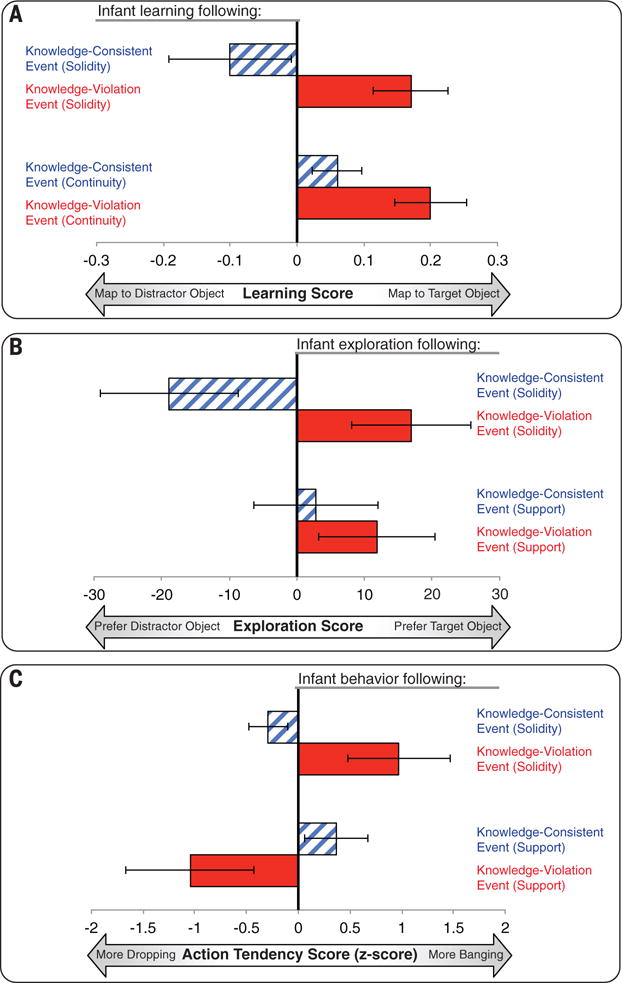
Given the overwhelming quantity of information available from the environment, how do young learners know what to learn about and what to ignore? We found that 11-month-old infants (N = 110) used violations of prior expectations as special opportunities for learning. The infants were shown events that violated expectations about object behavior or events that were nearly identical but did not violate expectations. The sight of an object that violated expectations enhanced learning and promoted information-seeking behaviors; specifically, infants learned more effectively about objects that committed violations, explored those objects more, and engaged in hypothesis-testing behaviors that reflected the particular kind of violation seen. Thus, early in life, expectancy violations offer a wedge into the problem of what to learn.
鉴于环境中存在海量信息,幼儿学习者如何知道该学习什么、忽略什么呢?我们发现,11个月大的婴儿(N = 110)将违背先前预期的情况视为特殊的学习机会。研究人员向婴儿展示了违背物体行为预期的事件,或者几乎相同但未违背预期的事件。看到违背预期的物体会增强学习效果并促进信息寻求行为;具体而言,婴儿对出现违背预期情况的物体学习得更有效,对这些物体探索得更多,并参与反映所观察到的特定违背情况的假设检验行为。因此,在生命早期,预期违背为解决学习内容的问题提供了一个切入点。