Department of Chemical Sciences, University of Naples "Federico II", Complesso Universitario Monte S. Angelo, Via Cintia 4, 80126 Naples, Italy.
Istituto Nazionale Biostrutture e Biosistemi (I.N.B.B), Viale Medaglie D'Oro 305, 00136 Roma, Italy.
Mar Drugs. 2024 Jun 28;22(7):299. doi: 10.3390/md22070299.
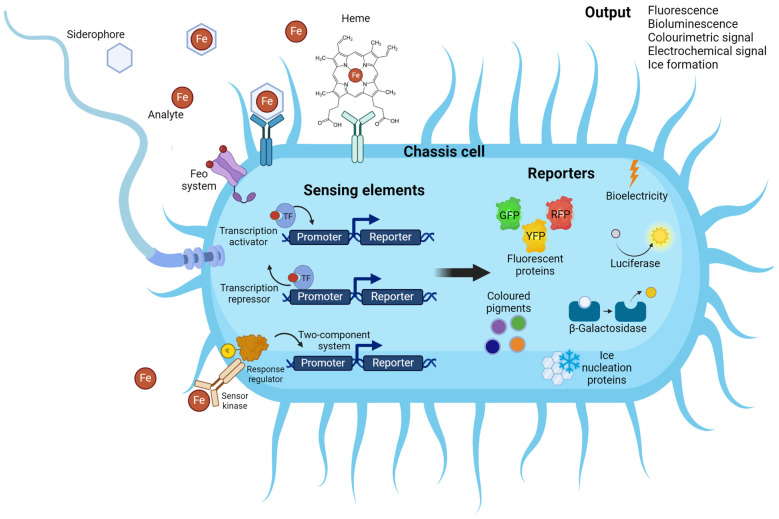
Iron is a key micronutrient essential for various essential biological processes. As a consequence, alteration in iron concentration in seawater can deeply influence marine biodiversity. In polar marine environments, where environmental conditions are characterized by low temperatures, the role of iron becomes particularly significant. While iron limitation can negatively influence primary production and nutrient cycling, excessive iron concentrations can lead to harmful algal blooms and oxygen depletion. Furthermore, the growth of certain phytoplankton species can be increased in high-iron-content environments, resulting in altered balance in the marine food web and reduced biodiversity. Although many chemical/physical methods are established for inorganic iron quantification, the determination of the bio-available iron in seawater samples is more suitably carried out using marine microorganisms as biosensors. Despite existing challenges, whole-cell biosensors offer other advantages, such as real-time detection, cost-effectiveness, and ease of manipulation, making them promising tools for monitoring environmental iron levels in polar marine ecosystems. In this review, we discuss fundamental biosensor designs and assemblies, arranging host features, transcription factors, reporter proteins, and detection methods. The progress in the genetic manipulation of iron-responsive regulatory and reporter modules is also addressed to the optimization of the biosensor performance, focusing on the improvement of sensitivity and specificity.
铁是一种关键的微量元素,对各种基本的生物过程至关重要。因此,海水中铁浓度的变化会深刻影响海洋生物多样性。在极地海洋环境中,环境条件的特点是低温,铁的作用变得尤为重要。虽然铁限制会对初级生产力和营养循环产生负面影响,但过量的铁浓度会导致有害藻类大量繁殖和氧气耗尽。此外,在高铁含量环境中,某些浮游植物的生长会增加,导致海洋食物网的平衡发生改变,生物多样性减少。尽管有许多化学/物理方法可用于无机铁的定量,但更适合使用海洋微生物作为生物传感器来测定海水中的生物可利用铁。尽管存在挑战,但全细胞生物传感器具有实时检测、经济高效和易于操作等其他优势,使其成为监测极地海洋生态系统环境铁水平的有前途的工具。在这篇综述中,我们讨论了基本的生物传感器设计和组装,包括宿主特征、转录因子、报告蛋白和检测方法。还讨论了铁反应性调节和报告模块的遗传操作的进展,以优化生物传感器的性能,重点是提高灵敏度和特异性。