Sevilla Emma, Yuste Luis, Rojo Fernando
Departamento de Biotecnología Microbiana, Centro Nacional de Biotecnología, CSIC, Darwin 3, Cantoblanco, Madrid, 28049, Spain.
Microb Biotechnol. 2015 Jul;8(4):693-706. doi: 10.1111/1751-7915.12286. Epub 2015 Apr 15.
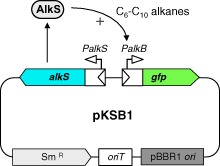
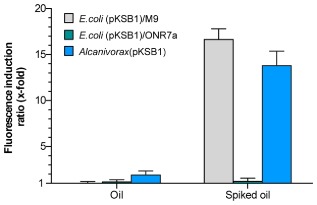
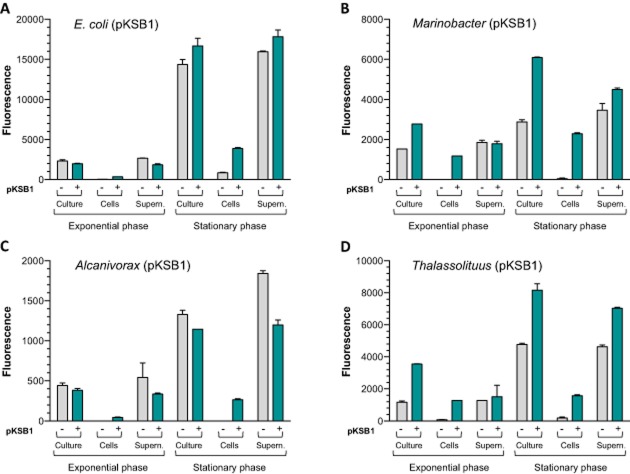
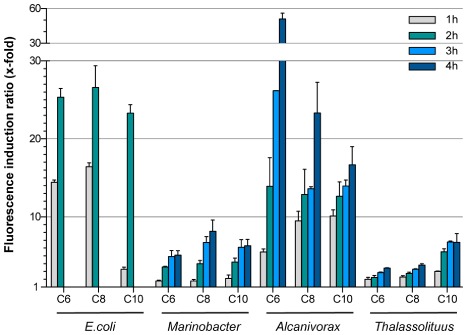
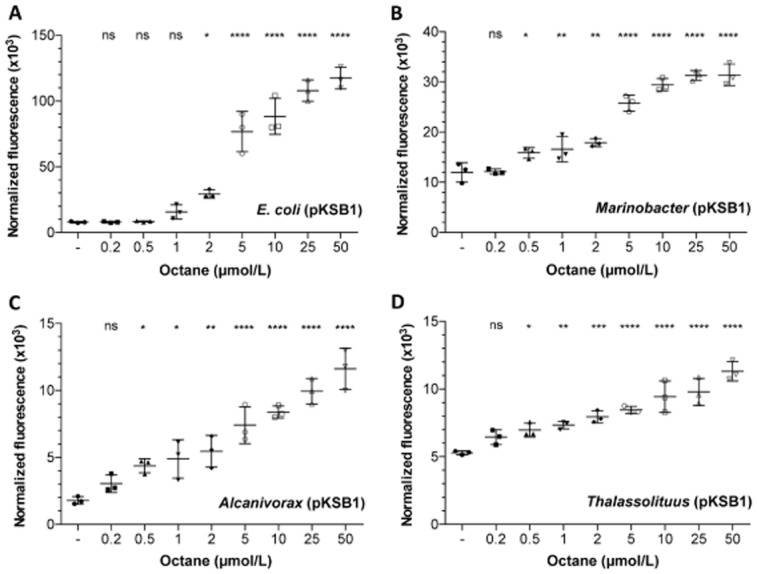
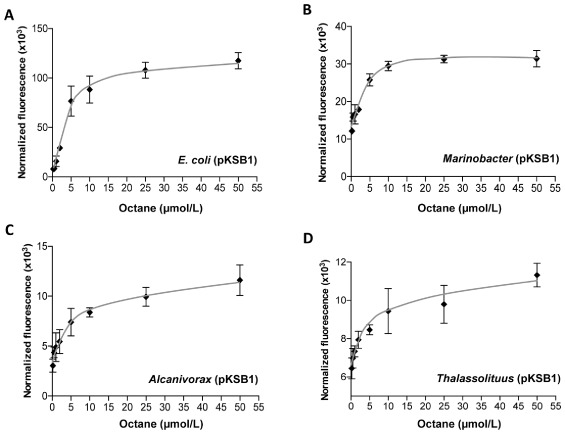
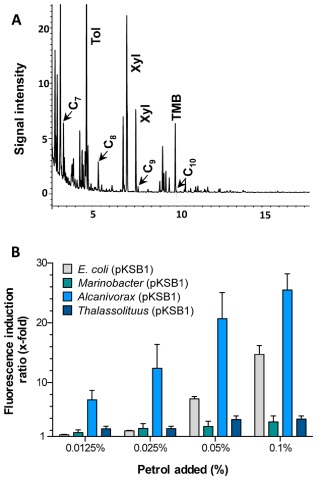
Whole-cell biosensors offer potentially useful, cost-effective systems for the in-situ monitoring of seawater for hydrocarbons derived from accidental spills. The present work compares the performance of a biosensor system for the detection of alkanes in seawater, hosted in either Escherichia coli (commonly employed in whole-cell biosensors but not optimized for alkane assimilation) or different marine bacteria specialized in assimilating alkanes. The sensor system was based on the Pseudomonas putida AlkS regulatory protein and the PalkB promoter fused to a gene encoding the green fluorescent protein. While the E. coli sensor provided the fastest response to pure alkanes (25-fold induction after 2 h under the conditions used), a sensor based on Alcanivorax borkumensis was slower, requiring 3-4 h to reach similar induction values. However, the A. borkumensis sensor showed a fourfold lower detection threshold for octane (0.5 μM), and was also better at sensing the alkanes present in petrol. At petrol concentrations of 0.0125%, the A. borkumensis sensor rendered a sevenfold induction, while E. coli sensor showed no response. We discuss possible explanations to this behaviour in terms of the cellular adaptations to alkane uptake and the basal fluorescence produced by each bacterial strain, which was lowest for A. borkumensis.
全细胞生物传感器为原位监测因意外泄漏而进入海水中的碳氢化合物提供了潜在有用且具有成本效益的系统。目前的工作比较了一种用于检测海水中烷烃的生物传感器系统的性能,该系统以大肠杆菌(全细胞生物传感器中常用但未针对烷烃同化进行优化)或专门同化烷烃的不同海洋细菌为宿主。该传感器系统基于恶臭假单胞菌的AlkS调节蛋白和与编码绿色荧光蛋白的基因融合的PalkB启动子。虽然大肠杆菌传感器对纯烷烃的响应最快(在所使用的条件下2小时后诱导25倍),但基于博氏食烷菌的传感器较慢,需要3 - 4小时才能达到类似的诱导值。然而,博氏食烷菌传感器对辛烷的检测阈值低四倍(0.5 μM),并且在检测汽油中存在的烷烃方面也更好。在汽油浓度为0.0125%时,博氏食烷菌传感器产生七倍诱导,而大肠杆菌传感器无响应。我们根据细胞对烷烃摄取的适应性以及每个细菌菌株产生的基础荧光来讨论这种行为的可能解释,博氏食烷菌产生的基础荧光最低。