Department of Neurology, Neuromuscular Center, Charles University, 2nd Faculty of Medicine and University Hospital Motol, Prague, Czech Republic.
Department of Biology and Medical Genetics, Charles University, 2nd Faculty of Medicine and University Hospital Motol, Prague, Czech Republic.
J Neuromuscul Dis. 2024;11(5):1035-1048. doi: 10.3233/JND-230236.
Genetic factors are involved in the pathogenesis of familial and sporadic amyotrophic lateral sclerosis (ALS) and constitute a link to its association with frontotemporal dementia (FTD). Gene-targeted therapies for some forms of ALS (C9orf72, SOD1) have recently gained momentum. Genetic architecture in Czech ALS patients has not been comprehensively assessed so far.
We aimed to deliver pilot data on the genetic landscape of ALS in our country.
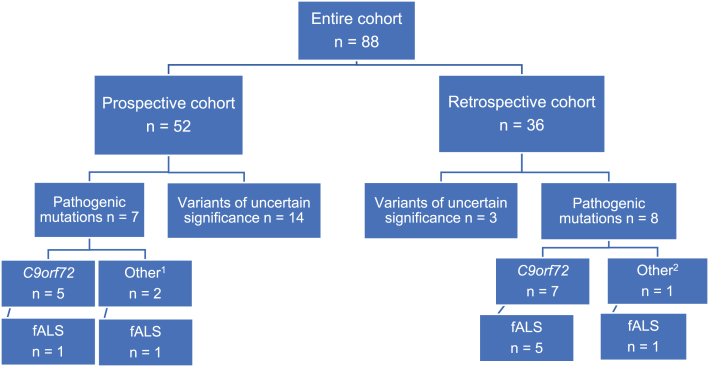
A cohort of patients with ALS (n = 88), recruited from two Czech Neuromuscular Centers, was assessed for hexanucleotide repeat expansion (HRE) in C9orf72 and also for genetic variations in other 36 ALS-linked genes via next-generation sequencing (NGS). Nine patients (10.1%) had a familial ALS. Further, we analyzed two subgroups of sporadic patients - with concomitant FTD (n = 7) and with young-onset of the disease (n = 22).
We detected the pathogenic HRE in C9orf72 in 12 patients (13.5%) and three other pathogenic variants in FUS, TARDBP and TBK1, each in one patient. Additional 7 novel and 9 rare known variants with uncertain causal significance have been detected in 15 patients. Three sporadic patients with FTD (42.9%) were harbouring a pathogenic variant (all HRE in C9orf72). Surprisingly, none of the young-onset sporadic patients harboured a pathogenic variant and we detected no pathogenic SOD1 variant in our cohort.
Our findings resemble those from other European populations, with the highest prevalence of HRE in the C9orf72 gene. Further, our findings suggest a possibility of a missing genetic variability among young-onset patients.
遗传因素参与家族性和散发性肌萎缩侧索硬化症(ALS)的发病机制,并构成其与额颞叶痴呆(FTD)相关的一个环节。最近,针对某些形式的 ALS(C9orf72、SOD1)的基因靶向疗法已经取得了进展。到目前为止,捷克 ALS 患者的遗传结构尚未得到全面评估。
我们旨在提供有关我国 ALS 遗传结构的初步数据。
从捷克的两个神经肌肉中心招募了 88 名 ALS 患者组成队列,评估 C9orf72 中六核苷酸重复扩增(HRE),并通过下一代测序(NGS)评估其他 36 个与 ALS 相关的基因中的遗传变异。9 名患者(10.1%)患有家族性 ALS。此外,我们分析了两个散发性患者亚组——同时伴有额颞叶痴呆(n=7)和疾病早发(n=22)。
我们在 12 名患者(13.5%)中检测到 C9orf72 中的致病性 HRE,在 1 名患者中检测到 FUS、TARDBP 和 TBK1 中的另外 3 种致病性变异。在 15 名患者中还检测到 7 种新的和 9 种罕见的、具有不确定因果意义的已知变体。3 名伴有额颞叶痴呆的散发性患者(42.9%)携带致病性变异(均为 C9orf72 中的 HRE)。令人惊讶的是,在年轻的散发性患者中没有携带致病性变异,而且我们的队列中没有检测到致病性 SOD1 变异。
我们的发现与其他欧洲人群相似,C9orf72 基因中的 HRE 患病率最高。此外,我们的发现表明年轻发病患者中可能存在遗传变异性缺失。