Department of Clinical Neurosciences and Cambridge Stem Cell Institute, John van Geest Centre for Brain Repair, University of Cambridge, Cambridge, UK.
Department of Experimental Medical Science, Wallenberg Neuroscience Center, Lund University, Lund, Sweden.
Bioessays. 2024 Dec;46(12):e2400118. doi: 10.1002/bies.202400118. Epub 2024 Jul 26.
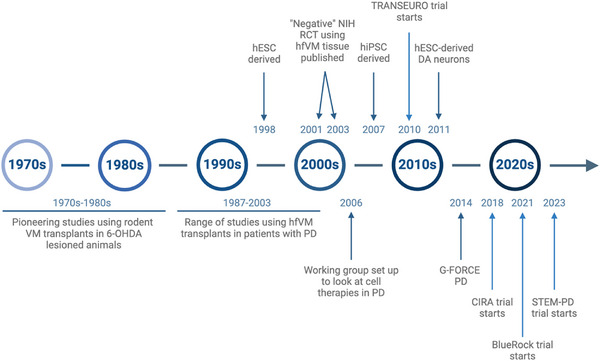
Parkinson's disease (PD) is characterized by the loss of the dopaminergic nigrostriatal pathway which has led to the successful development of drug therapies that replace or stimulate this network pharmacologically. Although these drugs work well in the early stages of the disease, over time they produce side effects along with less consistent clinical benefits to the person with Parkinson's (PwP). As such there has been much interest in repairing this pathway using transplants of dopamine neurons. This work which began 50 years ago this September is still ongoing and has now moved to first in human trials using human pluripotent stem cell-derived dopaminergic neurons. The results of these trials are eagerly awaited although proof of principle data has already come from trials using human fetal midbrain dopamine cell transplants. This data has shown that developing dopamine cells when transplanted in the brain of a PwP can survive long term with clinical benefits lasting decades and with restoration of normal dopaminergic innervation in the grafted striatum. In this article, we discuss the history of this field and how this has now led us to the recent stem cell trials for PwP.
帕金森病(PD)的特征是多巴胺能黑质纹状体通路的丧失,这导致了药物治疗的成功发展,这些治疗方法可以在药理学上替代或刺激这个网络。尽管这些药物在疾病的早期阶段效果很好,但随着时间的推移,它们会产生副作用,同时对帕金森病患者(PwP)的临床益处也不那么一致。因此,人们对使用多巴胺神经元移植来修复这条通路产生了浓厚的兴趣。这项工作始于 50 年前的 9 月,至今仍在进行,并已转向使用人类多能干细胞衍生的多巴胺能神经元进行首次人体试验。虽然已经有使用人胎脑中脑多巴胺细胞移植的试验提供了原理证明数据,但人们急切地等待着这些试验的结果。这些数据表明,在 PwP 的大脑中移植发育中的多巴胺细胞可以长期存活,并具有长达几十年的临床益处,同时在移植的纹状体中恢复正常的多巴胺能神经支配。在本文中,我们将讨论这一领域的历史,以及这如何使我们最近对 PwP 进行了干细胞试验。