Department of Critical Care Medicine, State Key Laboratory of Complex Severe and Rare Diseases, Peking Union Medical College Hospital, Peking Union Medical College and Chinese Academy of Medical Sciences, Beijing, 100730, China.
Information Center, State Key Laboratory of Complex Severe and Rare Diseases, Peking Union Medical College Hospital, Chinese Academy of Medical Sciences and Peking Union Medical College, Beijing, 100730, China.
EBioMedicine. 2024 Aug;106:105257. doi: 10.1016/j.ebiom.2024.105257. Epub 2024 Jul 25.
Sepsis is a leading cause of mortality in intensive care units and vasoactive drugs are widely used in septic patients. The cardiovascular response of septic shock patients during resuscitation therapies and the relationship of the cardiovascular response and clinical outcome has not been clearly described.
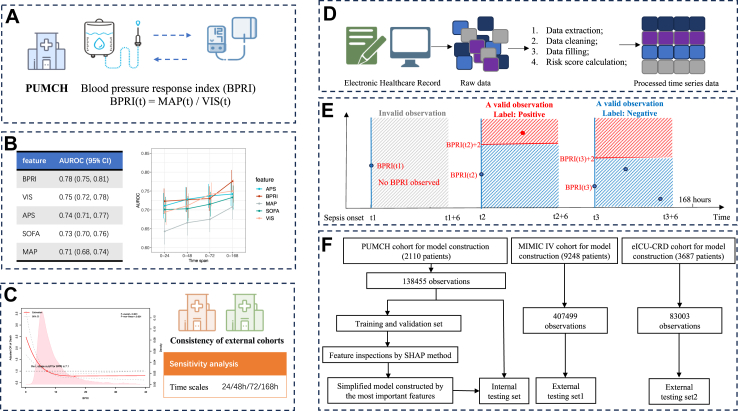
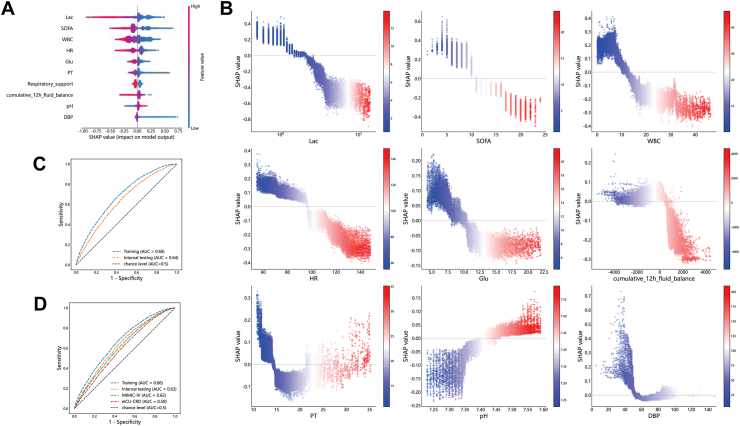
We included adult patients admitted to the ICU with sepsis from Peking Union Medical College Hospital (internal), Medical Information Mart for Intensive Care IV (MIMIC-IV) and eICU Collaborative Research Database (eICU-CRD). The Blood Pressure Response Index (BPRI) was defined as the ratio between the mean arterial pressure and the vasoactive-inotropic score. BRRI was compared with existing risk scores on predicting in-hospital death. The relationship between BPRI and in-hospital mortality was calculated. A XGBoost's machine learning model identified the features that influence short-term changes in BPRI.
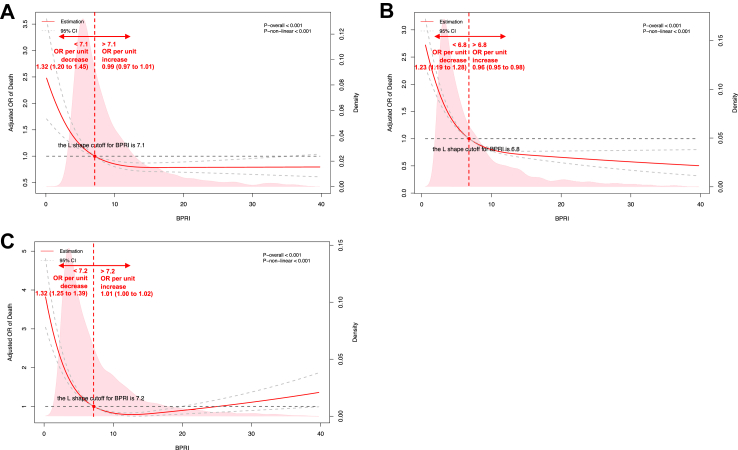
There were 2139, 9455, and 4202 patients in the internal, MIMIC-IV and eICU-CRD cohorts, respectively. BPRI had a better AUROC for predicting in-hospital mortality than SOFA (0.78 vs. 0.73, p = 0.01) and APS (0.78 vs. 0.74, p = 0.03) in the internal cohort. The estimated odds ratio for death per unit decrease in BPRI was 1.32 (95% CI 1.20-1.45) when BPRI was below 7.1 vs. 0.99 (95% CI 0.97-1.01) when BPRI was above 7.1 in the internal cohort; similar relationships were found in MIMIC-IV and eICU-CRD. Respiratory support and latest cumulative 12-h fluid balance were intervention-related features influencing BPRI.
BPRI is an easy, rapid, precise indicator of the response of patients with septic shock to vasoactive drugs. It is a comparable and even better predictor of prognosis than SOFA and APS in sepsis and it is simpler and more convenient in use. The application of BPRI could help clinicians identify potentially at-risk patients and provide clues for treatment.
Fundings for the Beijing Municipal Natural Science Foundation; the National High Level Hospital Clinical Research Funding; the CAMS Innovation Fund for Medical Sciences (CIFMS) from Chinese Academy of Medical Sciences and the National Key R&D Program of China, Ministry of Science and Technology of the People's Republic of China.
脓毒症是重症监护病房死亡的主要原因,血管活性药物广泛应用于脓毒症患者。在复苏治疗期间,脓毒性休克患者的心血管反应以及心血管反应与临床结局的关系尚未明确描述。
我们纳入了来自北京协和医院(内部)、医疗信息集市重症监护 IV(MIMIC-IV)和 eICU 协作研究数据库(eICU-CRD)的成年 ICU 脓毒症患者。血压反应指数(BPRI)定义为平均动脉压与血管活性-正性肌力评分的比值。BPRI 与现有风险评分预测院内死亡的能力进行了比较。计算 BPRI 与院内死亡率的关系。XGBoost 机器学习模型确定了影响 BPRI 短期变化的特征。
内部队列、MIMIC-IV 队列和 eICU-CRD 队列分别有 2139 例、9455 例和 4202 例患者。BPRI 对预测院内死亡率的 AUC 优于 SOFA(0.78 对 0.73,p=0.01)和 APS(0.78 对 0.74,p=0.03)。在内部队列中,BPRI 每降低一个单位,死亡的估计比值比为 1.32(95%CI 1.20-1.45),而 BPRI 高于 7.1 时为 0.99(95%CI 0.97-1.01);在 MIMIC-IV 和 eICU-CRD 中也发现了类似的关系。呼吸支持和最新的 12 小时累积液体平衡是影响 BPRI 的干预相关特征。
BPRI 是脓毒性休克患者对血管活性药物反应的一种简单、快速、精确的指标。它是一种与 SOFA 和 APS 相当甚至更好的预后预测指标,在脓毒症中更简单、更方便。BPRI 的应用可以帮助临床医生识别潜在的高危患者,并为治疗提供线索。
北京市自然科学基金;国家高水准医院临床研究基金;中国医学科学院创新基金(CIFMS)和国家重点研发计划,中华人民共和国科学技术部。