Acadia Pharmaceuticals, San Diego, CA, USA.
Analysis Group, Inc, Boston, MA, USA.
J Neurodev Disord. 2024 Jul 26;16(1):42. doi: 10.1186/s11689-024-09557-6.
With the advent of the first targeted therapy for Rett Syndrome (RTT), a comprehensive assessment of the journey of RTT is needed to elucidate on present unmet needs in this population. This study characterized females with RTT in the United States and their disease journey with respect to longitudinal treatment patterns, RTT-related outcomes, and changes in disease severity.
This retrospective cohort study used registry data of females with RTT from the 5211 RTT Natural History Study (RNHS) (November 2015-July 2021). Pharmacological and supportive therapy use, RTT-related outcomes, and RTT severity, as measured by the Clinical Severity Scale and Motor Behavioral Assessment scale, were evaluated following the first RNHS visit. Analyses were conducted overall and in subgroups by RTT type (classic and atypical RTT) and age at first visit (pediatric and adult).
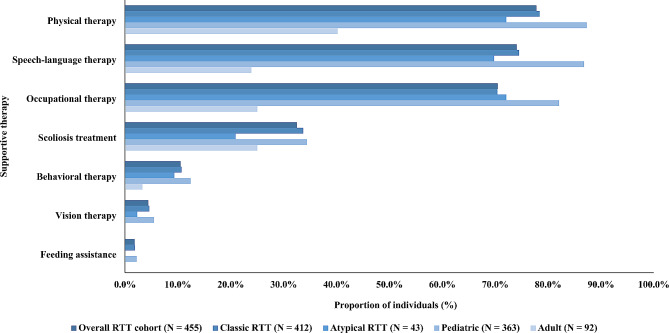
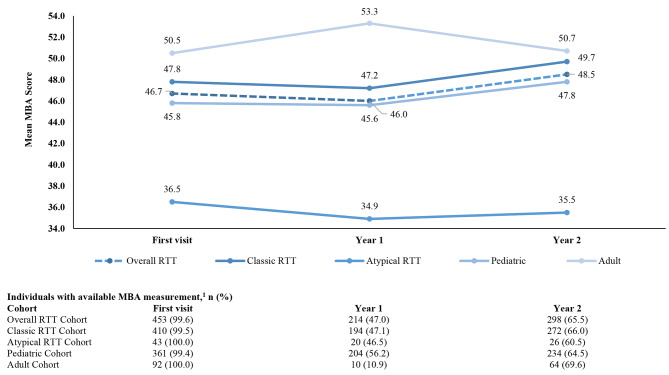
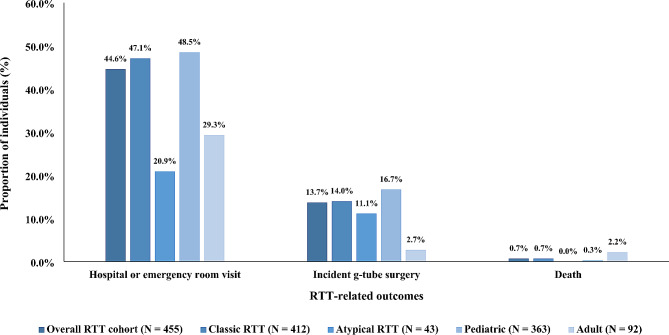
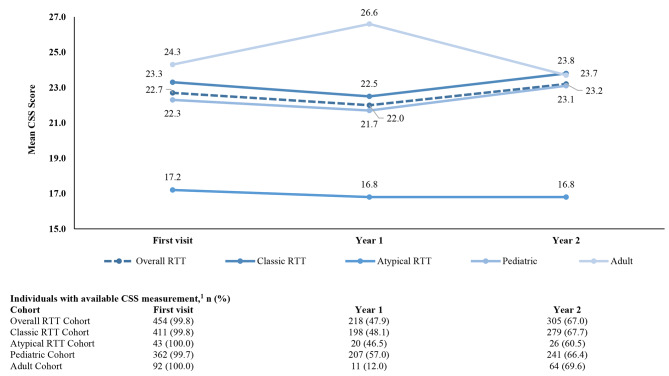
A total of 455 females with RTT were included in the study, of whom 90.5% had classic RTT and 79.8% were pediatric individuals. Over a median follow-up of 4 years, use of pharmacological therapies, including prokinetic agents (42.7% vs. 28.3%), and supportive therapies, including physical therapy (87.3% vs. 40.2%) and speech-language therapy (86.8% vs. 23.9%), were more common in pediatric than adult individuals (all p < 0.05). Nearly half (44.6%) of all individuals had a hospital or emergency room visit, with a higher proportion of visits in individuals with classic RTT than atypical RTT and pediatric than adult individuals (both p = 0.001). An increasing trend in clinical severity was observed in pediatric individuals (mean change per year: 0.24; 95% confidence interval [CI]: 0.03, 0.44), while an increasing trend in motor-behavioral dysfunction was observed in pediatric individuals (mean change per year: 1.12; 95% CI: 0.63, 1.60) and those with classic RTT (mean change per year: 0.97; 95% CI: 0.53, 1.41).
Findings from this study highlight the considerable burden of RTT across disease subtype and age. Despite reliance on supportive therapies and healthcare encounters, individuals with RTT experience increasing disease severity and motor-behavioral dysfunction in childhood and adolescence, underscoring the unmet needs of this population and the value of early intervention to manage RTT in the long-term.
随着首个雷特综合征(RTT)靶向治疗药物的问世,需要对 RTT 患者的治疗历程进行全面评估,以明确该人群目前尚未满足的需求。本研究旨在对美国 RTT 女性患者进行特征描述,并探讨其疾病进展过程,包括纵向治疗模式、RTT 相关结局以及疾病严重程度的变化。
本回顾性队列研究使用了 5211 名 RTT 自然史研究(RNHS)(2015 年 11 月至 2021 年 7 月)中女性 RTT 患者的登记数据。对患者首次就诊后,使用药物治疗和支持性治疗的情况、RTT 相关结局以及使用临床严重程度评分(Clinical Severity Scale)和运动行为评估量表(Motor Behavioral Assessment scale)评估疾病严重程度。分析按 RTT 类型(经典型和非经典型)和就诊年龄(儿科和成年)进行了总体分析和亚组分析。
共纳入了 455 名 RTT 女性患者,其中 90.5%为经典型 RTT,79.8%为儿科患者。在中位随访 4 年后,儿科患者使用药物治疗(包括促动力药物,42.7%比 28.3%)和支持性治疗(包括物理治疗,87.3%比 40.2%;言语治疗,86.8%比 23.9%)的比例高于成年患者(均 P<0.05)。将近一半(44.6%)的患者有过住院或急诊就诊经历,其中经典型 RTT 患者的就诊比例高于非经典型 RTT 患者,儿科患者的就诊比例高于成年患者(均 P=0.001)。儿科患者的临床严重程度呈逐渐加重趋势(每年平均变化:0.24;95%置信区间:0.03,0.44),而儿科患者和经典型 RTT 患者的运动行为障碍呈逐渐加重趋势(每年平均变化:1.12;95%置信区间:0.63,1.60;0.97;95%置信区间:0.53,1.41)。
本研究结果强调了 RTT 患者在疾病亚型和年龄方面存在较大的疾病负担。尽管依赖于支持性治疗和医疗服务,RTT 患者在儿童和青少年时期经历了疾病严重程度和运动行为障碍的逐渐加重,这凸显了该人群的未满足需求以及早期干预以长期管理 RTT 的重要性。