Department of Pharmacy, Zhongda Hospital, School of Medicine, Southeast University, Nanjing, China.
Department of Cardiac Surgery, Peking University People's Hospital, Peking University, Beijing, China.
BMC Public Health. 2024 Jul 26;24(1):2002. doi: 10.1186/s12889-024-19545-z.
Hyperglycemia is a rapidly increasing risk factor for cancer mortality worldwide. However, the dose‒response relationship between glucose levels and all-cause mortality in cancer survivors is still uncertain.
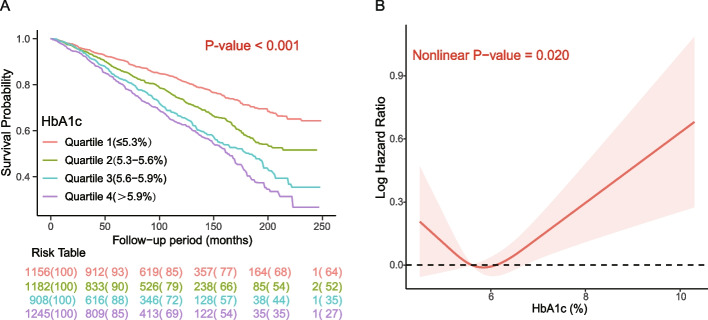
We enrolled 4,491 cancer survivors (weighted population 19,465,739) from the 1999-2019 National Health and Nutrition Examination Survey (NHANES). Cancer survivors were defined based on the question of whether they had ever been diagnosed with cancer by a doctor or a health professional. Hemoglobin A1c (HbA1c) was selected in this study as a stable marker of glucose level. Mortality was ascertained by linkage to National Death Index records until December 31, 2019. Cox proportional hazard, Kaplan‒Meier survival curves and Restricted cubic spline regression models were used to evaluate the associations between HbA1c and all-cause mortality risk in cancer survivors.
In NHANES, after adjusting for confounders, HbA1c had an independent nonlinear association with increased all-cause mortality in cancer survivors (nonlinear P value < 0.05). The threshold value for HbA1c was 5.4%, and the HRs (95% CI) below and above the threshold value were 0.917 (0.856,0.983) and 1.026 (1.010,1.043), respectively. Similar associations were found between fasting glucose and all-cause mortality in cancer survivors, and the threshold value was 5.7 mmol/L.
HbA1c was nonlinearly associated with all-cause mortality in cancer survivors, and the critical value of HbA1c in decreased mortality was 5.4%, suggesting optimal glucose management in cancer survivors may be a key to preventing premature death in cancer survivors.
高血糖是全球癌症死亡的一个快速增长的危险因素。然而,癌症幸存者的血糖水平与全因死亡率之间的剂量-反应关系仍不确定。
我们从 1999 年至 2019 年的国家健康和营养检查调查(NHANES)中招募了 4491 名癌症幸存者(加权人口为 19465739 人)。癌症幸存者的定义是基于他们是否曾被医生或健康专业人员诊断患有癌症的问题。本研究选择糖化血红蛋白(HbA1c)作为血糖水平的稳定标志物。通过与国家死亡指数记录的链接确定死亡率,直至 2019 年 12 月 31 日。Cox 比例风险、Kaplan-Meier 生存曲线和限制三次样条回归模型用于评估 HbA1c 与癌症幸存者全因死亡率风险之间的关系。
在 NHANES 中,在调整混杂因素后,HbA1c 与癌症幸存者全因死亡率的增加呈独立的非线性关系(非线性 P 值<0.05)。HbA1c 的阈值为 5.4%,阈值以下和以上的 HR(95%CI)分别为 0.917(0.856,0.983)和 1.026(1.010,1.043)。在癌症幸存者中,空腹血糖与全因死亡率之间也存在类似的关联,阈值为 5.7mmol/L。
HbA1c 与癌症幸存者的全因死亡率呈非线性相关,HbA1c 降低死亡率的临界值为 5.4%,这表明癌症幸存者的最佳血糖管理可能是预防癌症幸存者过早死亡的关键。