Han Claire J, Ning Xia, Burd Christin E, Spakowicz Daniel J, Tounkara Fode, Kalady Matthew F, Noonan Anne M, McCabe Susan, Von Ah Diane
Center for Healthy Aging, Self-Management and Complex Care, College of Nursing, The Ohio State University, Columbus, OH 43210, USA.
The Ohio State University-James: Cancer Treatment and Research Center, Columbus, OH 43210, USA.
Cancers (Basel). 2024 Jul 20;16(14):2597. doi: 10.3390/cancers16142597.
Colorectal cancer (CRC) patients experience multiple types of chemotoxicity affecting treatment compliance, survival, and quality of life (QOL). Prior research shows clinician-reported chemotoxicity (i.e., grading scales or diagnostic codes) predicts rehospitalization and cancer survival. However, a comprehensive synthesis of clinician-reported chemotoxicity is still lacking.
We conducted a systematic review and meta-analysis to determine chemotoxicity's prevalence and risk factors in CRC.
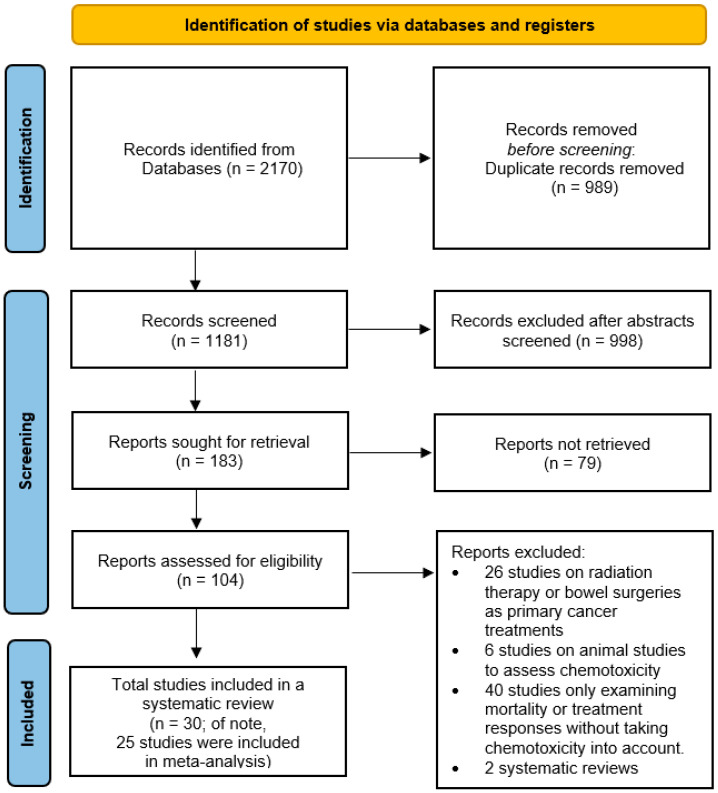
A systematic search from 2009 to 2024 yielded 30 studies for review, with 25 included in the meta-analysis.
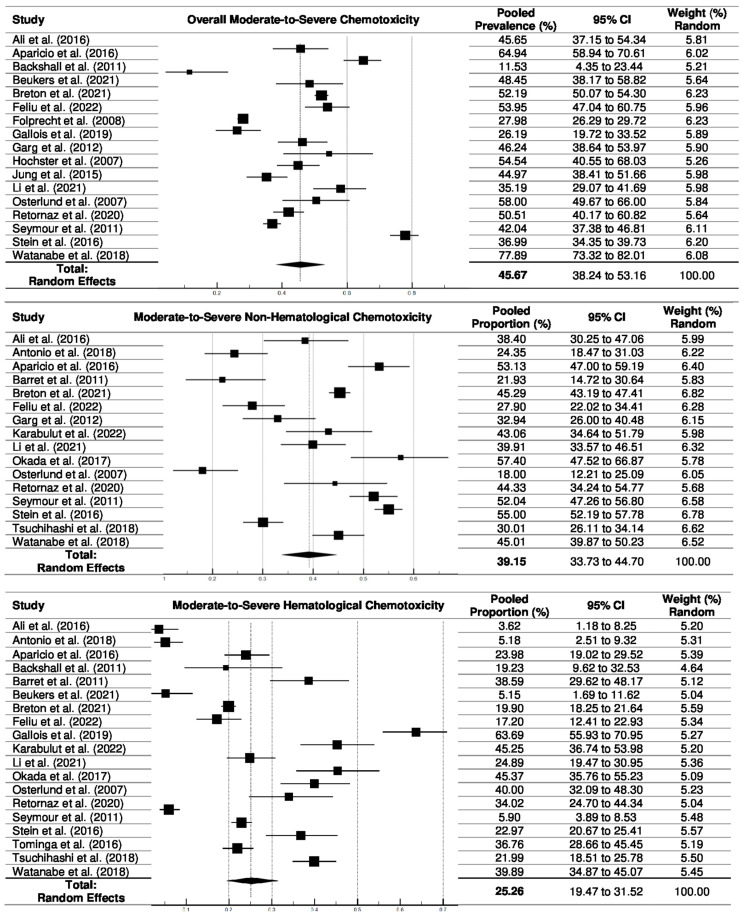
Pooled prevalences of overall, non-hematological, and hematological moderate-to-severe toxicities were 45.7%, 39.2%, and 25.3%, respectively. The most common clinician-reported chemotoxicities were gastrointestinal (GI) toxicity (22.9%) and neuropathy or neutropenia (17.9%). Significant risk factors at baseline were malnutritional status, frailty, impaired immune or hepato-renal functions, short telomere lengths, low gut lactobacillus levels, age, female sex, aggressive chemotherapy, and low QOL. Age was associated with neutropenia (β: -1.44) and GI toxicity (β:1.85) (-values < 0.01). Older adults (>65 y.o.) had higher prevalences of overall (OR: 1.14) and GI (OR: 1.65) toxicities, but a lower prevalence of neutropenia (OR: 0.65) than younger adults (-values < 0.05).
Our findings highlight the importance of closely monitoring and managing chemotoxicity in CRC patients receiving chemotherapy.
结直肠癌(CRC)患者会经历多种化疗毒性,这会影响治疗依从性、生存率和生活质量(QOL)。先前的研究表明,临床医生报告的化疗毒性(即分级量表或诊断代码)可预测再次住院和癌症生存率。然而,目前仍缺乏对临床医生报告的化疗毒性的全面综合分析。
我们进行了一项系统综述和荟萃分析,以确定CRC中化疗毒性的患病率和危险因素。
对2009年至2024年进行的系统检索产生了30项可供综述的研究,其中25项纳入了荟萃分析。
总体、非血液学和血液学中重度毒性的合并患病率分别为45.7%、39.2%和25.3%。临床医生报告的最常见化疗毒性是胃肠道(GI)毒性(22.9%)和神经病变或中性粒细胞减少(17.9%)。基线时的显著危险因素包括营养不良状态、虚弱、免疫或肝肾功能受损、端粒长度短、肠道乳酸杆菌水平低、年龄、女性、积极化疗和低生活质量。年龄与中性粒细胞减少(β:-1.44)和胃肠道毒性(β:1.85)相关(P值<0.01)。与年轻人相比,老年人(>65岁)总体毒性(OR:1.14)和胃肠道毒性(OR:1.65)的患病率更高,但中性粒细胞减少的患病率更低(OR:0.65)(P值<0.05)。
我们的研究结果强调了密切监测和管理接受化疗的CRC患者化疗毒性的重要性。