Jo Hye-Jeong, Park Chanmi, Lee Eunyoung, Lee Jee Hang, Kim Jinwoo, Han Sujin, Kim Joohan, Kim Eun Joo, Kim Eosu, Kim Jae-Jin
Graduate School of Medical Science, Brain Korea 21 Project, Yonsei University College of Medicine, Seoul 03722, Republic of Korea.
HCI Lab, Cognitive Science, Yonsei University, Seoul 03722, Republic of Korea.
Brain Sci. 2024 Jun 26;14(7):637. doi: 10.3390/brainsci14070637.
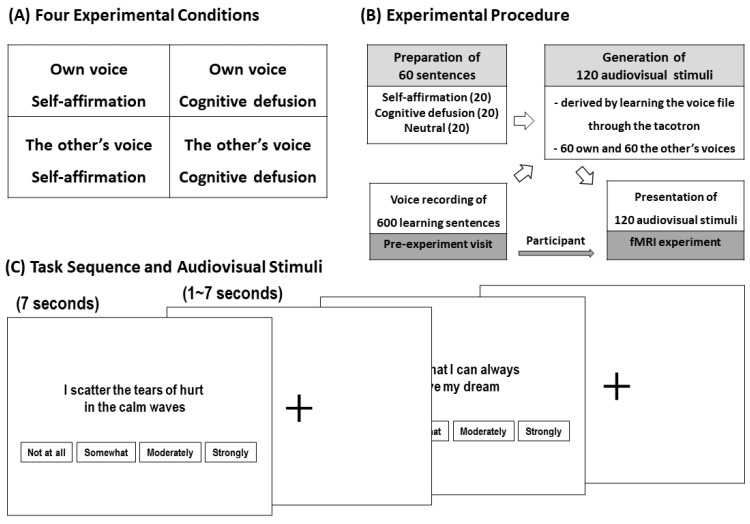
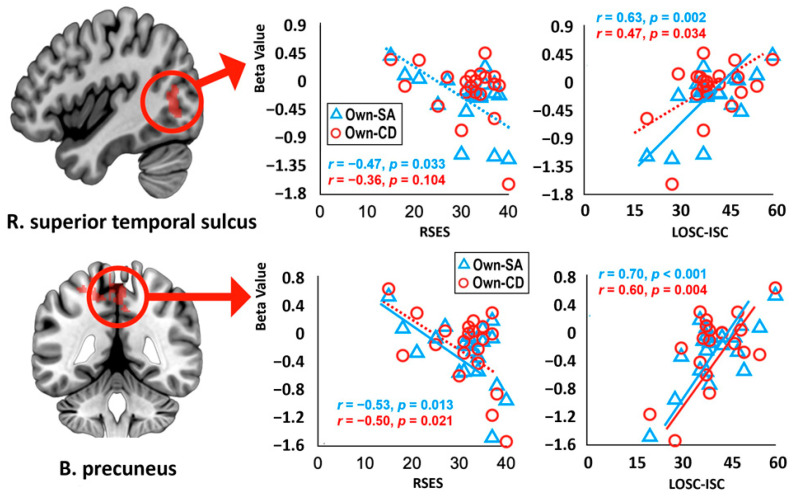
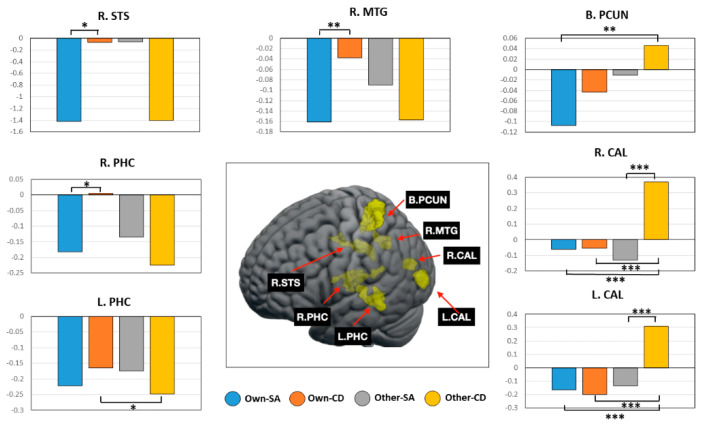
One's own voice undergoes unique processing that distinguishes it from others' voices, and thus listening to it may have a special neural basis for self-talk as an emotion regulation strategy. This study aimed to elucidate how neural effects of one's own voice differ from those of others' voices on the implementation of emotion regulation strategies. Twenty-one healthy adults were scanned using fMRI while listening to sentences synthesized in their own or others' voices for self-affirmation and cognitive defusion, which were based on mental commitments to strengthen one's positive aspects and imagining metaphoric actions to shake off negative aspects, respectively. The interaction effect between voice identity and strategy was observed in the superior temporal sulcus, middle temporal gyrus, and parahippocampal cortex, and activity in these regions showed that the uniqueness of one's own voice is reflected more strongly for cognitive defusion than for self-affirmation. This interaction was also seen in the precuneus, suggesting intertwining of self-referential processing and episodic memory retrieval in self-affirmation with one's own voice. These results imply that unique effects of one's own voice may be expressed differently due to the degree of engagement of neural sharpening-related regions and self-referential networks depending on the type of emotion regulation.
一个人自己的声音会经历独特的处理过程,使其与他人的声音区分开来,因此,聆听自己的声音可能具有作为一种情绪调节策略的自我对话的特殊神经基础。本研究旨在阐明在实施情绪调节策略时,自己的声音与他人的声音在神经效应上有何不同。21名健康成年人在功能磁共振成像(fMRI)扫描下,聆听用自己或他人声音合成的句子,分别用于自我肯定和认知解离,自我肯定基于强化自身积极方面的心理承诺,认知解离基于想象隐喻行为以摆脱消极方面。在颞上沟、颞中回和海马旁皮质观察到声音身份与策略之间的交互作用,这些区域的活动表明,自己声音的独特性在认知解离方面比自我肯定方面表现得更为强烈。在楔前叶也观察到了这种交互作用,这表明在使用自己的声音进行自我肯定时,自我参照加工和情景记忆检索相互交织。这些结果表明,由于与神经锐化相关区域和自我参照网络的参与程度不同,自己声音的独特效应可能因情绪调节类型的不同而有所差异。