Zhang Qi, Wu Shuang, Chen Qiubing, Zhang Yahong, Zhang Cai, Yin Runting, Ouyang Zhen, Wei Yuan
School of Pharmacy, Jiangsu University, Zhenjiang 212013, China.
Department of Urology, Frontier Science Centre for Immunology and Metabolism, Medical Research Institute, Zhongnan Hospital of Wuhan University, Wuhan University, Wuhan 430071, China.
Biomedicines. 2024 Jul 6;12(7):1505. doi: 10.3390/biomedicines12071505.
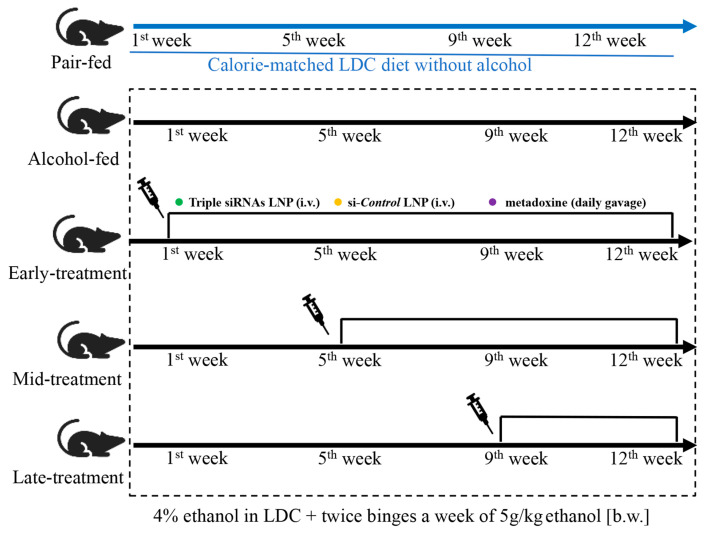
The prevalence of excessive drinking-related alcoholic liver disease (ALD) is rising, yet therapeutic options remain limited. High alcohol consumption and consequent oxidative metabolism by cytochrome P450 (CYP) can lead to extremely high levels of reactive oxygen species, which overwhelm cellular defenses and harm hepatocytes. Our previous investigations showed that inhibiting using RNA interference reduced the incidence of ALD. However, compensatory mechanisms other than CYP2E1 contribute to oxidative stress in the liver. Therefore, we coupled triple siRNA lipid nanoparticles (LNPs) targeting with two isoenzymes and to treat ALD mouse models fed with Lieber-Decarli ethanol liquid diet for 12 weeks at the early (1st week), middle (5th week), and late (9th week) stages. The administration of triple siRNA LNPs significantly ameliorated chronic alcoholic liver injury in mice, and early treatment achieved the most profound effects. These effects can be attributed to a reduction in oxidative stress and increased expression of antioxidant genes, including , , and . Moreover, we observed the alleviation of inflammation, evidenced by the downregulation of , , , and , and the prevention of excessive lipid synthesis, evidenced by the restoration of the expression of , , and . Finally, triple siRNA treatment maintained normal metabolism in lipid oxidation. In brief, our research examined the possible targets for clinical intervention in ALD by examining the therapeutic effects of triple siRNA LNPs targeting , , and . The in vivo knockdown of the three genes in this study is suggested as a promising siRNA therapeutic approach for ALD.
与过度饮酒相关的酒精性肝病(ALD)的患病率正在上升,但治疗选择仍然有限。高酒精摄入量以及细胞色素P450(CYP)随之而来的氧化代谢会导致活性氧水平极高,这会使细胞防御不堪重负并损害肝细胞。我们之前的研究表明,使用RNA干扰抑制[具体基因]可降低ALD的发病率。然而,除CYP2E1之外的代偿机制也会导致肝脏中的氧化应激。因此,我们将靶向[具体基因]的三联小干扰RNA脂质纳米颗粒(LNPs)与两种同工酶[具体同工酶]相结合,用于治疗用Lieber-Decarli乙醇液体饲料喂养12周的ALD小鼠模型,给药时间分别为早期(第1周)、中期(第5周)和晚期(第9周)。三联小干扰RNA LNPs的给药显著改善了小鼠的慢性酒精性肝损伤,早期治疗效果最为显著。这些效果可归因于氧化应激的降低以及抗氧化基因表达的增加,包括[具体抗氧化基因]。此外,我们观察到炎症减轻,表现为[具体炎症相关基因]的下调,以及脂质合成过度得到预防,表现为[具体脂质合成相关基因]表达的恢复。最后,三联小干扰RNA治疗维持了脂质氧化的正常代谢。简而言之,我们的研究通过研究靶向[具体基因]的三联小干扰RNA LNPs的治疗效果,探讨了ALD临床干预的可能靶点。本研究中对这三个基因的体内敲低被认为是一种有前景的ALD小干扰RNA治疗方法。