Wang Huaiyu, Xu Peijing, Jiang Yali
School of Psychology, South China Normal University, Guangzhou 510631, China.
Department of Psychology, School of Education Science, Hunan Normal University, Changsha 410081, China.
Behav Sci (Basel). 2024 Jun 21;14(7):517. doi: 10.3390/bs14070517.
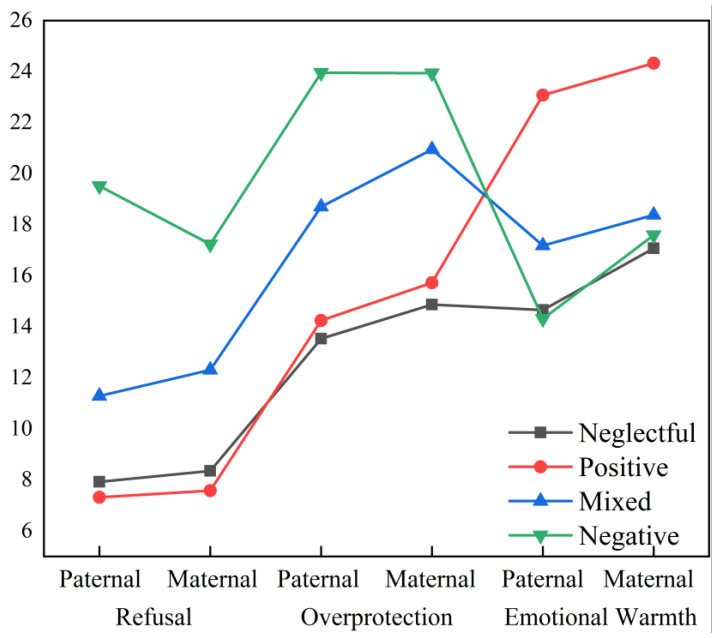
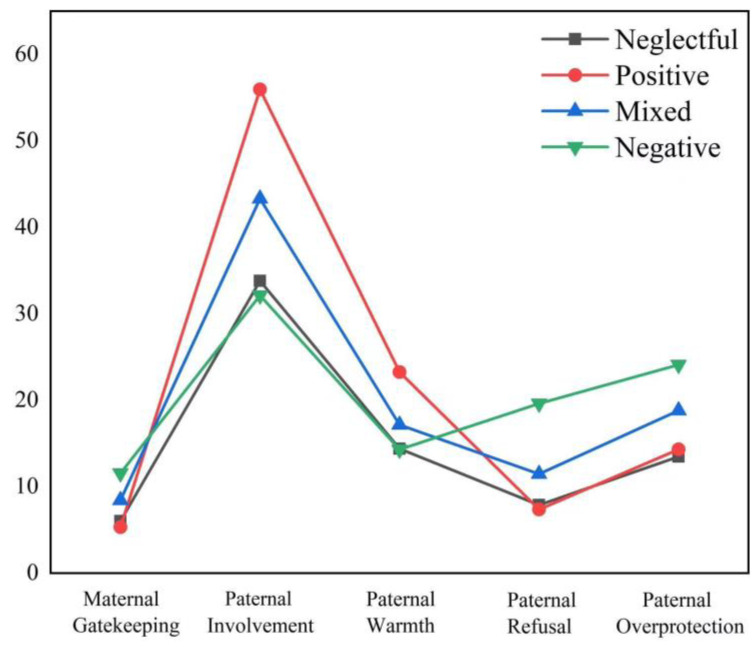
Based on the traditional Chinese cultural belief of "male breadwinner, female homemaker", as well as the systemic and interactive characteristics of families, this study aims to explore the relationship between maternal gatekeeping behavior and the quality and quantity of paternal parenting, as well as adolescent aggressive behavior. A total of 483 seventh-grade students completed questionnaires on maternal gatekeeping behavior, paternal involvement, parenting styles, and aggressive behavior. Latent profile analysis identified four parenting combinations: positive, negative, mixed, and neglectful. Adolescents under negative parenting exhibited the highest aggression and experienced the highest maternal gatekeeping behavior, while those under positive and neglectful parenting showed the least aggression and least maternal gatekeeping behavior. Maternal gatekeeping behavior correlated with paternal negative parenting and adolescent aggression. Paternal negative parenting mediated the relationship between maternal gatekeeping and aggression, while paternal involvement moderated this relationship. These findings highlight the role of parental interaction in adolescent behavior and support family-based interventions.
基于中国传统文化中“男主外,女主内”的观念,以及家庭的系统性和互动性特征,本研究旨在探讨母亲的把关行为与父亲育儿的质量和数量以及青少年攻击行为之间的关系。共有483名七年级学生完成了关于母亲把关行为、父亲参与度、育儿方式和攻击行为的问卷调查。潜在剖面分析确定了四种育儿组合:积极型、消极型、混合型和忽视型。处于消极育儿方式下的青少年表现出最高的攻击性,且经历的母亲把关行为最多,而处于积极和忽视型育儿方式下的青少年攻击性最低,母亲把关行为也最少。母亲的把关行为与父亲的消极育儿方式和青少年的攻击行为相关。父亲的消极育儿方式在母亲把关与攻击行为之间起中介作用,而父亲的参与度调节了这种关系。这些发现凸显了父母互动在青少年行为中的作用,并支持基于家庭的干预措施。