Zhang Limin, Cao Hongjian, Lin Chaopai, Ye Pingzhi
Department of Early Childhood Education, School of Education, Guangzhou University, 602 Xing Zheng Xi Building, No. 230 Wai Huan Xi Road, Guangzhou 510006 China.
Institute of Early Childhood Education, Faculty of Education, Beijing Normal University, China.
Early Child Res Q. 2022;60:137-149. doi: 10.1016/j.ecresq.2022.01.007. Epub 2022 Jan 31.
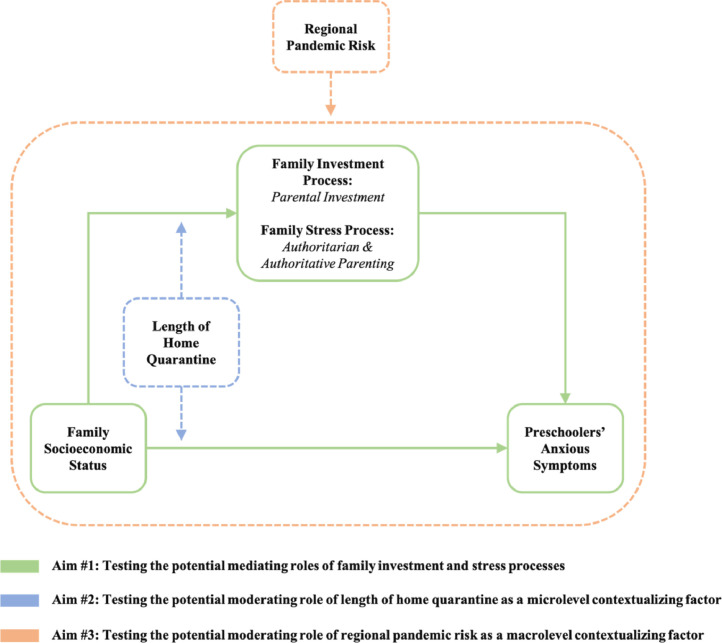
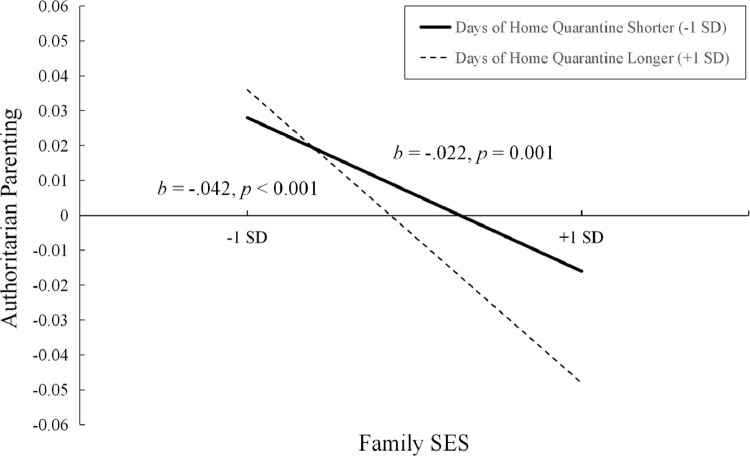
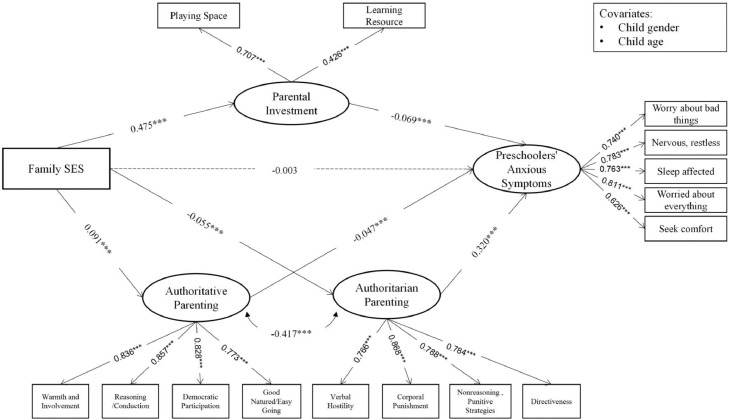
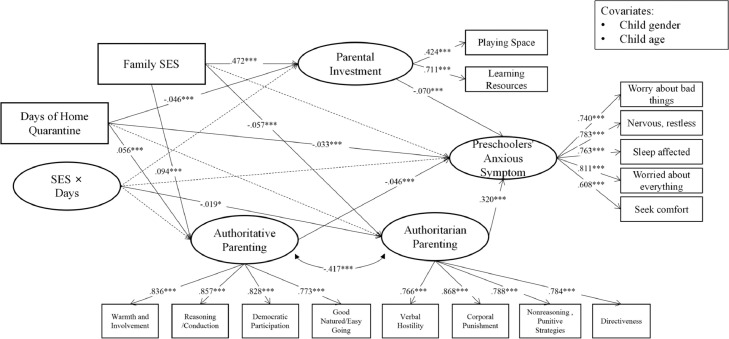
Using data from 16,161 families with target child of 3-6 years old in Hubei, China during COVID-19 pandemic, this study examined the association between family socio-economic status (SES) and preschoolers' anxious symptoms (PAS). Parental investment and parenting style were tested as mediators for this association. Home quarantine length was tested as a moderator for this direct association and for the associations between family SES and parenting processes, whereas regional pandemic risk was tested as a moderator for the entire model. Results support the utility of Family Stress and Family Investment Models in a Chinese context by identifying unique roles of parental investment and parenting style in mediating the link between family SES and PAS. Quarantine length moderated the link between family SES and authoritarian parenting: Strength of this negative association was stronger for families with longer quarantine than for those with shorter quarantine. Further, family SES was negatively associated with PAS through its negative association with authoritarian parenting, regardless of the quarantine length. Model comparison analyses between high-risk region versus low/medium-risk region groups indicated that the pandemic risk for living regions did not alter any pathway in the model. Such findings inform the designs of targeted interventions to help families cope with pandemic-related challenges. Promoting parental investment and adaptive patenting style represents an avenue to diminish consequences of family economic hardship for young children's mental health, regardless of macrolevel pandemic risk. Interventions should attend to home quarantine duration, as it contextualizes the links among family SES, parenting, and child well-being.
本研究利用新冠疫情期间中国湖北16161个有3至6岁目标儿童家庭的数据,考察了家庭社会经济地位(SES)与学龄前儿童焦虑症状(PAS)之间的关联。研究检验了父母投入和养育方式作为这种关联的中介作用。检验了居家隔离时长作为这种直接关联以及家庭SES与养育过程之间关联的调节变量,而地区疫情风险则作为整个模型的调节变量进行了检验。研究结果通过确定父母投入和养育方式在调节家庭SES与PAS之间联系中的独特作用,支持了家庭压力和家庭投资模型在中国背景下的实用性。隔离时长调节了家庭SES与专制型养育方式之间的联系:这种负向关联的强度在隔离时间较长的家庭中比在隔离时间较短的家庭中更强。此外,无论隔离时长如何,家庭SES通过其与专制型养育方式的负向关联与PAS呈负相关。高风险地区与低/中风险地区组之间的模型比较分析表明,居住地区的疫情风险并未改变模型中的任何路径。这些发现为有针对性的干预措施设计提供了参考,以帮助家庭应对与疫情相关的挑战。促进父母投入和适应性养育方式是减轻家庭经济困难对幼儿心理健康影响的一条途径,无论宏观层面的疫情风险如何。干预措施应关注居家隔离时长,因为它为家庭SES、养育方式和儿童福祉之间的联系提供了背景。