Xi'an Medical University, Xi'an 710021, China.
Department of Hepatobiliary Surgery, Xijing Hospital, Fourth Military Medical University, Xi'an 710032, China.
Biomolecules. 2024 Jun 23;14(7):743. doi: 10.3390/biom14070743.
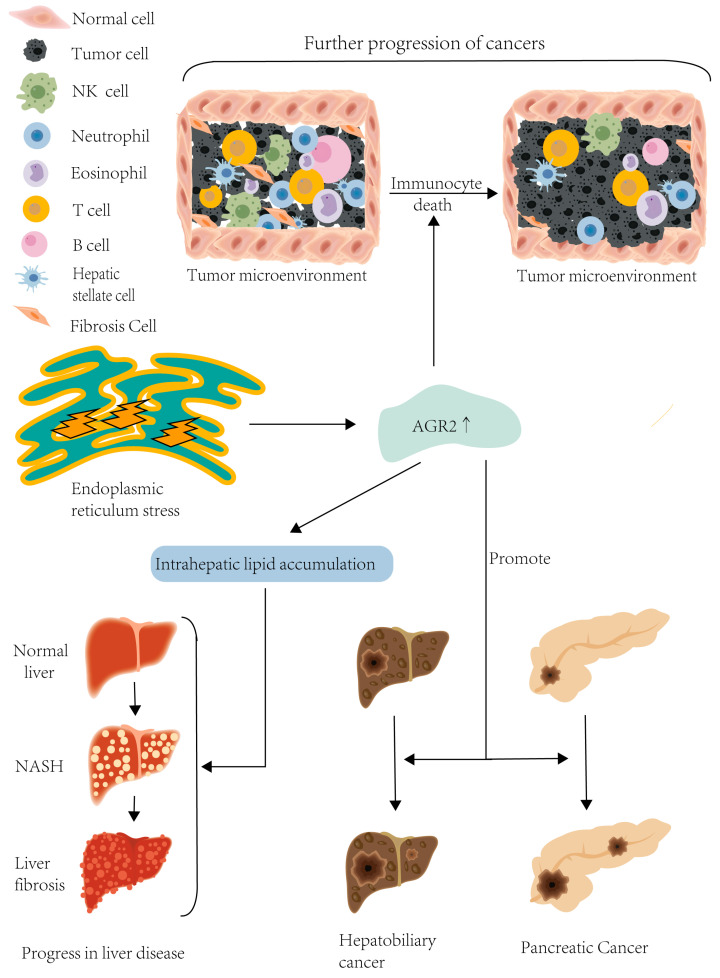
The anterior gradient protein 2 (AGR2) plays a crucial role in facilitating the formation of protein disulfide bonds within the endoplasmic reticulum (ER). Research suggests that AGR2 can function as an oncogene, with its heightened expression linked to the advancement of hepatobiliary and pancreatic cancers through invasion and metastasis. Notably, AGR2 not only serves as a pro-oncogenic agent but also as a downstream targeting protein, indirectly fostering cancer progression. This comprehensive review delves into the established functions and expression patterns of AGR2, emphasizing its pivotal role in cancer progression, particularly in hepatobiliary and pancreatic malignancies. Furthermore, AGR2 emerges as a potential cancer prognostic marker and a promising target for immunotherapy, offering novel avenues for the treatment of hepatobiliary and pancreatic cancers and enhancing patient outcomes.
前沿梯度蛋白 2(AGR2)在促进内质网(ER)内蛋白质二硫键形成方面发挥着关键作用。研究表明,AGR2 可以作为一种致癌基因发挥作用,其表达水平的升高与肝胆和胰腺癌症的侵袭和转移有关。值得注意的是,AGR2 不仅是一种致癌原,而且还是一种下游靶向蛋白,间接地促进癌症的进展。本综述深入探讨了 AGR2 的既定功能和表达模式,强调了其在癌症进展中的关键作用,特别是在肝胆和胰腺恶性肿瘤中。此外,AGR2 作为一种潜在的癌症预后标志物和免疫治疗的有前途的靶点出现,为肝胆和胰腺癌症的治疗提供了新的途径,并提高了患者的治疗效果。