Institute of Diagnostic Virology, Friedrich-Loeffler-Institut, Federal Research Institute for Animal Health, 17493 Greifswald, Germany.
Department of Experimental Animal Facilities and Biorisk Management, Friedrich-Loeffler-Institut, Federal Research Institute for Animal Health, 17493 Greifswald, Germany.
Int J Mol Sci. 2024 Jul 21;25(14):7976. doi: 10.3390/ijms25147976.
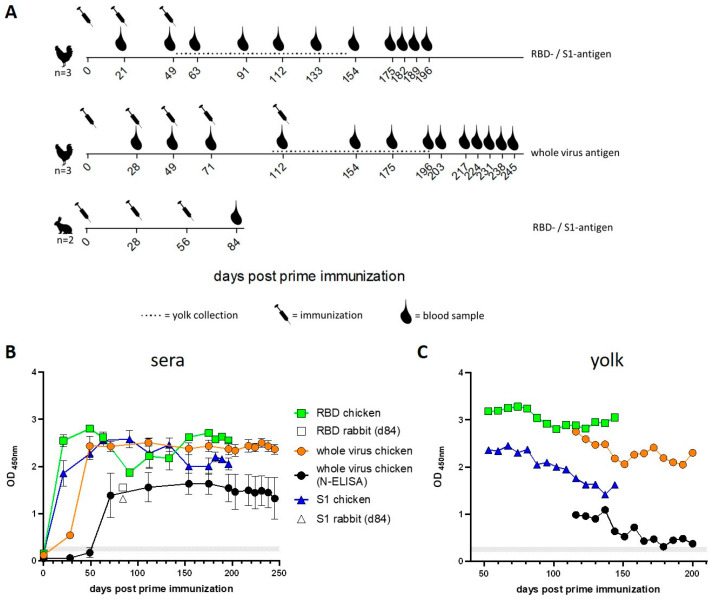
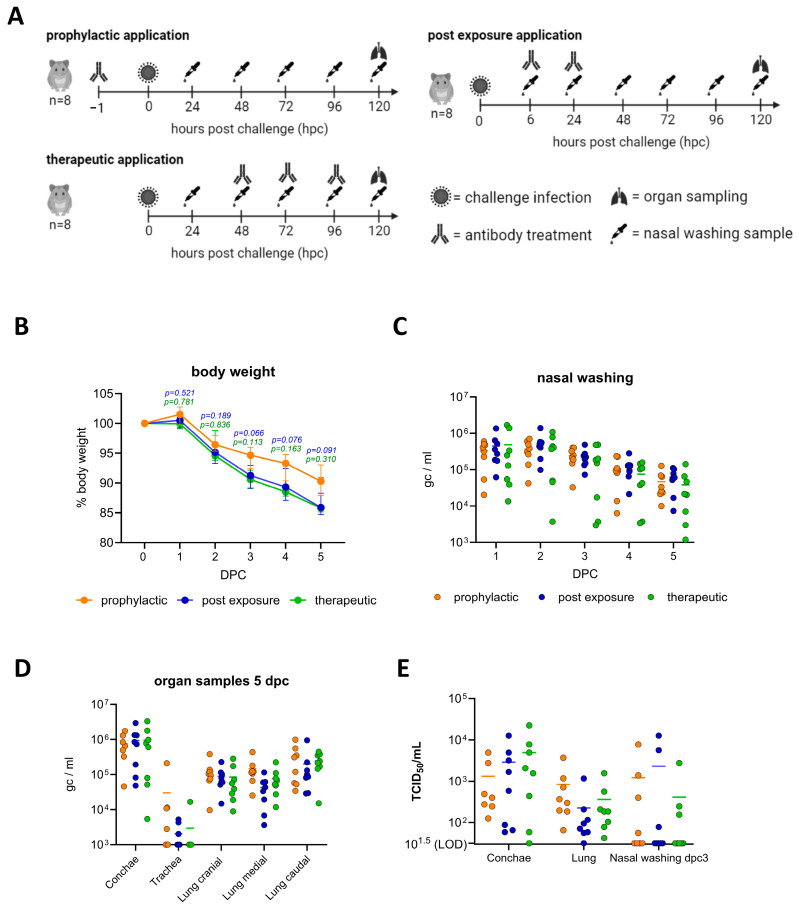
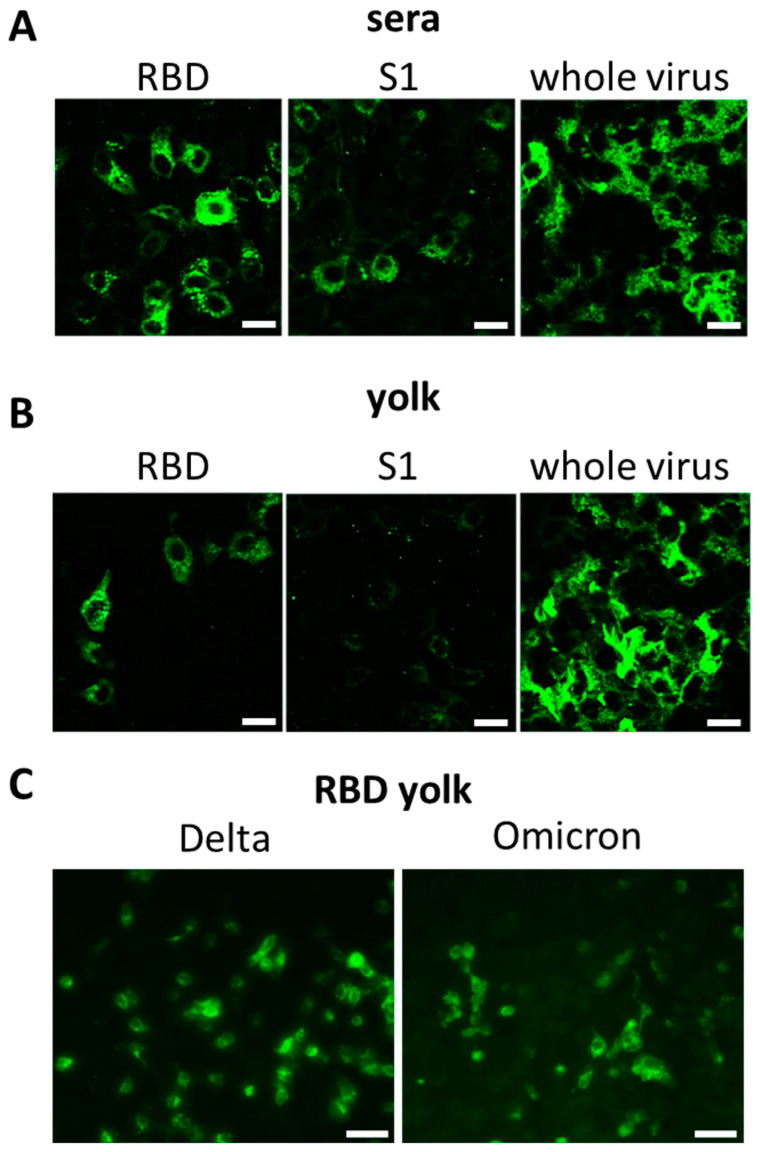
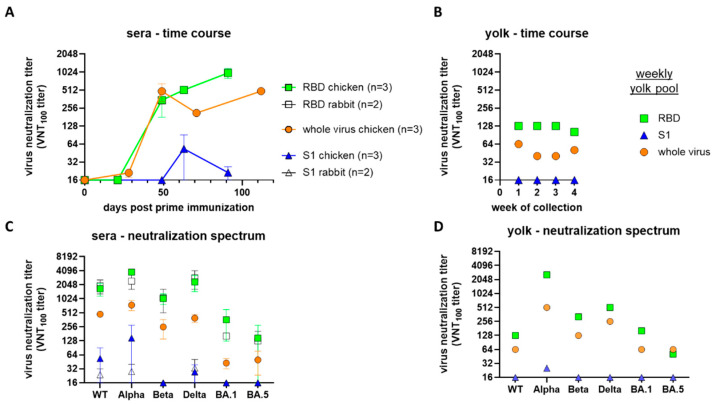
The emergence of SARS-CoV-2 in late 2019 initiated a global pandemic, which led to a need for effective therapeutics and diagnostic tools, including virus-specific antibodies. Here, we investigate different antigen preparations to produce SARS-CoV-2-specific and virus-neutralizing antibodies in chickens (n = 3/antigen) and rabbits (n = 2/antigen), exploring, in particular, egg yolk for large-scale production of immunoglobulin Y (IgY). Reactivity profiles of IgY preparations from chicken sera and yolk and rabbit sera were tested in parallel. We compared three types of antigens based on ancestral SARS-CoV-2: an inactivated whole-virus preparation, an S1 spike-protein subunit (S1 antigen) and a receptor-binding domain (RBD antigen, amino acids 319-519) coated on lumazine synthase (LS) particles using SpyCather/SpyTag technology. The RBD antigen proved to be the most efficient immunogen, and the resulting chicken IgY antibodies derived from serum or yolk, displayed strong reactivity with ELISA and indirect immunofluorescence and broad neutralizing activity against SARS-CoV-2 variants, including Omicron BA.1 and BA.5. Preliminary in vivo studies using RBD-lumazine synthase yolk preparations in a hamster model showed that local application was well tolerated and not harmful. However, despite the in vitro neutralizing capacity, this antibody preparation did not show protective effect. Further studies on galenic properties seem to be necessary. The RBD-lumazine antigen proved to be suitable for producing SARS-CoV-2 specific antibodies that can be applied to such therapeutic approaches and as reference reagents for SARS-CoV-2 diagnostics, including virus neutralization assays.
2019 年末,SARS-CoV-2 的出现引发了全球大流行,这导致人们需要有效的治疗方法和诊断工具,包括针对病毒的特异性抗体。在这里,我们研究了不同的抗原制剂,以在鸡(n=3/抗原)和兔(n=2/抗原)中产生 SARS-CoV-2 特异性和病毒中和抗体,特别探索了卵黄用于大规模生产免疫球蛋白 Y(IgY)。同时平行测试了来自鸡血清和卵黄以及兔血清的 IgY 制剂的反应谱。我们比较了三种基于原始 SARS-CoV-2 的抗原:灭活全病毒制剂、S1 刺突蛋白亚单位(S1 抗原)和使用 SpyCather/SpyTag 技术包被在光氨酸合酶(LS)颗粒上的受体结合域(RBD 抗原,氨基酸 319-519)。RBD 抗原被证明是最有效的免疫原,由此产生的鸡 IgY 抗体来自血清或卵黄,在 ELISA 和间接免疫荧光中显示出强烈的反应性,并对 SARS-CoV-2 变体具有广泛的中和活性,包括奥密克戎 BA.1 和 BA.5。使用 RBD-光氨酸合酶卵黄制剂在仓鼠模型中的初步体内研究表明,局部应用耐受性良好且无害。然而,尽管具有体外中和能力,但这种抗体制剂并未显示出保护作用。似乎有必要对制剂的药剂学性质进行进一步研究。RBD-光氨酸抗原被证明适合用于生产针对 SARS-CoV-2 的特异性抗体,可应用于此类治疗方法,并作为 SARS-CoV-2 诊断的参考试剂,包括病毒中和测定。