Di Pietrantonio Daniela, Pace Palitti Valeria, Cichelli Angelo, Tacconelli Stefania
Department of Innovative Technologies in Medicine and Dentistry, "G. d'Annunzio" University, Via dei Vestini 31, 66100 Chieti, Italy.
Internal Medicine and Hepatology Unit, Azienda Sanitaria Locale, Via R. Paolini 47, 65125 Pescara, Italy.
Foods. 2024 Jul 20;13(14):2280. doi: 10.3390/foods13142280.
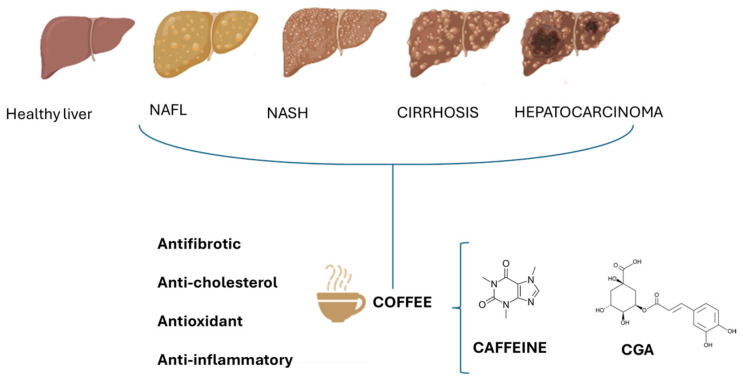
Coffee is one of the most widely consumed beverages in the world due to its unique aroma and psychostimulant effects, mainly due to the presence of caffeine. In recent years, experimental evidence has shown that the moderate consumption of coffee (3/4 cups per day) is safe and beneficial to human health, revealing protective effects against numerous chronic metabolic diseases such as diabetes, cardiovascular, neurodegenerative, and hepatic diseases. This review focuses on two of coffee's main bioactive compounds, i.e., caffeine and chlorogenic acids, and their effects on the progression of chronic liver diseases, demonstrating that regular coffee consumption correlates with a lower risk of the development and progression of non-alcoholic steatohepatitis, viral hepatitis, liver cirrhosis, and hepatocellular carcinoma. In particular, this review analyzes caffeine and chlorogenic acid from a pharmacological point of view and explores the molecular mechanism through which these compounds are responsible for the protective role of coffee. Both bioactive compounds, therefore, have antifibrotic effects on hepatic stellate cells and hepatocytes, induce a decrease in connective tissue growth factor, stimulate increased apoptosis with anti-cancer effects, and promote a major inhibition of focal adhesion kinase, actin, and protocollagen synthesis. In conclusion, coffee shows many beneficial effects, and experimental data in favor of coffee consumption in patients with liver diseases are encouraging, but further prospective studies are needed to demonstrate its preventive and therapeutic role in chronic liver diseases.
咖啡因其独特的香气和精神兴奋作用,成为世界上消费最为广泛的饮品之一,这主要归功于咖啡因的存在。近年来,实验证据表明,适量饮用咖啡(每天3/4杯)对人体健康是安全且有益的,显示出对多种慢性代谢疾病如糖尿病、心血管疾病、神经退行性疾病和肝脏疾病具有保护作用。本综述聚焦于咖啡的两种主要生物活性化合物,即咖啡因和绿原酸,以及它们对慢性肝病进展的影响,表明经常饮用咖啡与非酒精性脂肪性肝炎、病毒性肝炎、肝硬化和肝细胞癌发生及进展风险较低相关。特别是,本综述从药理学角度分析了咖啡因和绿原酸,并探讨了这些化合物发挥咖啡保护作用的分子机制。因此,这两种生物活性化合物对肝星状细胞和肝细胞均具有抗纤维化作用,可使结缔组织生长因子减少,通过诱导细胞凋亡增加发挥抗癌作用,并极大地抑制粘着斑激酶、肌动蛋白和原胶原的合成。总之,咖啡显示出诸多有益作用,支持肝病患者饮用咖啡的实验数据令人鼓舞,但仍需要进一步的前瞻性研究来证明其在慢性肝病中的预防和治疗作用。