Van Dijck Thomas, Stevens Vincent, Steenaerts Laure, Thijs Sofie, Van Mechelen Carmen, Artois Tom, Rineau François
Centre for Environmental Sciences, Zoology: Biodiversity and Toxicology, Hasselt University, 3590 Diepenbeek, Belgium.
Centre for Environmental Sciences, Environmental Biology, Hasselt University, 3590 Diepenbeek, Belgium.
Microorganisms. 2024 Jun 21;12(7):1261. doi: 10.3390/microorganisms12071261.
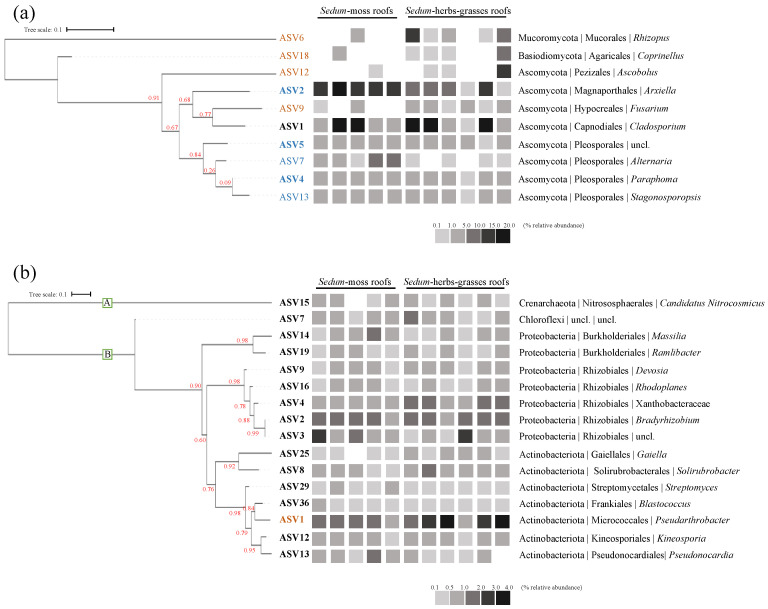
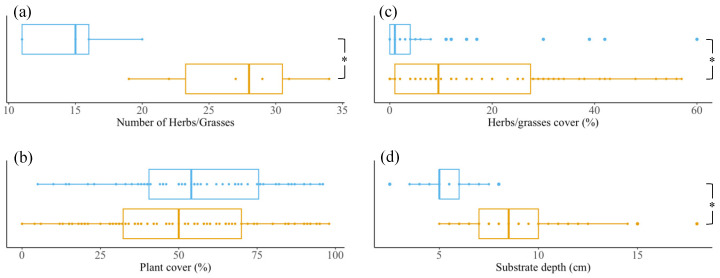
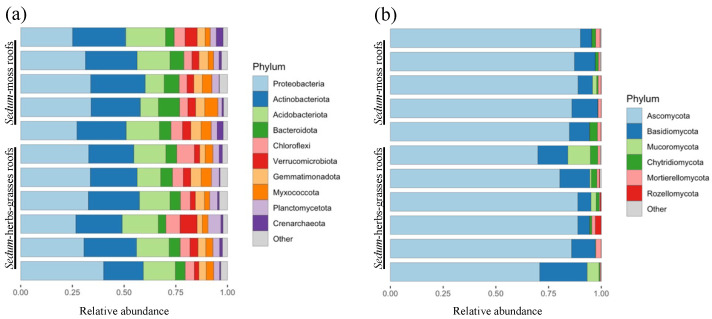
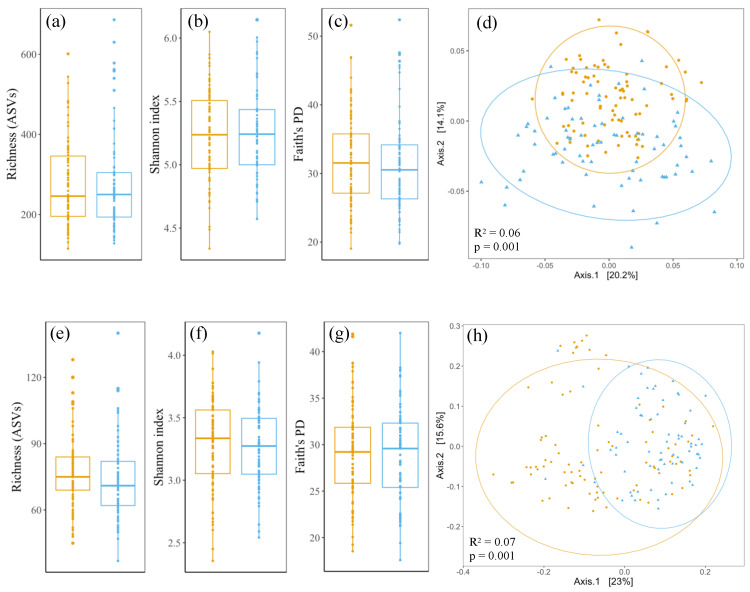
Extensive green roofs provide for many ecosystem services in urban environments. The efficacy of these services is influenced by the vegetation structure. Despite their key role in plant performance and productivity, but also their contribution to nitrogen fixation or carbon sequestration, green roof microbial communities have received little attention so far. No study included a spatiotemporal aspect to investigate the core microbiota residing in the substrates of extensive green roofs, although these key taxa are hypothesized to be amongst the most ecologically important taxa. Here, we identified the core microbiota residing in extensive green roof substrates and investigated whether microbial community composition is affected by the vegetation that is planted on extensive green roofs. Eleven green roofs from three different cities in Flanders (Belgium), planted either with a mixture of grasses, wildflowers and succulents ( spp.; -herbs-grasses roofs) or solely species of (-moss roofs), were seasonally sampled to investigate prokaryotic and fungal communities via metabarcoding. Identifying the key microbial taxa revealed that most taxa are dominant phylotypes in soils worldwide. Many bacterial core taxa are capable of nitrogen fixation, and most fungal key taxa are stress-tolerant saprotrophs, endophytes, or both. Considering that soil microbes adapted to the local edaphic conditions have been found to improve plant fitness, further investigation of the core microbiome is warranted to determine the extent to which these stress-tolerant microbes are beneficial for the vegetational layer. Although -herbs-grasses roofs contained more plant species than -moss roofs, we observed no discriminant microbial communities between both roof types, likely due to sharing the same substrate textures and the vegetational layers that became more similar throughout time. Future studies are recommended to comprehensively characterize the vegetational layer and composition to examine the primary drivers of microbial community assembly processes.
广泛的绿色屋顶为城市环境提供了许多生态系统服务。这些服务的功效受植被结构的影响。尽管绿色屋顶微生物群落在植物性能和生产力方面发挥着关键作用,并且在固氮或碳固存方面也有贡献,但到目前为止,它们很少受到关注。尽管这些关键分类群被认为是生态上最重要的分类群之一,但尚无研究从时空角度调查广泛绿色屋顶基质中存在的核心微生物群。在这里,我们确定了广泛绿色屋顶基质中存在的核心微生物群,并研究了微生物群落组成是否受到广泛绿色屋顶上种植的植被的影响。我们对来自比利时弗拉芒三个不同城市的11个绿色屋顶进行了季节性采样,这些屋顶要么种植了草、野花和多肉植物的混合物(草本-草屋顶),要么只种植了苔藓(苔藓屋顶),通过元条形码技术研究原核生物和真菌群落。对关键微生物分类群的鉴定表明,大多数分类群是全球土壤中的优势系统发育型。许多细菌核心分类群能够固氮,大多数真菌关键分类群是耐胁迫腐生菌、内生菌或两者皆是。鉴于已发现适应当地土壤条件的土壤微生物可提高植物适应性,有必要进一步研究核心微生物组,以确定这些耐胁迫微生物对植被层有益的程度。尽管草本-草屋顶比苔藓屋顶包含更多的植物物种,但我们观察到两种屋顶类型之间没有明显不同的微生物群落,这可能是由于它们具有相同的基质质地,并且随着时间的推移植被层变得更加相似。建议未来的研究全面描述植被层及其组成,以研究微生物群落组装过程的主要驱动因素。