Tan Zhao-Siu, Jamal Zaini, Teo Desmond W Y, Ko Hor-Cheng, Seah Zong-Long, Phua Hao-Yu, Ho Peter K H, Png Rui-Qi, Chua Lay-Lay
Department of Chemistry, National University of Singapore, Lower Kent Ridge Road, S117552, Singapore, Singapore.
Department of Physics, National University of Singapore, Lower Kent Ridge Road, S117550, Singapore, Singapore.
Nat Commun. 2024 Jul 28;15(1):6354. doi: 10.1038/s41467-024-50257-5.
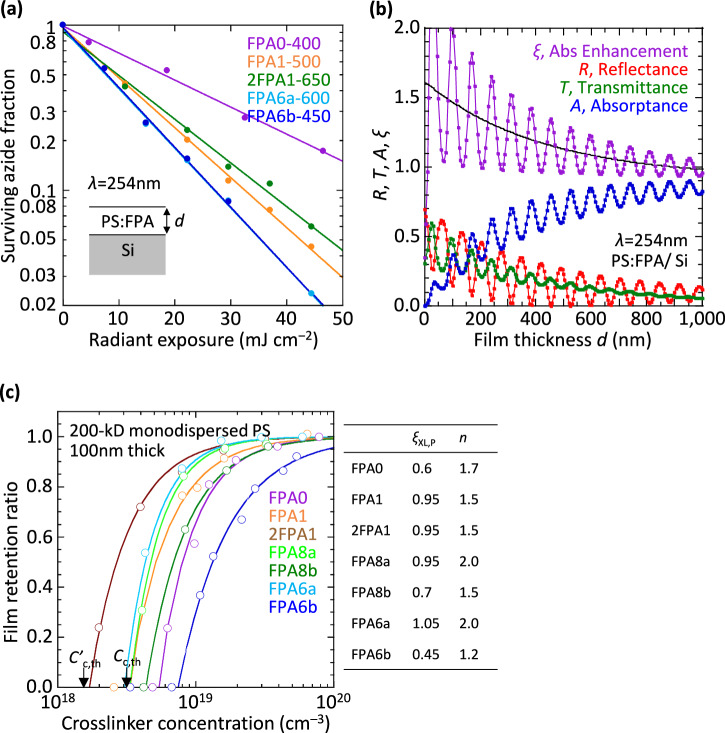
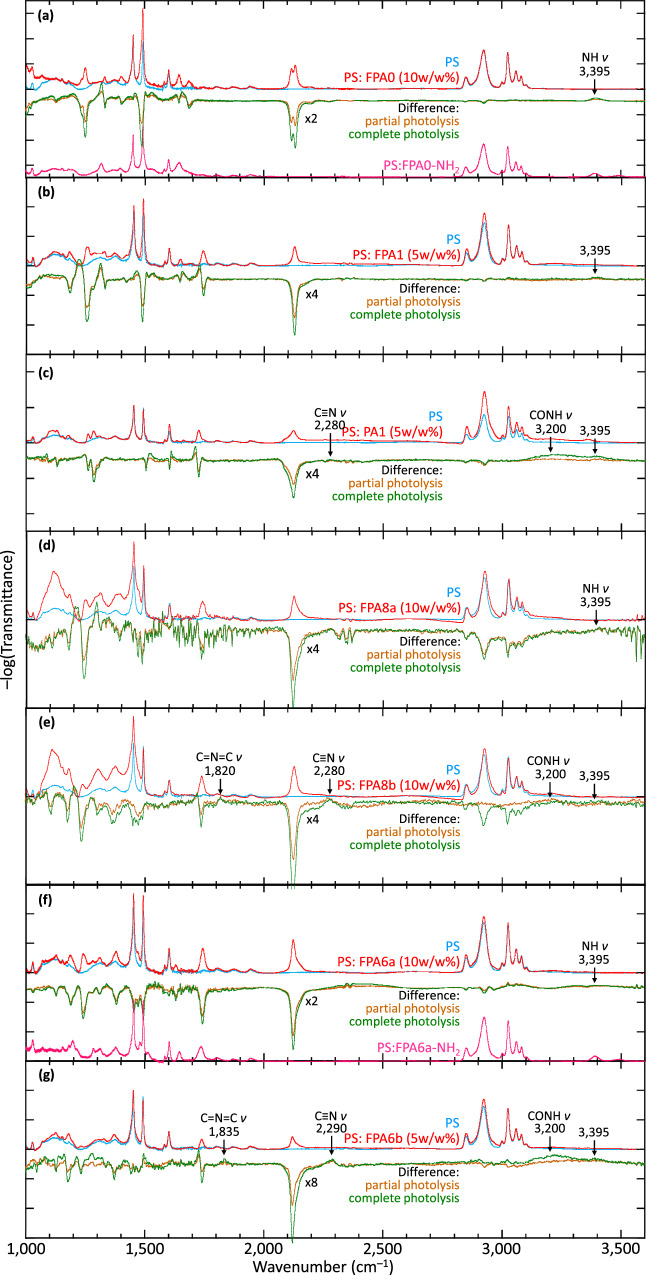
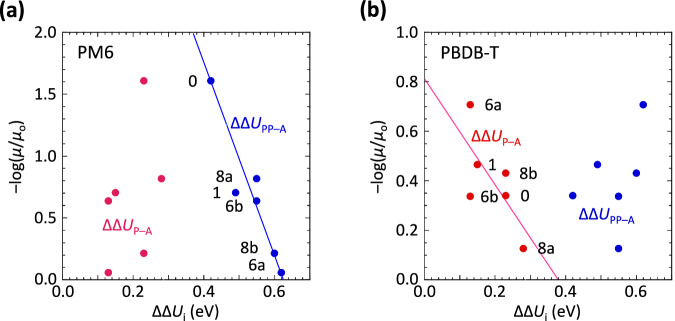
Fluorinated phenyl azides (FPA) enable photo-structuring of π-conjugated polymer films for electronic device applications. Despite their potential, FPAs have faced limitations regarding their crosslinking efficiency, and more importantly, their impact on critical semiconductor properties, such as charge-carrier mobility. Here, we report that azide photolysis and photocrosslinking can achieve unity quantum efficiencies for specific FPAs. This suggests preferential nitrene insertion into unactivated C‒H bonds over benzazirine and ketenimine reactions, which we attribute to rapid interconversion between the initially formed hot states. Furthermore, we establish a structure‒activity relationship for carrier mobility quenching. The binding affinity of FPA crosslinker to polymer π-stacks governs its propensity for mobility quenching in both PM6 and PBDB-T used as model conjugated polymers. This binding affinity can be suppressed by FPA ring substitution, but varies in a non-trivial way with π-stack order. Utilizing the optimal FPA, photocrosslinking enables the fabrication of morphology-stabilized, acceptor-infiltrated donor polymer networks (that is, PBDB-T: ITIC and PM6: Y6) for solar cells. Our findings demonstrate the exceptional potential of the FPA photochemistry and offer a promising approach to address the challenges of modelling realistic molecular interactions in complex polymer morphologies, moving beyond the limitations of Flory‒Huggins mean field theory.
氟化苯基叠氮化物(FPA)可实现用于电子器件应用的π共轭聚合物薄膜的光结构化。尽管具有潜力,但FPA在交联效率方面存在局限性,更重要的是,它们对诸如电荷载流子迁移率等关键半导体性能有影响。在此,我们报告叠氮光解和光交联可实现特定FPA的单位量子效率。这表明与苯并氮杂环丙烷和乙烯酮亚胺反应相比,氮烯优先插入未活化的C-H键,我们将其归因于最初形成的热态之间的快速相互转化。此外,我们建立了载流子迁移率猝灭的结构-活性关系。FPA交联剂与聚合物π堆积的结合亲和力决定了其在用作模型共轭聚合物的PM6和PBDB-T中猝灭迁移率的倾向。这种结合亲和力可通过FPA环取代来抑制,但随π堆积顺序以非平凡的方式变化。利用最佳的FPA,光交联能够制造用于太阳能电池的形态稳定、受体渗透的供体聚合物网络(即PBDB-T:ITIC和PM6:Y6)。我们的研究结果证明了FPA光化学的非凡潜力,并提供了一种有前景的方法来应对在复杂聚合物形态中模拟现实分子相互作用的挑战,超越了弗洛里-哈金斯平均场理论的局限性。