Institute of Molecular and Translational Cardiology, IRCCS Policlinico San Donato, Piazza Malan 2, 20097, San Donato Milanese, Italy.
Dept of Biochemistry and Biophysics, National Bioinformatics Infrastructure Sweden, Science for Life Laboratory, Stockholm University, Box 1031, SE-17121, Solna, Sweden.
Nat Commun. 2024 Jul 28;15(1):6359. doi: 10.1038/s41467-024-50686-2.
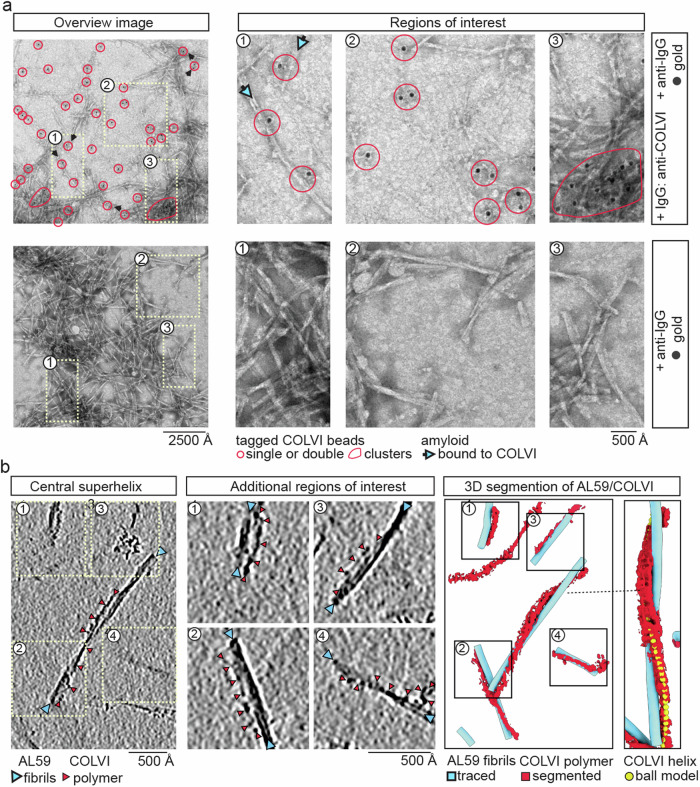
Systemic light chain (LC) amyloidosis (AL) is a disease where organs are damaged by an overload of a misfolded patient-specific antibody-derived LC, secreted by an abnormal B cell clone. The high LC concentration in the blood leads to amyloid deposition at organ sites. Indeed, cryogenic electron microscopy (cryo-EM) has revealed unique amyloid folds for heart-derived fibrils taken from different patients. Here, we present the cryo-EM structure of heart-derived AL amyloid (AL59) from another patient with severe cardiac involvement. The double-layered structure displays a u-shaped core that is closed by a β-arc lid and extended by a straight tail. Noteworthy, the fibril harbours an extended constant domain fragment, thus ruling out the variable domain as sole amyloid building block. Surprisingly, the fibrils were abundantly concatenated with a proteinaceous polymer, here identified as collagen VI (COLVI) by immuno-electron microscopy (IEM) and mass-spectrometry. Cryogenic electron tomography (cryo-ET) showed how COLVI wraps around the amyloid forming a helical superstructure, likely stabilizing and protecting the fibrils from clearance. Thus, here we report structural evidence of interactions between amyloid and collagen, potentially signifying a distinct pathophysiological mechanism of amyloid deposits.
系统性轻链 (LC) 淀粉样变性 (AL) 是一种疾病,其中器官被异常 B 细胞克隆分泌的错误折叠的患者特异性抗体衍生的 LC 过载所破坏。血液中 LC 的高浓度导致在器官部位发生淀粉样沉积。事实上,低温电子显微镜 (cryo-EM) 已经揭示了来自不同患者的心脏来源纤维所具有的独特淀粉样折叠。在这里,我们展示了另一位患有严重心脏受累的患者的心脏来源 AL 淀粉样蛋白 (AL59) 的 cryo-EM 结构。双层结构显示出 U 形核心,由 β-弧形盖封闭,并由直尾巴延伸。值得注意的是,纤维含有扩展的恒定结构域片段,因此排除了可变结构域作为唯一的淀粉样构建块。令人惊讶的是,纤维大量地串联在一起形成了一种蛋白聚合物,通过免疫电子显微镜 (IEM) 和质谱法鉴定为胶原 VI (COLVI)。低温电子断层扫描 (cryo-ET) 显示了 COLVI 如何围绕淀粉样形成螺旋超结构,可能稳定并保护纤维免受清除。因此,在这里我们报告了淀粉样蛋白与胶原蛋白之间相互作用的结构证据,这可能代表了淀粉样沉积物的一种独特的病理生理机制。