Wu Haiyan, He Yanan, Chen Duke, Liu Mei, Zhao Xiujuan
Department of Radiation Oncology, Chongqing University Cancer Hospital, Chongqing, China.
Department of Gynecological Oncology, Chongqing University Cancer Hospital, Chongqing, China.
Front Oncol. 2024 Jul 12;14:1366323. doi: 10.3389/fonc.2024.1366323. eCollection 2024.
To assess the differences among three dose-fractionation schedules of image-guided adaptive brachytherapy (IGABT) in cervical squamous cell carcinoma (CSCC) by comparing the dosimetry and clinical outcomes.
Forty-five patients with CSCC who underwent chemoradiotherapy and IGABT were retrospectively enrolled and divided into three groups based on their dose-fractionation schedules of brachytherapy as: Group-5.5 (5.5 Gy × 6 fractions), Group-6.0 (6.0 Gy × 5 fractions), and Group-7.0 (7.0 Gy × 4 fractions). The analyzed dose-volume histogram parameters included D and D of the high-risk clinical target volume (HR-CTV), D and D of intermediate-risk clinical target volume (IR-CTV), and D and D of the organs-at-risk (OARs, namely the bladder, rectum, sigmoid and small intestine). Furthermore, the therapeutic efficacy and late toxicities were also compared among the three groups.
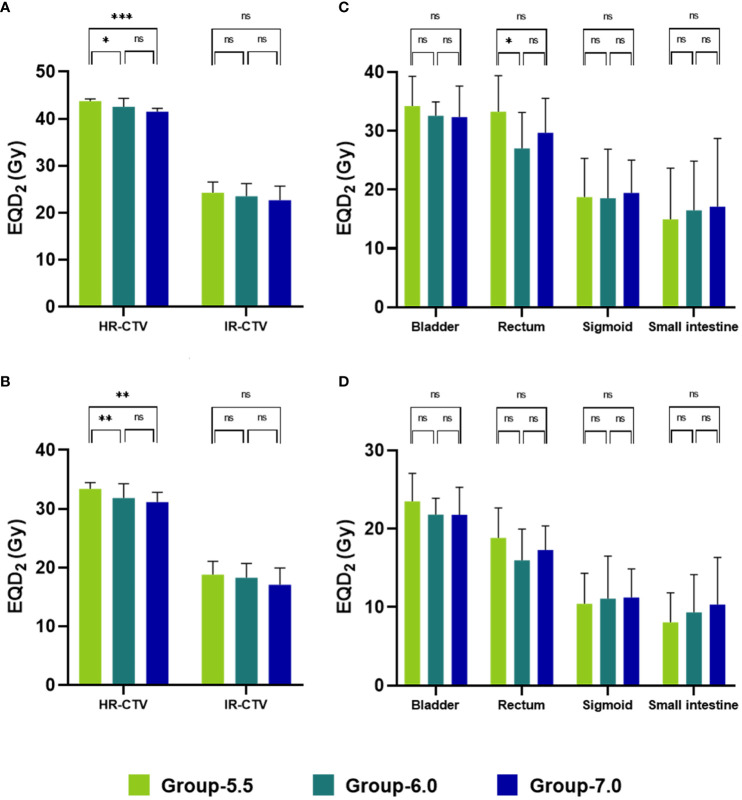
The doses of HR-CTV and IR-CTV in Group-5.5 were found to be the highest among the three groups, followed by those in Group-6.0. Significant differences were found for the doses of HR-CTV between Group-5.5 and the other groups. There were no significant differences in the bladder, sigmoid and small intestine dose among the three groups. However, Group-6.0 yielded the lowest rectum received doses, with a significant difference in D being detected between Group-6.0 and Group-5.5. The median follow-up time was 30.08 months [range, 6.57-46.3]. The numbers of patients with complete response in Group-5.5, Group-6.0 and Group-7.0 were 13, 14 and 14, respectively (P > 0.05). In regard to the toxicitiy, the incidence of radiation cystitis and proctitis in Group-6.0 was lower than that in Group-5.5 and Group-7.0 (P > 0.05).
The dose-fractionation schedule of 6.0 Gy × 5 fractions provided the most beneficial effects with relatively low OARs doses, suggesting that this dose-fractionation schedule should be prioritized in the clinical application of brachytherapy in cervical cancer.
通过比较剂量学和临床结果,评估三种剂量分割方案的图像引导自适应近距离放射治疗(IGABT)在宫颈鳞状细胞癌(CSCC)中的差异。
回顾性纳入45例行放化疗及IGABT的CSCC患者,根据近距离放射治疗的剂量分割方案将其分为三组:5.5组(5.5 Gy×6次分割)、6.0组(6.0 Gy×5次分割)和7.0组(7.0 Gy×4次分割)。分析的剂量体积直方图参数包括高危临床靶区(HR-CTV)的D 和D 、中危临床靶区(IR-CTV)的D 和D 以及危及器官(OARs,即膀胱、直肠、乙状结肠和小肠)的D 和D 。此外,还比较了三组的治疗效果和晚期毒性。
发现5.5组的HR-CTV和IR-CTV剂量在三组中最高,其次是6.0组。5.5组与其他组之间的HR-CTV剂量存在显著差异。三组之间膀胱、乙状结肠和小肠剂量无显著差异。然而,6.0组的直肠受量最低,6.0组与5.5组之间的D 存在显著差异。中位随访时间为30.08个月[范围,6.57 - 46.3]。5.5组、6.0组和7.0组的完全缓解患者数分别为13例、14例和14例(P>0.05)。在毒性方面,6.0组的放射性膀胱炎和直肠炎发生率低于5.5组和7.0组(P>0.05)。
6.0 Gy×5次分割的剂量分割方案在OARs剂量相对较低的情况下提供了最有益的效果,表明该剂量分割方案在宫颈癌近距离放射治疗的临床应用中应优先考虑。