Zuo Zhiqiang, Xing Yaxin, Lu Xi, Liu Tao, Zheng Min, Guo Miao, Liu Yanchen, Huang Xia
State Key Joint Laboratory of Environment Simulation and Pollution Control, School of Environment, Tsinghua University, Beijing 100084, PR China.
Australian Centre for Water and Environmental Biotechnology, The University of Queensland, St Lucia QLD 4072, Australia.
Water Res X. 2024 Jun 30;24:100231. doi: 10.1016/j.wroa.2024.100231. eCollection 2024 Sep 1.
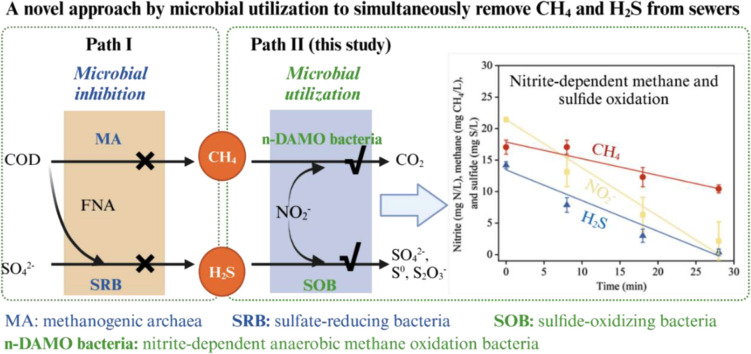
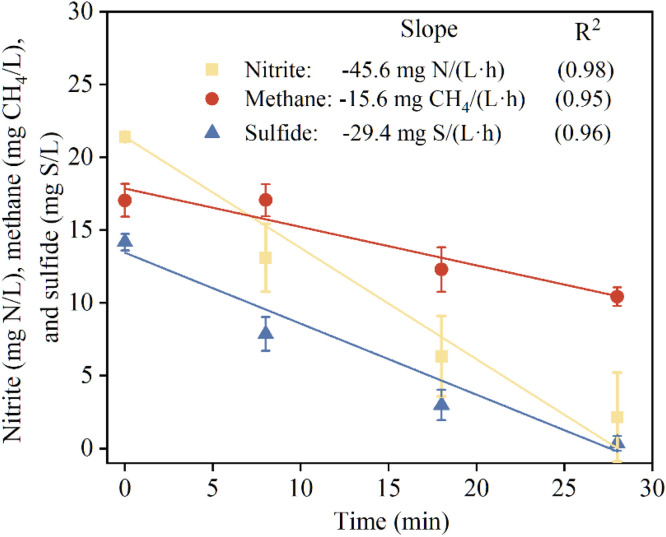
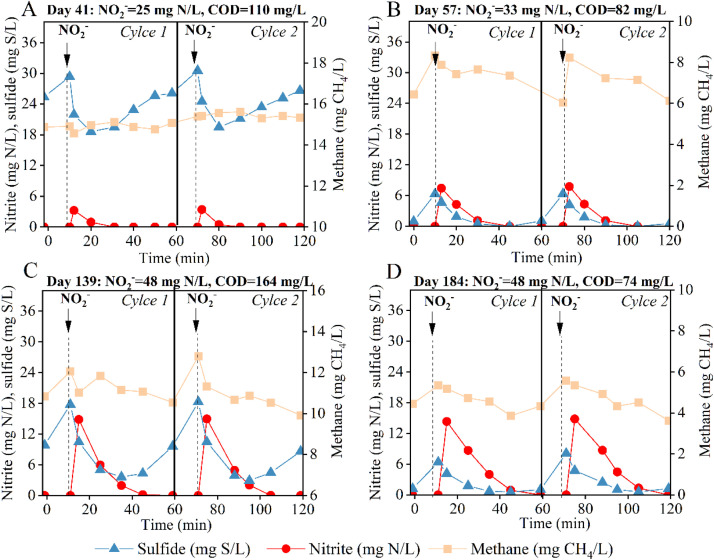
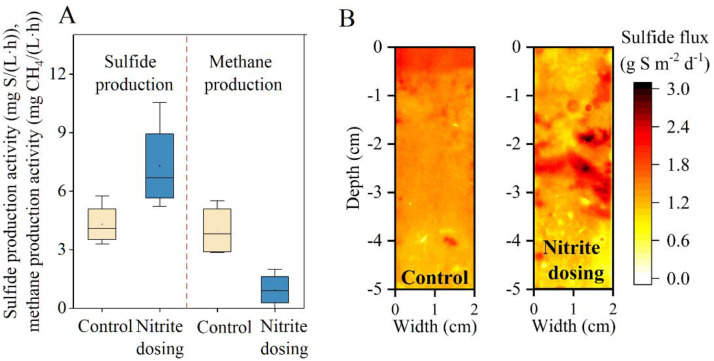
Chemicals are commonly dosed in sewer systems to reduce the emission of hydrogen sulfide (HS) and methane (CH), incurring high costs and environmental concerns. Nitrite dosing is a promising approach as nitrite can be produced from urine wastewater, which is a feasible integrated water management strategy. However, nitrite dosing usually requires strict conditions, e.g., relatively high nitrite concentration (e.g., ∼200 mg N/L) and acidic environment, to inhibit microorganisms. In contrast to "microbial inhibition", this study proposes "microbial utilization" concept, i.e., utilizing nitrite as a substrate for HS and CH consumption in sewer. In a laboratory-scale sewer reactor, nitrite at a relatively low concentrations of 25-48 mg N/L was continuously dosed. Two nitrite-dependent microbial utilization processes, i.e., nitrite-dependent anaerobic methane oxidation (n-DAMO) and microbial sulfide oxidation, successfully occurred in conjunction with nitrite reduction. The occurrence of both processes achieved a 58 % reduction in dissolved methane and over 90 % sulfide removal in the sewer reactor, with microbial activities measured as 15.6 mg CH/(L·h) and 29.4 mg S/(L·h), respectively. High copy numbers of n-DAMO bacteria and sulfide-oxidizing bacteria (SOB) were detected in both sewer biofilms and sediments. Mechanism analysis confirmed that the dosed nitrite at a relatively low level did not cause the inhibition of sulfidogenic process due to the downward migration of activity zones in sewer sediments. Therefore, the proposed "microbial utilization" concept offers a new alternative for simultaneous removal of sulfide and methane in sewers.
通常会在下水道系统中添加化学药剂以减少硫化氢(HS)和甲烷(CH)的排放,但这会产生高昂成本并引发环境问题。投加亚硝酸盐是一种很有前景的方法,因为亚硝酸盐可由尿液废水产生,这是一种可行的综合水管理策略。然而,投加亚硝酸盐通常需要严格的条件,例如相对较高的亚硝酸盐浓度(例如约200 mg N/L)和酸性环境,以抑制微生物。与“微生物抑制”不同,本研究提出了“微生物利用”的概念,即利用亚硝酸盐作为下水道中消耗HS和CH的底物。在实验室规模的下水道反应器中,连续投加浓度相对较低的25 - 48 mg N/L的亚硝酸盐。两个依赖亚硝酸盐的微生物利用过程,即依赖亚硝酸盐的厌氧甲烷氧化(n-DAMO)和微生物硫化物氧化,与亚硝酸盐还原同时成功发生。这两个过程的发生使下水道反应器中的溶解甲烷减少了58%,硫化物去除率超过90%,微生物活性分别为15.6 mg CH/(L·h)和29.4 mg S/(L·h)。在下水道生物膜和沉积物中均检测到高拷贝数的n-DAMO细菌和硫化物氧化细菌(SOB)。机理分析证实,由于下水道沉积物中活性区域的向下迁移,投加的低水平亚硝酸盐不会导致对产硫化物过程的抑制。因此,所提出的“微生物利用”概念为下水道中同时去除硫化物和甲烷提供了一种新的选择。