Center for Innovation in Medical Education, Leiden University Medical Center, the Netherlands.
School of Health Professions Education, Faculty of Health, Medicine and Life Sciences, Maastricht University, the Netherlands.
Perspect Med Educ. 2024 Jul 26;13(1):406-416. doi: 10.5334/pme.1345. eCollection 2024.
Computerized adaptive testing tailors test items to students' abilities by adapting difficulty level. This more efficient, and reliable assessment form may provide advantages over a conventional medical progress test (PT). Prior to our study, a direct comparison of students' performance on a computer adaptive progress test (CA-PT) and a conventional PT, which is crucial for nationwide implementation of the CA-PT, was missing. Therefore, we assessed the correlation between CA-PT and conventional PT test performance and explored the feasibility and student experiences of CA-PT in a large medical cohort.
In this cross-over study medical students (n = 1432) of three Dutch medical schools participated in both a conventional PT and CA-PT. They were stratified to start with either a conventional PT or CA-PT to determine test performance. Student motivation, engagement and experiences were assessed by questionnaires in students from seven Dutch medical schools. Parallel-forms reliability was assessed using the Pearson correlation coefficient.
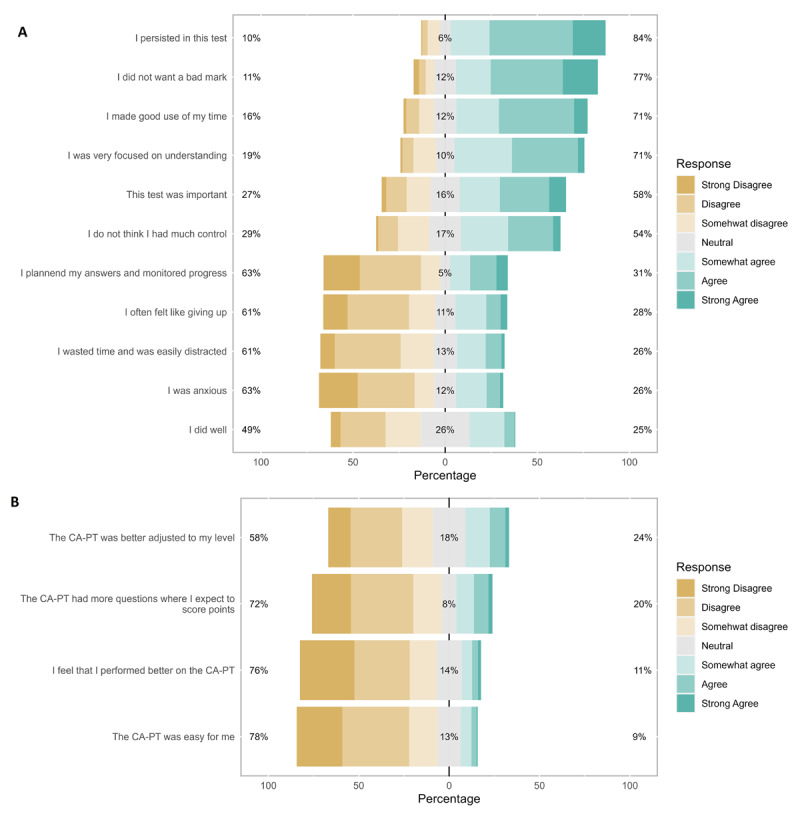
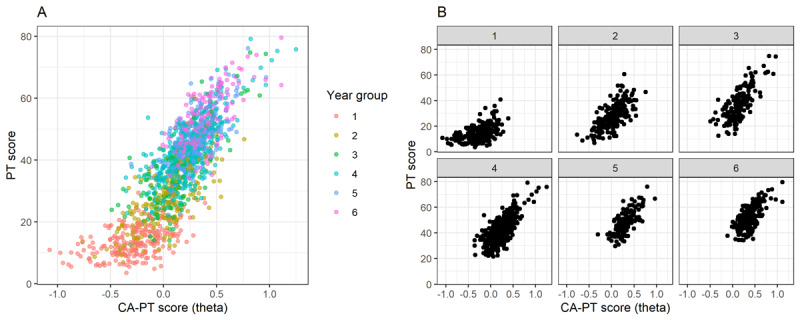
A strong correlation was found (0.834) between conventional PT and CA-PT test performance. The CA-PT was administered without system performance issues and was completed in a median time of 83 minutes (67-102 minutes). Questionnaire response rate was 31.7% (526/1658). Despite a higher experienced difficulty, most students reported persistence, adequate task management and good focus during the CA-PT.
CA-PT provides a reliable estimation of students' ability level in less time than a conventional non-adaptive PT and is feasible in students throughout the entire medical curriculum. Despite the strong correlation between PT scores, students found the CA-PT more challenging.
计算机化自适应测试通过调整试题难度来适应学生的能力。这种更高效、更可靠的评估形式可能优于传统的医学进展测试(PT)。在我们的研究之前,缺乏对计算机自适应进展测试(CA-PT)和传统 PT 学生表现的直接比较,这对于 CA-PT 在全国范围内的实施至关重要。因此,我们评估了 CA-PT 和传统 PT 测试表现之间的相关性,并在一个大型医学队列中探索了 CA-PT 的可行性和学生体验。
在这项交叉研究中,来自三所荷兰医学院的 1432 名医学生参加了传统 PT 和 CA-PT。他们被分层,以确定从传统 PT 或 CA-PT 开始的测试表现。来自七所荷兰医学院的学生通过问卷评估学生的动机、参与度和体验。平行形式的可靠性使用 Pearson 相关系数进行评估。
传统 PT 和 CA-PT 测试表现之间存在很强的相关性(0.834)。CA-PT 的实施没有出现系统性能问题,完成时间中位数为 83 分钟(67-102 分钟)。问卷回复率为 31.7%(526/1658)。尽管经历了更高的难度,大多数学生报告在 CA-PT 期间保持坚持、适当的任务管理和良好的专注度。
CA-PT 能够在比传统非自适应 PT 更短的时间内提供学生能力水平的可靠估计,并且在整个医学课程的学生中是可行的。尽管 PT 分数之间存在很强的相关性,但学生发现 CA-PT 更具挑战性。