Cheng Zilu, Chu Huikuan, Seki Ekihiro, Lin Rong, Yang Ling
Division of Gastroenterology, Union Hospital, Tongji Medical College, Huazhong University of Science and Technology, Wuhan, Hubei, China.
Karsh Division of Gastroenterology and Hepatology, Cedars-Sinai Medical Center, Los Angeles, CA, United States.
Front Cell Dev Biol. 2024 Jul 12;12:1431921. doi: 10.3389/fcell.2024.1431921. eCollection 2024.
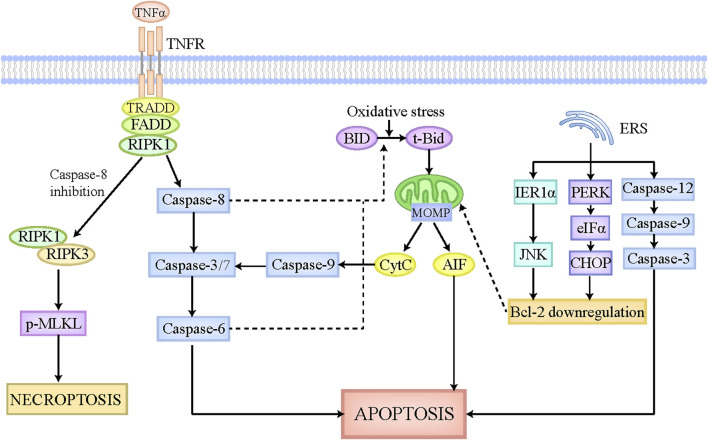
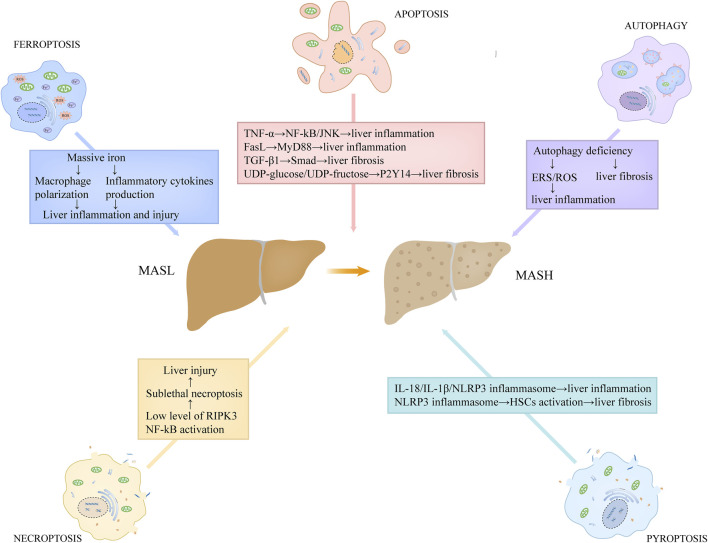
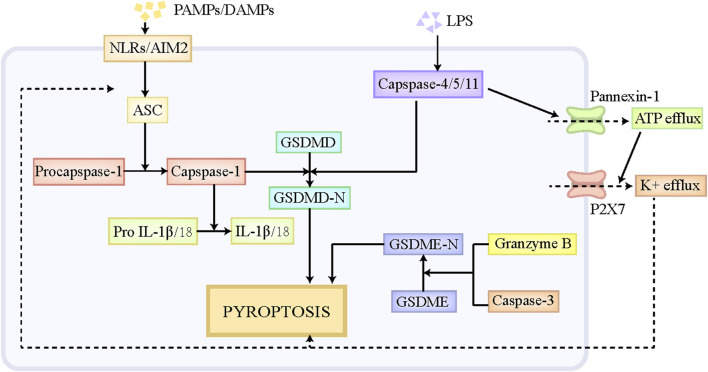
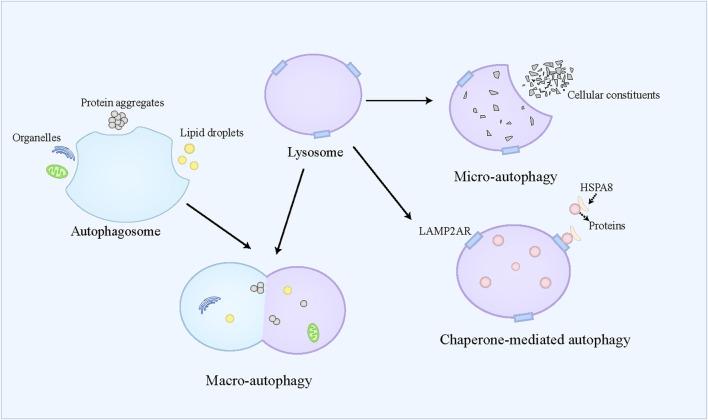
By replacing and removing defective or infected cells, programmed cell death (PCD) contributes to homeostasis maintenance and body development, which is ubiquitously present in mammals and can occur at any time. Besides apoptosis, more novel modalities of PCD have been described recently, such as necroptosis, pyroptosis, ferroptosis, and autophagy-dependent cell death. PCD not only regulates multiple physiological processes, but also participates in the pathogenesis of diverse disorders, including metabolic dysfunction-associated steatotic liver disease (MASLD). MASLD is mainly classified into metabolic dysfunction-associated steatotic liver (MASL) and metabolic dysfunction-associated steatohepatitis (MASH), and the latter putatively progresses to cirrhosis and hepatocellular carcinoma. Owing to increased incidence and obscure etiology of MASH, its management still remains a tremendous challenge. Recently, hepatocyte PCD has been attracted much attention as a potent driver of the pathological progression from MASL to MASH, and some pharmacological agents have been proved to exert their salutary effects on MASH partly via the regulation of the activity of hepatocyte PCD. The current review recapitulates the pathogenesis of different modalities of PCD, clarifies the mechanisms underlying how metabolic disorders in MASLD induce hepatocyte PCD and how hepatocyte PCD contributes to inflammatory and fibrotic progression of MASH, discusses several signaling pathways in hepatocytes governing the execution of PCD, and summarizes some potential pharmacological agents for MASH treatment which exert their therapeutic effects partly via the regulation of hepatocyte PCD. These findings indicate that hepatocyte PCD putatively represents a new therapeutic point of intervention for MASH.
通过替换和清除有缺陷或受感染的细胞,程序性细胞死亡(PCD)有助于维持体内平衡和身体发育,这在哺乳动物中普遍存在,且可在任何时候发生。除了凋亡,最近还描述了更多PCD的新形式,如坏死性凋亡、焦亡、铁死亡和自噬依赖性细胞死亡。PCD不仅调节多种生理过程,还参与多种疾病的发病机制,包括代谢功能障碍相关脂肪性肝病(MASLD)。MASLD主要分为代谢功能障碍相关脂肪性肝病(MASL)和代谢功能障碍相关脂肪性肝炎(MASH),后者可能进展为肝硬化和肝细胞癌。由于MASH的发病率增加且病因不明,其治疗仍然是一个巨大的挑战。最近,肝细胞PCD作为从MASL到MASH病理进展的有力驱动因素受到了广泛关注,一些药物已被证明部分通过调节肝细胞PCD的活性对MASH发挥有益作用。本综述概述了不同形式PCD的发病机制,阐明了MASLD中的代谢紊乱如何诱导肝细胞PCD以及肝细胞PCD如何促进MASH的炎症和纤维化进展的潜在机制,讨论了肝细胞中控制PCD执行的几种信号通路,并总结了一些用于治疗MASH的潜在药物,这些药物部分通过调节肝细胞PCD发挥治疗作用。这些发现表明,肝细胞PCD可能代表了MASH的一个新的治疗干预点。