Beringer Marc, Choudhury Rimjhim Roy, Mandáková Terezie, Grünig Sandra, Poretti Manuel, Leitch Ilia J, Lysak Martin A, Parisod Christian
Department of Biology, University of Fribourg, Chemin du Musée 10, 1700 Fribourg, Switzerland.
Institute of Plant Sciences, University of Bern, Altenbergrain 21, 3013 Bern, Switzerland.
Mol Biol Evol. 2024 Aug 2;41(8). doi: 10.1093/molbev/msae155.
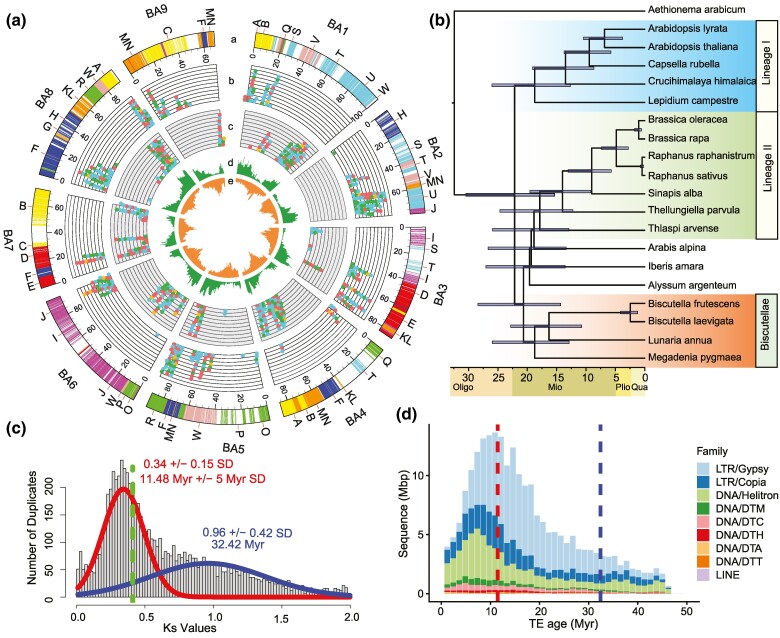
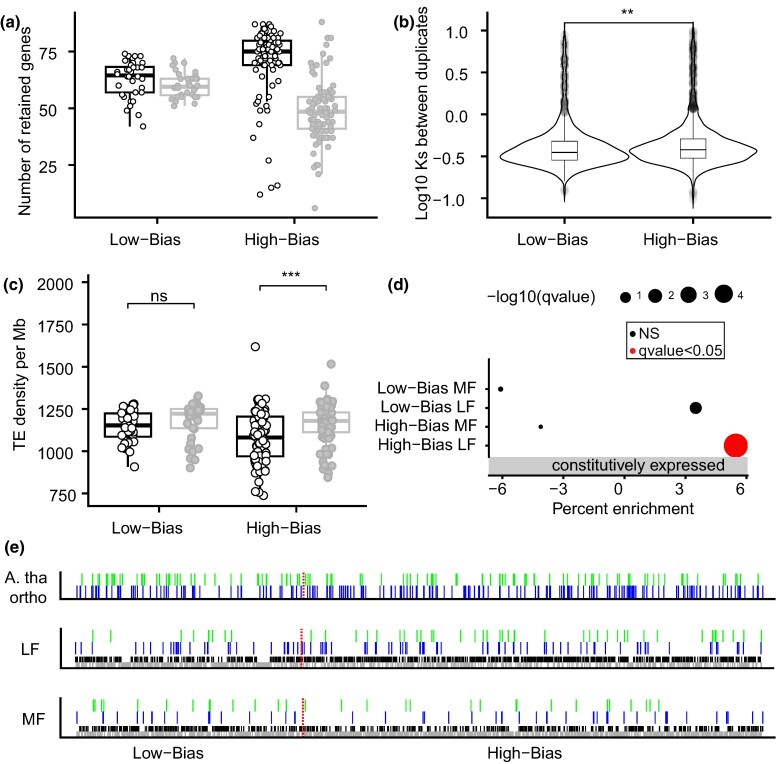
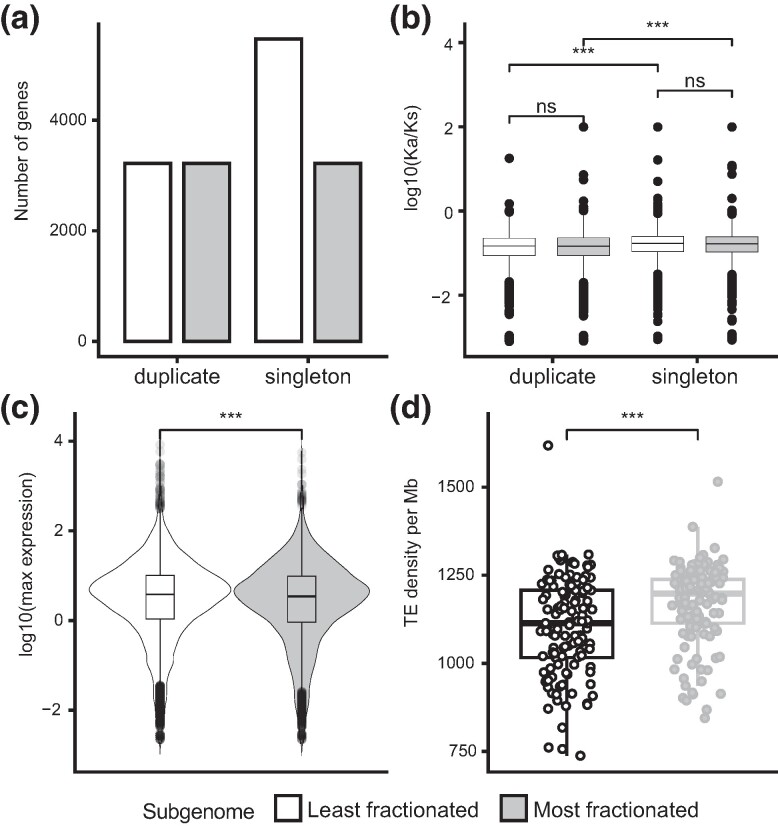
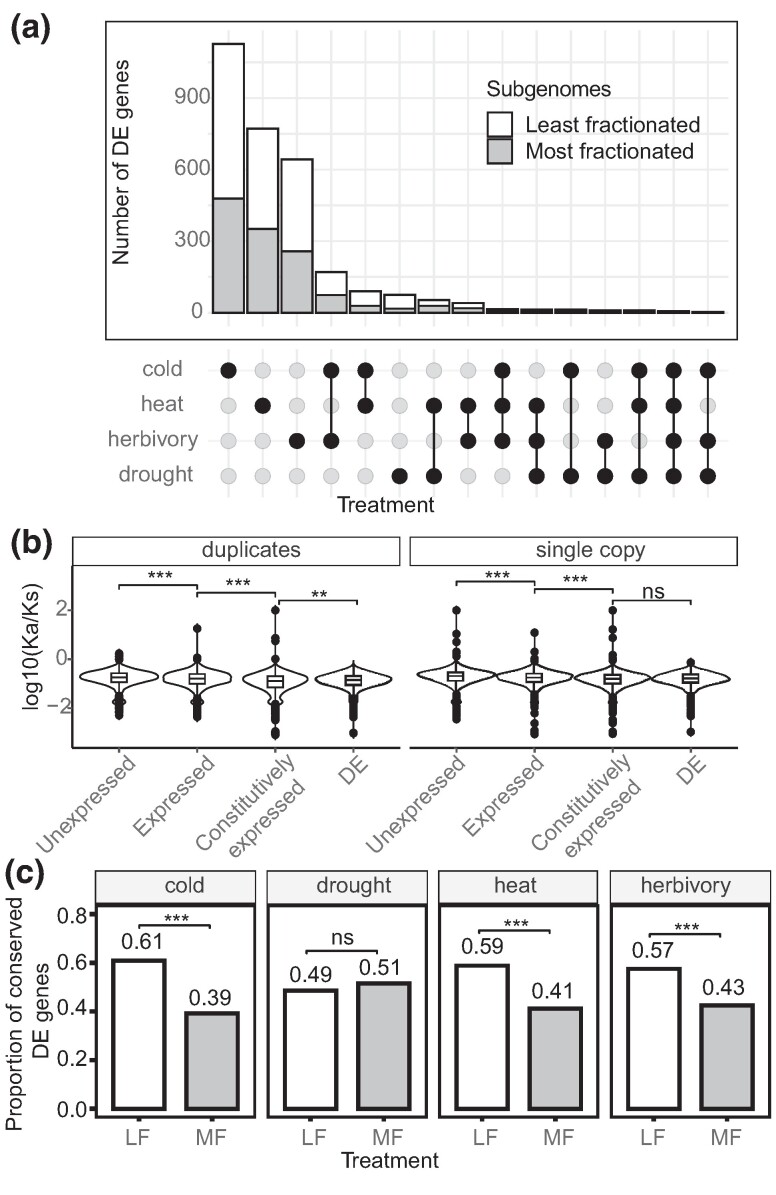
The molecular underpinnings and consequences of cycles of whole-genome duplication (WGD) and subsequent gene loss through subgenome fractionation remain largely elusive. Endogenous drivers, such as transposable elements (TEs), have been postulated to shape genome-wide dominance and biased fractionation, leading to a conserved least-fractionated (LF) subgenome and a degenerated most-fractionated (MF) subgenome. In contrast, the role of exogenous factors, such as those induced by environmental stresses, has been overlooked. In this study, a chromosome-scale assembly of the alpine buckler mustard (Biscutella laevigata; Brassicaceae) that underwent a WGD event about 11 million years ago is coupled with transcriptional responses to heat, cold, drought, and herbivory to assess how gene expression is associated with differential gene retention across the MF and LF subgenomes. Counteracting the impact of TEs in reducing the expression and retention of nearby genes across the MF subgenome, dosage balance is highlighted as a main endogenous promoter of the retention of duplicated gene products under purifying selection. Consistent with the "turn a hobby into a job" model, about one-third of environment-responsive duplicates exhibit novel expression patterns, with one copy typically remaining conditionally expressed, whereas the other copy has evolved constitutive expression, highlighting exogenous factors as a major driver of gene retention. Showing uneven patterns of fractionation, with regions remaining unbiased, but with others showing high bias and significant enrichment in environment-responsive genes, this mesopolyploid genome presents evolutionary signatures consistent with an interplay of endogenous and exogenous factors having driven gene content following WGD-fractionation cycles.
全基因组复制(WGD)循环以及随后通过亚基因组分离导致的基因丢失,其分子基础和后果在很大程度上仍然难以捉摸。诸如转座元件(TEs)等内源性驱动因素被认为塑造了全基因组的优势和偏向性分离,导致了保守的最少分离(LF)亚基因组和退化的最多分离(MF)亚基因组。相比之下,诸如环境胁迫诱导的外源性因素的作用却被忽视了。在本研究中,对大约1100万年前经历了WGD事件的高山盾牌芥(Biscutella laevigata;十字花科)进行染色体水平的组装,并结合其对热、冷、干旱和食草动物的转录反应,以评估基因表达如何与MF和LF亚基因组间不同的基因保留相关联。抵消了TEs在降低MF亚基因组中附近基因表达和保留方面的影响,剂量平衡被强调为在纯化选择下重复基因产物保留的主要内源性促进因素。与“把爱好变成工作”模型一致,约三分之一的环境响应性重复基因表现出新颖的表达模式,其中一个拷贝通常保持条件性表达,而另一个拷贝则进化出组成型表达,突出了外源性因素作为基因保留的主要驱动因素。这个中多倍体基因组显示出不均匀的分离模式,有些区域保持无偏向性,但其他区域则表现出高度偏向性且在环境响应基因中显著富集,呈现出与内源性和外源性因素相互作用驱动WGD-分离循环后基因含量变化相一致的进化特征。