School of Life Science and Technology, Harbin Institute of Technology, Harbin, Heilongjiang, China.
Department of Radiation Oncology, Harbin Medical University Cancer Hospital, Harbin, Heilongjiang, China.
Front Immunol. 2024 Jul 15;15:1412693. doi: 10.3389/fimmu.2024.1412693. eCollection 2024.
Esophageal cancer (ESCA) is one of the most common tumors in the world, and treatment using neoadjuvant therapy (NT) based on radiotherapy and/or chemotherapy has still unsatisfactory results. Neoadjuvant immunochemotherapy (NICT) has also become an effective treatment strategy nowadays. However, its impact on the tumor microenvironment (TME) and regulatory mechanisms on T cells and NK cells needs to be further elucidated.
A total of 279 cases of ESCA who underwent surgery alone [non-neoadjuvant therapy (NONE)], neoadjuvant chemotherapy (NCT), and NICT were collected, and their therapeutic effect and survival period were compared. Further, RNA sequencing combined with biological information was used to analyze the expression of immune-related genes. Immunohistochemistry, immunofluorescence, and quantitative real-time PCR (qRT-PCR) were used to verify the activation and infiltration status of CD8+ T and CD16+ NK cells, as well as the function and regulatory pathway of killing tumor cells.
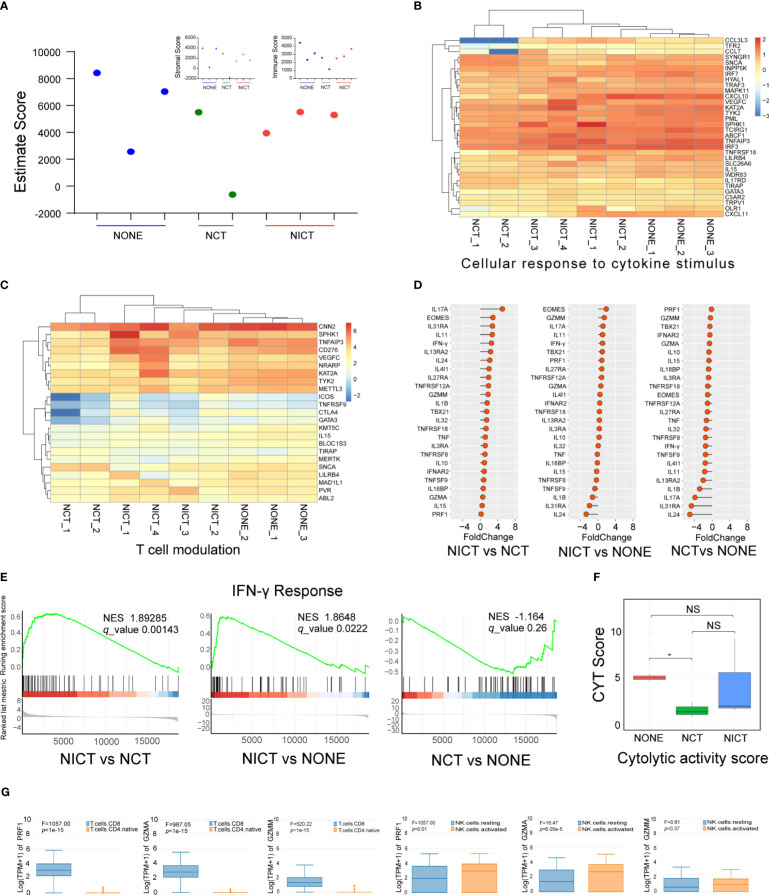
Patients with ESCA in the NICT group showed better clinical response, median survival, and 2-year survival rates ( < 0.05) compared with the NCT group. Our RNA sequencing data revealed that NICT could promote the expression of immune-related genes. The infiltration and activation of immune cells centered with CD8+ T cells were significantly enhanced. CD8+ T cells activated by PD-1 inhibitors secreted more IFN-γ and cytotoxic effector factor cells through the transcription factor of EOMES and TBX21. At the same time, activated CD8+ T cells mediated the CD16+ NK cell activation and secreted more IFN-γ to kill ESCA cells. In addition, the immunofluorescence co-staining results showed that more CD276+ tumor cells and CD16+ NK cells were existed in pre-NCT and pre-NICT group. However, CD276+ tumor cells were reduced significantly in the post-NICT group, while they still appeared in the post-NCT group, which means that CD16+ NK cells can recognize and kill CD276+ tumor cells after immune checkpoint blocker (ICB) treatment.
NICT can improve the therapeutic effect and survival period of resectable ESCA patients. NICT could promote the expression of immune-related genes and activate CD8+ T and CD16+ NK cells to secrete more IFN-γ to kill ESCA cells. It provides a theoretical basis and clinical evidence for its potential as an NT strategy in ESCA.
食管癌(ESCA)是世界上最常见的肿瘤之一,基于放疗和/或化疗的新辅助治疗(NT)的治疗效果仍不尽如人意。新辅助免疫化疗(NICT)目前也已成为一种有效的治疗策略。然而,其对肿瘤微环境(TME)的影响以及对 T 细胞和 NK 细胞的调控机制仍有待进一步阐明。
共收集了 279 例接受单纯手术[非新辅助治疗(NONE)]、新辅助化疗(NCT)和 NICT 的 ESCA 患者,比较其治疗效果和生存时间。进一步采用 RNA 测序结合生物信息学分析免疫相关基因的表达。采用免疫组织化学、免疫荧光和实时定量 PCR(qRT-PCR)验证 CD8+T 和 CD16+NK 细胞的激活和浸润状态,以及杀伤肿瘤细胞的功能和调控途径。
与 NCT 组相比,NICT 组 ESCA 患者的临床反应、中位生存时间和 2 年生存率更好(<0.05)。我们的 RNA 测序数据显示,NICT 可促进免疫相关基因的表达。以 CD8+T 细胞为中心的免疫细胞的浸润和激活明显增强。PD-1 抑制剂激活的 CD8+T 细胞通过转录因子 EOMES 和 TBX21 分泌更多的 IFN-γ和细胞毒性效应因子。同时,激活的 CD8+T 细胞介导 CD16+NK 细胞的激活并分泌更多的 IFN-γ来杀伤 ESCA 细胞。此外,免疫荧光共染色结果显示,在新辅助治疗前和新辅助免疫化疗前组中存在更多的 CD276+肿瘤细胞和 CD16+NK 细胞。然而,在新辅助免疫化疗后组中 CD276+肿瘤细胞明显减少,而在新辅助化疗后组中仍存在 CD276+肿瘤细胞,这意味着在免疫检查点抑制剂(ICB)治疗后,CD16+NK 细胞可以识别并杀伤 CD276+肿瘤细胞。
NICT 可提高可切除 ESCA 患者的治疗效果和生存时间。NICT 可促进免疫相关基因的表达,激活 CD8+T 和 CD16+NK 细胞分泌更多的 IFN-γ杀伤 ESCA 细胞。为其作为 ESCA 的 NT 策略提供了理论依据和临床证据。