Kadoglou Nikolaos Pe, Stasinopoulou Marianna, Velidakis Nikolaos, Khattab Elina, Christodoulou Eirini, Gkougkoudi Evangelia, Valsami Georgia
Medical School, University of Cyprus, 2029 Nicosia, Cyprus.
Center of Clinical, Experimental Surgery, and Translational Research, Biomedical Research Foundation, Academy of Athens, 11527 Athens, Greece.
Rev Cardiovasc Med. 2024 Jan 30;25(2):51. doi: 10.31083/j.rcm2502051. eCollection 2024 Feb.
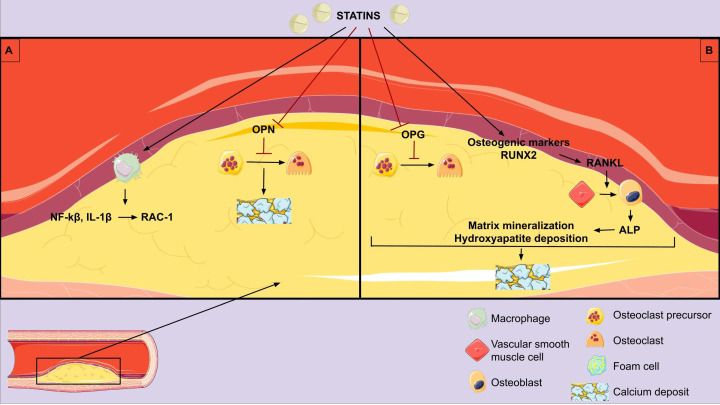
Vascular calcification (VC) is a complex process of calcium deposition on the arterial wall and atherosclerotic plaques and involves interaction between vascular smooth muscle cells, inflammatory and VC mediators. The latter are independent predictors of cardiovascular morbidity and mortality and potential targets of pharmaceutical therapy. This paper is a narrative review of the complex mechanisms of VC development and in this context the potential anti-atherosclerotic effects of statins. At the initial stages of atherosclerosis VC correlates with atherosclerosis burden and in the long-term with cardiovascular morbidity and mortality. A plethora of animal and clinical studies have proposed statins as the cornerstone of primary and secondary prevention of atherosclerotic cardiovascular disease. Based on coronary computed tomography data, high doses of statins may have negligible or even positive effects on the progression of coronary artery calcification. Growing data support an increase in atherosclerotic plaque calcification in peripheral arteries (e.g., carotids), after long-term, statin-therapy. Despite the paradox of increasing VC, those effects of statins have been associated with higher plaque stability, reducing the risk of consequent adverse events. Statins seem to promote a "favorable" atherosclerotic calcification, suppressing atherosclerotic lesion expansion and their vulnerability. More studies are required to clarify the underlying mechanisms.
血管钙化(VC)是钙在动脉壁和动脉粥样硬化斑块上沉积的复杂过程,涉及血管平滑肌细胞、炎症介质和血管钙化介质之间的相互作用。后者是心血管发病率和死亡率的独立预测因子,也是药物治疗的潜在靶点。本文是一篇关于血管钙化发展复杂机制以及他汀类药物在此背景下潜在抗动脉粥样硬化作用的叙述性综述。在动脉粥样硬化的初始阶段,血管钙化与动脉粥样硬化负担相关,长期来看则与心血管发病率和死亡率相关。大量动物和临床研究已将他汀类药物作为动脉粥样硬化性心血管疾病一级和二级预防的基石。基于冠状动脉计算机断层扫描数据,高剂量他汀类药物对冠状动脉钙化进展的影响可能微乎其微甚至具有积极作用。越来越多的数据表明,长期他汀类药物治疗后,外周动脉(如颈动脉)的动脉粥样硬化斑块钙化会增加。尽管存在血管钙化增加这一矛盾现象,但他汀类药物的这些作用与更高的斑块稳定性相关,降低了后续不良事件的风险。他汀类药物似乎促进了一种“有利的”动脉粥样硬化钙化,抑制了动脉粥样硬化病变的扩展及其易损性。需要更多研究来阐明其潜在机制。