Section of Inflammation and Cardiometabolic Diseases, National Heart, Lung, and Blood Institute, National Institutes of Health, Bethesda, Maryland, USA.
University of Wisconsin, Madison, Wisconsin, USA.
Clin Cardiol. 2022 Jun;45(6):622-628. doi: 10.1002/clc.23808. Epub 2022 Apr 2.
Statin treatment is a potent lipid-lowering therapy associated with decreased cardiovascular risk and mortality. Recent studies including the PARADIGM trial have demonstrated the impact of statins on promoting calcified coronary plaque.
The degree of systemic inflammation impacts the amount of increase in coronary plaque calcification over 2 years of statin treatment.
A subgroup of 142 participants was analyzed from the Risk Stratification with Image Guidance of HMG CoA Reductase Inhibitor Therapy (RIGHT) study (NCT01212900), who were on statin treatment and underwent cardiac computed tomography angiography (CCTA) at baseline and 2-year follow-up. This cohort was stratified by baseline median levels of high-sensitivity hs-CRP and analyzed with linear regressions using Stata-17 (StataCorp).
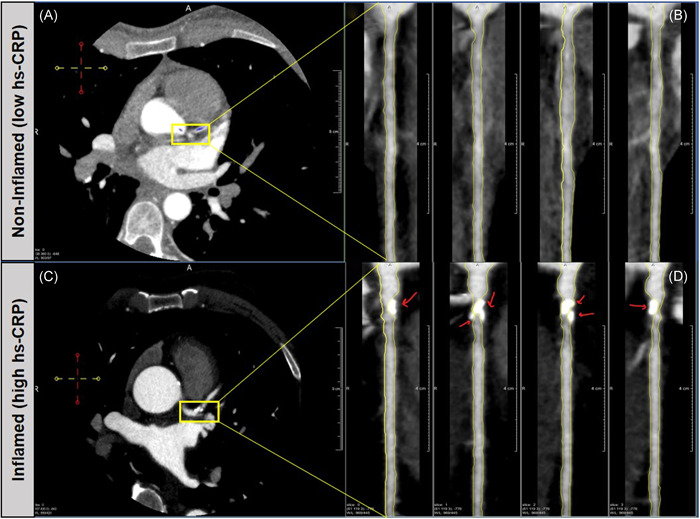
In the high versus low hs-CRP group, patients with higher baseline median hs-CRP had increased BMI (median [IQR]; 29 [27-31] vs. 27 [24-28]; p < .001), hypertension (59% vs. 41%; p = .03), and LDL-C levels (97 [77-113] vs. 87 [75-97] mg/dl; p = .01). After 2 years of statin treatment, the high hs-CRP group had significant increase in dense-calcified coronary burden versus the low hs-CRP group (1.27 vs. 0.32 mm [100×]; p = .02), beyond adjustment (β = .2; p = .03).
Statin treatment over 2 years associated with a significant increase in coronary calcification in patients with higher systemic inflammation, as measured by hs-CRP. These findings suggest that systemic inflammation plays a role in coronary calcification and further studies should be performed to better elucidate these findings.
他汀类药物治疗是一种强效的降脂疗法,可降低心血管风险和死亡率。最近的研究,包括 PARADIGM 试验,已经证明了他汀类药物对促进钙化性冠状动脉斑块的影响。
系统炎症的程度影响他汀类药物治疗 2 年后冠状动脉斑块钙化的增加量。
对 Risk Stratification with Image Guidance of HMG CoA Reductase Inhibitor Therapy(RIGHT)研究(NCT01212900)的 142 名参与者亚组进行了分析,这些参与者正在接受他汀类药物治疗,并在基线和 2 年随访时进行了心脏计算机断层扫描血管造影(CCTA)。根据基线时高敏 hs-CRP 的中位数水平对该队列进行分层,并使用 Stata-17(StataCorp)进行线性回归分析。
在高 hs-CRP 组与低 hs-CRP 组中,基线 hs-CRP 中位数较高的患者具有更高的 BMI(中位数[IQR];29[27-31]与 27[24-28];p<0.001)、高血压(59%与 41%;p=0.03)和 LDL-C 水平(97[77-113]与 87[75-97]mg/dl;p=0.01)。经过 2 年的他汀类药物治疗,高 hs-CRP 组的致密钙化冠状动脉负担显著增加,而低 hs-CRP 组则没有(1.27 与 0.32mm[100×];p=0.02),且经过调整后仍然如此(β=0.2;p=0.03)。
经过 2 年的他汀类药物治疗,与 hs-CRP 测量的系统炎症较高的患者的冠状动脉钙化显著增加相关。这些发现表明,系统炎症在冠状动脉钙化中起作用,应进一步开展研究以更好地阐明这些发现。