Szuromi Lilla, Hajas Orsolya, Nagy-Baló Edina, Forgács Ildikó N, Nagy László T, Fagyas Miklós, Tóth Attila, Nagy Béla, Kappelmayer János, Csanádi Zoltán
Division of Cardiology, Department of Cardiology, Faculty of Medicine, University of Debrecen, H-4032 Debrecen, Hungary.
Division of Clinical Physiology, Department of Cardiology, Faculty of Medicine, University of Debrecen, H-4032 Debrecen, Hungary.
Rev Cardiovasc Med. 2023 Jun 12;24(6):171. doi: 10.31083/j.rcm2406171. eCollection 2023 Jun.
Atrial fibrillation (AF) is accompanied by inflammation and fibrosis to variable extent. The biomarkers of fibrosis were measured in patients with different forms of AF and cardiac status. Herein, we assessed the associations of the baseline concentrations of different biomarkers with the long-term success of pulmonary vein isolation (PVI) in patients with a structurally normal heart. Furthermore, we compared biomarker levels before and 3 years after ablation to gain further insights into the AF mechanism.
Patients, undergoing PVI for paroxysmal/persistent AF were enrolled prospectively. Blood samples were obtained 24 hours before and 3 years after ablation. Serum cancer antigen 125 (CA-125), plasma Caspase-3, Galectin-3 and Cathepsin L concentrations were measured. Follow-up visits every 6 months included 12-lead electrocardiogram, 24-hour Holter, trans-telephonic monitoring as well as transthoracic echocardiography after ablation. Biomarker levels, left ventricular ejection fraction and left atrial (LA) diameters at baseline and at the 3-year follow-up were compared in patients with versus without AF recurrence.
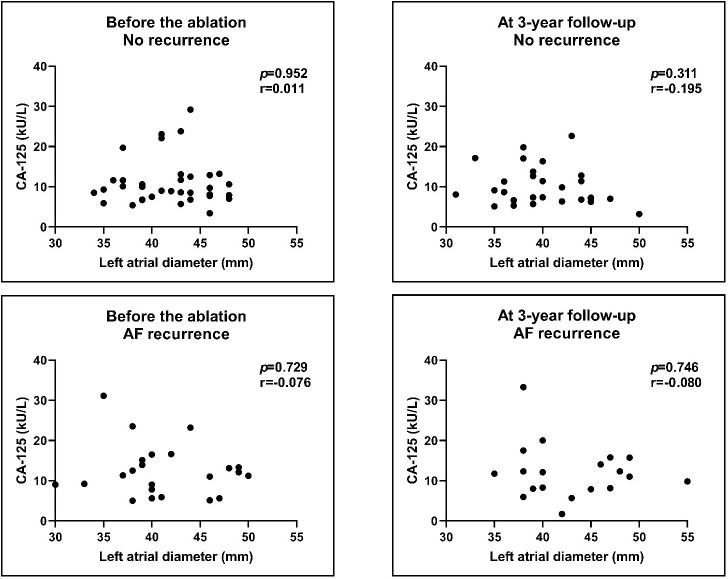
A total of 63 patients were enrolled (23 women; age 61.4 ( 8.8) years). The acute isolation of all pulmonary veins was achieved in all patients. During a mean follow-up of 36.3 6.3 months, AF recurrence was demonstrated in 26 (41.3%) patients. No significant differences were demonstrated in the levels of CA-125, Galectin-3, Caspase-3 and Cathepsin L pre- and post-ablation in patients with versus without AF recurrence. A significant decrease was detected in the concentrations of Caspase-3, Galectin-3 and Cathepsin L during follow-up with no difference in patients with versus without AF recurrence. A positive correlation was found between Caspase-3 levels and LA diameters in the AF recurrence group both before (r = 0.477; = 0.018) and after the procedure (r = 0.533; = 0.019).
Our results demonstrated that the levels of CA-125, Caspase-3, Cathepsin L and Galectin-3 are not associated with AF recurrence after PVI in patients with a structurally normal heart and mainly paroxysmal AF. Except for CA-125, all the other biomarkers demonstrated a significant decrease during a 3-year follow-up post-ablation. Furthermore, Caspase-3 levels demonstrated a positive correlation with LA dimensions in patients with AF recurrence.
心房颤动(AF)在不同程度上伴有炎症和纤维化。在不同类型的房颤和心脏状态患者中测量纤维化生物标志物。在此,我们评估了结构正常心脏患者中不同生物标志物的基线浓度与肺静脉隔离(PVI)长期成功率之间的关联。此外,我们比较了消融术前和术后3年的生物标志物水平,以进一步深入了解房颤机制。
前瞻性纳入接受阵发性/持续性房颤PVI治疗的患者。在消融术前24小时和术后3年采集血样。测量血清癌抗原125(CA-125)、血浆半胱天冬酶-3、半乳糖凝集素-3和组织蛋白酶L的浓度。每6个月的随访包括12导联心电图、24小时动态心电图、电话监测以及消融术后的经胸超声心动图。比较有和无房颤复发患者在基线和3年随访时的生物标志物水平、左心室射血分数和左心房(LA)直径。
共纳入63例患者(23例女性;年龄61.4±8.8岁)。所有患者均实现了所有肺静脉的急性隔离。在平均36.3±6.3个月的随访期间,26例(41.3%)患者出现房颤复发。有和无房颤复发患者消融前后CA-125、半乳糖凝集素-3、半胱天冬酶-3和组织蛋白酶L水平无显著差异。随访期间检测到半胱天冬酶-3、半乳糖凝集素-3和组织蛋白酶L浓度显著降低,有和无房颤复发患者之间无差异。在房颤复发组中,术前(r = 0.477;P = 0.018)和术后(r = 0.533;P = 0.019)半胱天冬酶-3水平与LA直径之间均发现正相关。
我们的结果表明,在结构正常心脏且主要为阵发性房颤的患者中,CA-125、半胱天冬酶-3、组织蛋白酶L和半乳糖凝集素-3水平与PVI术后房颤复发无关。除CA-125外,所有其他生物标志物在消融术后3年随访期间均显著降低。此外,在房颤复发患者中,半胱天冬酶-3水平与LA大小呈正相关。