Department of Pharmacology, Institute of Postgraduate Medical Education and Research, Kolkata, West Bengal, India.
Department of Clinical Immunology and Rheumatology, Institute of Postgraduate Medical Education and Research, Kolkata, West Bengal, India.
Indian J Pharmacol. 2024 May 1;56(3):166-171. doi: 10.4103/ijp.ijp_764_23. Epub 2024 Jul 5.
Azathioprine (AZA) is a widely used immunosuppressant drug. Leukopenia is a serious adverse effect of the drug which often necessitates dose reduction or drug withdrawal. Predictors of leukopenia include genetic and nongenetic factors. Genetic polymorphism of AZA-metabolizing enzyme, thiopurine S-methyltransferase (TPMT) is well established. There is inconclusive evidence about the role of Nudix hydrolase (NUDT15) gene polymorphism. This case-control study assessed the association of genetic polymorphisms of NUDT15 and TPMT with leukopenia induced by AZA.
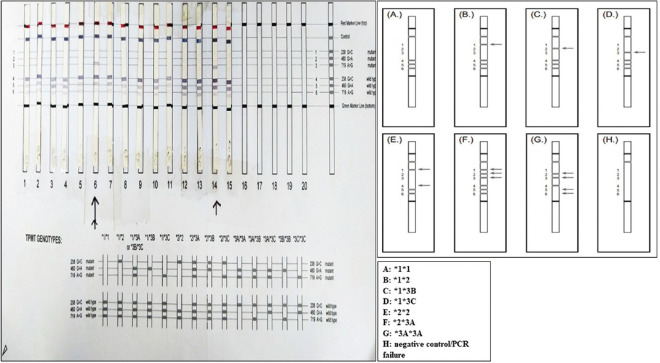
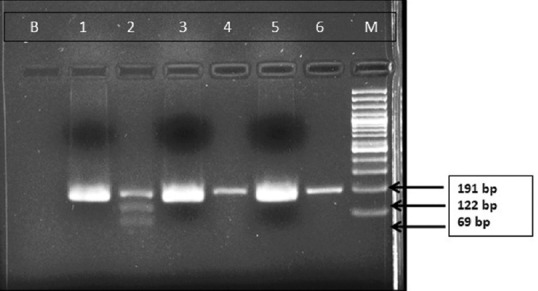
Cases were patients on AZA who developed leukopenia (white blood cell count <4000/μl) within 1 year of treatment initiation that necessitated dose reduction or drug withdrawal. Age and gender-matched patients without leukopenia within 1 year of treatment with AZA served as controls. TPMT (3 loci: c238G to C, c460G to A, c719A to G) and NUDT15 (c 415C to T, rs116855232) genotyping were done using TPMT strip assay and polymerase chain reaction-restriction fragment length polymorphism, respectively. Genotype frequencies were noted, and the odds ratio was calculated to determine the association between genotypes and leukopenia.
Twenty-nine subjects (15 cases and 14 controls) were enrolled. Statistically significant differences were not observed in the TPMT genotype (*1/*1 and *1/*3C) (P = 0.23) between cases and controls. NUDT15 genotypes (*1/*1 and *1/*3) (P = 0.65) also showed no statistically significant difference between cases and controls.
The above genotypes do not appear to be associated with AZA-induced leukopenia in an eastern Indian population.
巯嘌呤(AZA)是一种广泛使用的免疫抑制剂药物。白细胞减少是该药的一种严重不良反应,通常需要减少剂量或停药。白细胞减少的预测因素包括遗传和非遗传因素。AZA 代谢酶硫嘌呤甲基转移酶(TPMT)的遗传多态性已得到充分证实。关于 NUDT15 基因多态性在其中的作用还没有明确的证据。这项病例对照研究评估了 NUDT15 和 TPMT 基因多态性与 AZA 引起的白细胞减少之间的关联。
病例为在 AZA 治疗 1 年内发生白细胞减少(白细胞计数<4000/μl)的患者,需要减少剂量或停药。在 AZA 治疗 1 年内未发生白细胞减少的年龄和性别匹配的患者作为对照。使用 TPMT 条带测定法和聚合酶链反应-限制性片段长度多态性分别对 TPMT(3 个位点:c238G 至 C、c460G 至 A、c719A 至 G)和 NUDT15(c415C 至 T、rs116855232)进行基因分型。记录基因型频率,并计算比值比以确定基因型与白细胞减少之间的关联。
共纳入 29 名受试者(15 例病例和 14 例对照)。病例组和对照组之间 TPMT 基因型(*1/*1 和 *1/*3C)(P=0.23)无统计学显著差异。NUDT15 基因型(*1/*1 和 *1/*3)(P=0.65)在病例组和对照组之间也无统计学显著差异。
在印度东部人群中,上述基因型似乎与 AZA 引起的白细胞减少无关。