Department of Dermatology, Drug Hypersensitivity Clinical and Research Center, Chang Gung Memorial Hospital, Linkou, Taipei and Keelung, Taiwan.
Cancer Vaccine and Immune Cell Therapy Core Laboratory, Chang Gung Memorial Hospital, Linkou, Taiwan.
Clin Pharmacol Ther. 2022 Nov;112(5):1079-1087. doi: 10.1002/cpt.2716. Epub 2022 Aug 22.
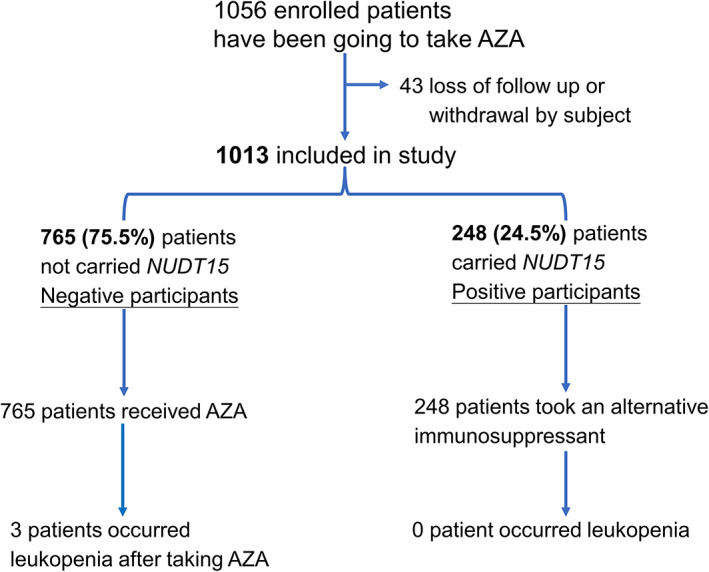
Azathioprine (AZA) is commonly used for many autoimmune disorders; however, the limitation of its clinical use is due to potential toxicities, including severe leukopenia. Recent studies have identified genetic NUDT15 variants strongly associated with AZA-induced leukopenia in Asian patients. This study aimed to investigate the strength of above genetic association and evaluate the usefulness of prospective screening of the NUDT15 variants to prevent AZA-induced leukopenia in Chinese patients. AZA-induced leukopenia in patients with autoimmune disorders were enrolled from multiple medical centers in Taiwan/China between 2012 and 2017 to determine the strength of genetic association of NUDT15 or TPMT variants by whole exome sequencing (WES). Furthermore, a prospective study was conducted between 2018 and 2021 to investigate the incidence of AZA-induced leukopenia with and without genetic screening. The WES result showed the genetic variants of NUDT15 R139C (rs116855232) (P = 3.7 × 10 , odds ratio (OR) = 21.7, 95% confidence interval (95% CI) = 12.1-38.8) and NUDT15 rs746071566 (P = 4.2 × 10 , OR = 7.1, 95% CI = 3.7-13.7), but not TPMT, were associated with AZA-induced leukopenia and NUDT15 R139C variant shows the highest sensitivity with 92.5%. Furthermore, the targeted screening of 1,013 participants for NUDT15 R139C enabled those identified as carriers to use alternative immunosuppressants. This strategy resulted in a significant decrease in the incidence of AZA-induced leukopenia compared with historical incidence (incidence rate = from 7.6% decreased to 0.4%; P = 9.3 × 10 ). In conclusion, the NUDT15 R139C variant was strongly associated with AZA-induced leukopenia in Chinese patients. The genetic screening of NUDT15 R139C followed by use of alternative immunosuppressants in identified carriers effectively decreased the incidence of AZA leukopenia for patients with autoimmune disorders.
硫唑嘌呤(AZA)常用于多种自身免疫性疾病;然而,其临床应用的局限性是由于潜在的毒性,包括严重的白细胞减少症。最近的研究发现,NUDT15 基因的变异与亚洲患者 AZA 诱导的白细胞减少症密切相关。本研究旨在探讨上述遗传关联的强度,并评估前瞻性筛查 NUDT15 变异以预防中国患者 AZA 诱导的白细胞减少症的有效性。
我们从 2012 年至 2017 年在台湾/中国大陆的多个医疗中心招募了自身免疫性疾病患者,通过全外显子组测序(WES)确定 NUDT15 或 TPMT 变异的遗传关联强度。此外,我们还进行了一项前瞻性研究,在 2018 年至 2021 年期间,研究了有无遗传筛查的 AZA 诱导性白细胞减少症的发生率。WES 结果显示,NUDT15 R139C(rs116855232)(P=3.7×10 -8 ,优势比(OR)=21.7,95%置信区间(95%CI)=12.1-38.8)和 NUDT15 rs746071566(P=4.2×10 -8 ,OR=7.1,95%CI=3.7-13.7)的遗传变异与 AZA 诱导的白细胞减少症相关,但 TPMT 不相关,NUDT15 R139C 变异的敏感性最高,为 92.5%。此外,对 1013 名 NUDT15 R139C 患者进行的靶向筛查使鉴定为携带者的患者能够使用替代免疫抑制剂。与历史发生率相比(发生率从 7.6%降至 0.4%;P=9.3×10 -8 ),这一策略显著降低了 AZA 诱导性白细胞减少症的发生率。
综上所述,NUDT15 R139C 变异与中国患者 AZA 诱导的白细胞减少症密切相关。对 NUDT15 R139C 进行遗传筛查,然后对鉴定为携带者的患者使用替代免疫抑制剂,可有效降低自身免疫性疾病患者 AZA 白细胞减少症的发生率。