Bibeau Kristen, Butler Kathleen, Wang Mingyue, Skaltsa Konstantina, Hamzavi Iltefat H
Incyte Corporation, Wilmington, DE, USA.
IQVIA Consulting Services, Barcelona, Spain.
Dermatol Ther (Heidelb). 2024 Aug;14(8):2223-2234. doi: 10.1007/s13555-024-01223-y. Epub 2024 Jul 30.
This study reports psychometric testing of the facial and total Vitiligo Area Scoring Index quantitative clinical instruments (F-VASI [range: 0-3], T-VASI [range: 0-100], respectively) using data from two phase 3 randomized, vehicle-controlled studies of ruxolitinib cream (TRuE-V1/TRuE-V2), the largest vitiligo trials conducted to date. Because VASI assessment is required by regulatory authorities, we evaluated the psychometric properties of the VASI instruments and confirmed thresholds for clinically meaningful change.
The TRuE-V1/TRuE-V2 full analysis set population included 652 patients (≥ 12 years old with nonsegmental vitiligo affecting ≤ 10% total body surface area, F-VASI ≥ 0.5, and T-VASI ≥ 3 at baseline). Data collected using the facial and total Patient Global Impression of Change-Vitiligo (PaGIC-V) and Physician's Global Vitiligo Assessment (PhGVA) scales were used as anchors to assess F-VASI and T-VASI for reliability, validity, sensitivity to change, and clinically meaningful change.
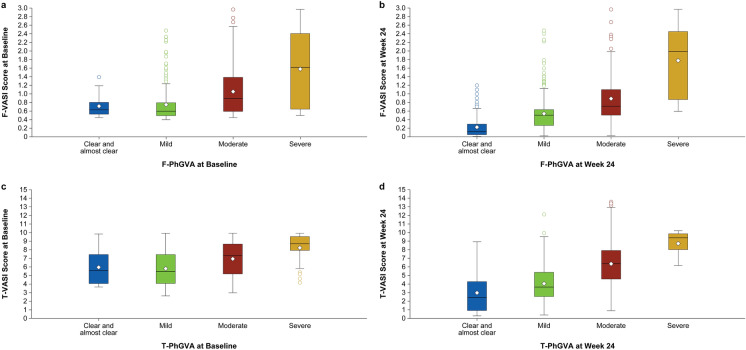
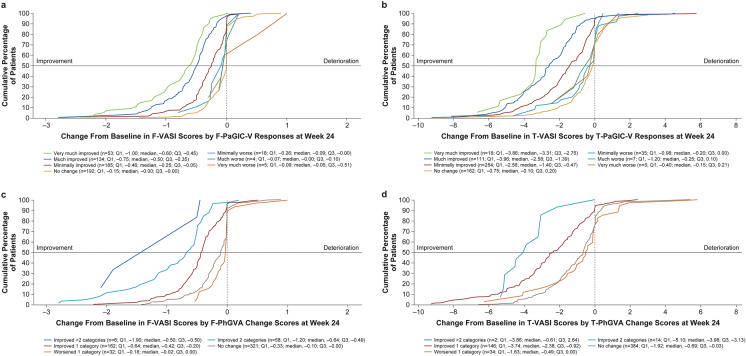
Median F-VASI and T-VASI scores were 0.70 and 6.76, respectively, at baseline, decreasing to 0.48 and 4.80 at week 24. Test-retest reliability was excellent between screening and baseline for F-VASI (intraclass correlation coefficient [ICC]: 0.943) and T-VASI (ICC: 0.945). Among stable patients per PaGIC-V and PhGVA, reliability was moderate to good for both F-VASI (ICC: 0.891 and 0.739, respectively) and T-VASI (ICC: 0.768 and 0.686). F-VASI and T-VASI differentiated well among PhGVA categories mild/moderate/severe at baseline and week 24. Both VASI instruments detected changes assessed by correlations with PaGIC-V scores at week 24 (F-VASI, r = 0.610; T-VASI, r = 0.512) and changes in PhGVA scores from baseline to week 24 (F-VASI, r = 0.501; T-VASI, r = 0.344). Thresholds for clinically meaningful improvement per PaGIC-V and PhGVA were 0.38-0.60 for F-VASI and 1.69-3.88 for T-VASI.
Data from the TRuE-V1/TRuE-V2 studies confirmed that F-VASI and T-VASI are reliable, valid, and responsive to change, with defined clinically meaningful change from baseline in patients with nonsegmental vitiligo.
The original studies were registered at ClinicalTrials.gov: NCT04052425/NCT04057573.
本研究报告了面部白癜风面积评分指数(F-VASI[范围:0-3])和白癜风总面积评分指数(T-VASI[范围:0-100])这两种定量临床工具的心理测量测试,使用了两项3期随机、赋形剂对照的芦可替尼乳膏研究(TRuE-V1/TRuE-V2)的数据,这是迄今为止开展的最大规模的白癜风试验。由于监管机构要求进行VASI评估,我们评估了VASI工具的心理测量特性,并确定了具有临床意义的变化阈值。
TRuE-V1/TRuE-V2全分析集人群包括652例患者(年龄≥12岁,非节段性白癜风累及体表面积≤10%,基线时F-VASI≥0.5且T-VASI≥3)。使用面部和整体白癜风患者总体变化印象量表(PaGIC-V)以及医生白癜风整体评估量表(PhGVA)收集的数据作为锚定指标,以评估F-VASI和T-VASI在可靠性、有效性、对变化的敏感性以及具有临床意义的变化方面的表现。
基线时F-VASI和T-VASI的中位数分别为0.70和6.76,在第24周时降至0.48和4.80。F-VASI(组内相关系数[ICC]:0.943)和T-VASI(ICC:0.945)在筛查和基线之间的重测信度极佳。在根据PaGIC-V和PhGVA判定为病情稳定的患者中,F-VASI(ICC分别为0.891和0.739)和T-VASI(ICC分别为0.768和0.686)的信度为中等至良好。F-VASI和T-VASI在基线和第24周时能够很好地区分PhGVA的轻度/中度/重度类别。两种VASI工具均通过与第24周时PaGIC-V评分的相关性(F-VASI,r = 0.610;T-VASI,r = 0.512)以及从基线到第24周时PhGVA评分的变化(F-VASI,r = 0.501;T-VASI,r = 0.344)检测到了变化。根据PaGIC-V和PhGVA,F-VASI具有临床意义的改善阈值为0.38-0.60,T-VASI为1.69-3.88。
TRuE-V1/TRuE-V2研究的数据证实,F-VASI和T-VASI可靠、有效且对变化有反应,对于非节段性白癜风患者,从基线开始有明确的具有临床意义的变化。
原始研究已在ClinicalTrials.gov注册:NCT04052425/NCT04057573。