Department of Epidemiology and Biostatistics, University of California, San Francisco.
Department of Epidemiology, Boston University, Boston, Massachusetts.
JAMA Netw Open. 2024 Jul 1;7(7):e2424539. doi: 10.1001/jamanetworkopen.2024.24539.
Vision and eye conditions are associated with increased risk for Alzheimer disease and related dementias (ADRDs), but the nature of the association and the underlying biological pathways remain unclear. If causal, vision would be an important modifiable risk factor with viable population-level interventions.
To evaluate potentially causal associations between visual acuity, eye conditions (specifically cataracts and myopia), neuroimaging outcomes, and ADRDs.
DESIGN, SETTING, AND PARTICIPANTS: A cohort and 2-sample bidirectional mendelian randomization (MR) study was conducted using UK Biobank participants and summary statistics from previously published genome-wide association studies on cataract, myopia, and AD. The participants included in the analysis were aged 55 to 70 years without dementia at baseline (calendar years 2006 to 2010), underwent genotyping, and reported on eye conditions; a subset completed visual acuity examinations (n = 69 852-71 429) or brain imaging (n = 36 591-36 855). Data were analyzed from August 15, 2022, through November 28, 2023.
Self-reported cataracts, visual acuity, and myopia measured by refraction error.
ADRD, AD, and vascular dementia were identified from electronic medical records. Total and regional brain volumes were determined using magnetic resonance imaging.
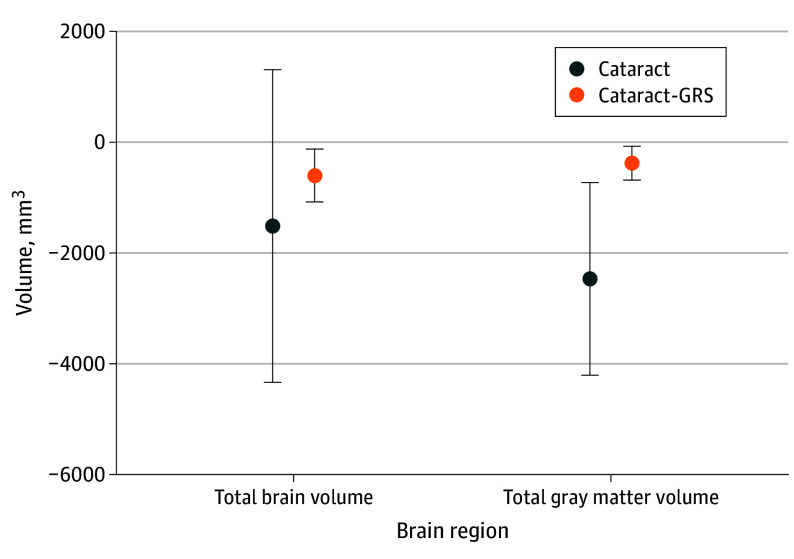
The sample included 304 953 participants (mean [SD] age, 62.1 (4.1) years; 163 825 women [53.72%]); 14 295 (4.69%) had cataracts and 2754 (3.86%) had worse than 20/40 vision. Cataracts (hazard ratio [HR], 1.18; 95% CI, 1.07-1.29) and myopia (HR, 1.35; 95% CI, 1.06-1.70) were associated with a higher hazard of ADRD. In MR analyses to estimate potential causal effects, cataracts were associated with increased risk of vascular dementia (inverse variance-weighted odds ratio [OR], 1.92; 95% CI, 1.26-2.92) but were not associated with increased dementia (OR, 1.21; 95% CI, 0.98-1.50). There were no associations between myopia and dementia. In MR for potential reverse causality, AD was not associated with cataracts (inverse variance-weighted OR, 0.99; 95% CI, 0.96-1.01). Genetic risk for cataracts was associated with smaller total brain (β = -597.43 mm3; 95% CI, -1077.87 to -117.00 mm3) and gray matter (β = -375.17 mm3; 95% CI, -680.10 to -70.24 mm3) volumes, but not other brain regions.
In this cohort and MR study of UK Biobank participants, cataracts were associated with increased risk of dementia, especially vascular dementia, and reduced total brain volumes. These findings lend further support to the hypothesis that cataract extraction may reduce the risk for dementia.
视力和眼部状况与阿尔茨海默病和相关痴呆症(ADRD)的风险增加有关,但关联的性质和潜在的生物学途径仍不清楚。如果是因果关系,视力将是一个重要的可改变的风险因素,有可行的人群水平干预措施。
评估视力、眼部状况(特别是白内障和近视)、神经影像学结果与 ADRD 之间潜在的因果关系。
设计、地点和参与者:使用 UK Biobank 参与者和先前发表的关于白内障、近视和 AD 的全基因组关联研究的汇总统计数据,进行了一项队列和 2 样本双向孟德尔随机化(MR)研究。纳入分析的参与者年龄在 55 至 70 岁之间,基线时无痴呆症(日历年份 2006 至 2010 年),接受基因分型,并报告眼部状况;一部分人完成了视力检查(n=69852-71429)或脑成像(n=36591-36855)。数据分析于 2022 年 8 月 15 日至 2023 年 11 月 28 日进行。
白内障、视力和近视通过折射误差测量。
ADRD、AD 和血管性痴呆从电子病历中确定。使用磁共振成像确定总脑和各脑区的体积。
样本包括 304953 名参与者(平均[SD]年龄 62.1[4.1]岁;163825 名女性[53.72%]);14295 人(4.69%)患有白内障,2754 人(3.86%)视力差于 20/40。白内障(风险比[HR],1.18;95%CI,1.07-1.29)和近视(HR,1.35;95%CI,1.06-1.70)与 ADRD 风险增加相关。在估计潜在因果效应的 MR 分析中,白内障与血管性痴呆风险增加相关(逆方差加权比值比[OR],1.92;95%CI,1.26-2.92),但与痴呆无关(OR,1.21;95%CI,0.98-1.50)。近视与痴呆之间没有关联。在潜在反向因果关系的 MR 中,AD 与白内障无关(逆方差加权 OR,0.99;95%CI,0.96-1.01)。白内障的遗传风险与总脑(β=-597.43mm3;95%CI,-1077.87 至-117.00mm3)和灰质(β=-375.17mm3;95%CI,-680.10 至-70.24mm3)体积较小有关,但与其他脑区无关。
在这项 UK Biobank 参与者的队列和 MR 研究中,白内障与痴呆,特别是血管性痴呆的风险增加有关,并与总脑体积减少有关。这些发现进一步支持了白内障摘除可能降低痴呆风险的假设。