Salzano Leah, Narayanan Nithya, Tobik Emily R, Akbarzada Sumaira, Wu Yanjun, Megiel Sarah, Choate Brittany, Wyllie Anne L
Department of Epidemiology of Microbial Diseases, Yale School of Public Health, New Haven, Connecticut, United States of America.
Department of Health Policy and Management, Yale School of Public Health, New Haven, Connecticut, United States of America.
PLOS Glob Public Health. 2024 Jul 30;4(7):e0003547. doi: 10.1371/journal.pgph.0003547. eCollection 2024.
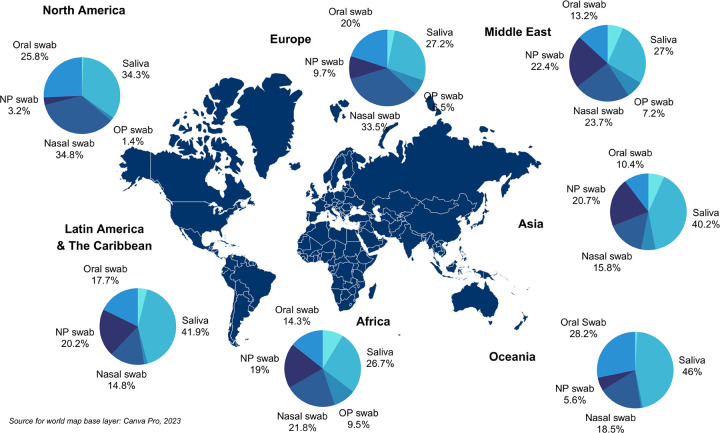
Public perception regarding diagnostic sample types as well as personal experiences can influence willingness to test. As such, public preferences for specific sample type(s) should be used to inform diagnostic and surveillance testing programs to improve public health response efforts. To understand where preferences lie, we conducted an international survey regarding the sample types used for SARS-CoV-2 tests. A Qualtrics survey regarding SARS-CoV-2 testing preferences was distributed via social media and email. The survey collected preferences regarding sample methods and key demographic data. Python was used to analyze survey responses. From March 30th to June 15th, 2022, 2,094 responses were collected from 125 countries. Participants were 55% female and predominantly aged 25-34 years (27%). Education and employment were skewed: 51% had graduate degrees, 26% had bachelor's degrees, 27% were scientists/researchers, and 29% were healthcare workers. By rank sum analysis, the most preferred sample type globally was the oral swab, followed by saliva, with parents/guardians preferring saliva-based testing for children. Respondents indicated a higher degree of trust in PCR testing (84%) vs. rapid antigen testing (36%). Preferences for self- or healthcare worker-collected sampling varied across regions. This international survey identified a preference for oral swabs and saliva when testing for SARS-CoV-2. Notably, respondents indicated that if they could be assured that all sample types performed equally, then saliva was preferred. Overall, survey responses reflected the region-specific testing experiences during the COVID-19. Public preferences should be considered when designing future response efforts to increase utilization, with oral sample types (either swabs or saliva) providing a practical option for large-scale, accessible diagnostic testing.
公众对诊断样本类型的认知以及个人经历会影响检测意愿。因此,应利用公众对特定样本类型的偏好,为诊断和监测检测计划提供参考,以改进公共卫生应对措施。为了解偏好所在,我们针对用于新冠病毒检测的样本类型开展了一项国际调查。通过社交媒体和电子邮件分发了一项关于新冠病毒检测偏好的Qualtrics调查。该调查收集了关于样本方法和关键人口统计数据的偏好。使用Python分析调查回复。在2022年3月30日至6月15日期间,从125个国家收集了2094份回复。参与者中55%为女性,主要年龄在25 - 34岁(27%)。教育程度和职业分布不均衡:51%拥有研究生学位,26%拥有学士学位,27%是科学家/研究人员,29%是医护人员。通过秩和分析,全球最受欢迎的样本类型是咽拭子,其次是唾液,家长/监护人更倾向于为儿童进行基于唾液的检测。受访者对聚合酶链反应检测(84%)的信任度高于快速抗原检测(36%)。对自我采集或医护人员采集样本的偏好因地区而异。这项国际调查确定了在进行新冠病毒检测时对咽拭子和唾液的偏好。值得注意的是,受访者表示,如果能确保所有样本类型的检测效果相同,那么他们更倾向于唾液样本。总体而言,调查回复反映了新冠疫情期间各地区特定的检测经历。在设计未来的应对措施以提高检测利用率时,应考虑公众偏好,口腔样本类型(咽拭子或唾液)为大规模、可及的诊断检测提供了一个切实可行的选择。