Department of Neonatology, All India Institute of Medical Sciences, Patna, Bihar, India.
Department of Neonatology, Institute of Postgraduate Medical Education and Research, Kolkata, West Bengal, India.
PLoS One. 2024 Jul 30;19(7):e0307903. doi: 10.1371/journal.pone.0307903. eCollection 2024.
Noninvasive High-Frequency Oscillatory Ventilation (NHFOV) is increasingly being adopted to reduce the need for invasive ventilation after extubation.
To evaluate the benefits and harms of NHFOV as post-extubation respiratory support in newborns compared to other non-invasive respiratory support modes.
MATERIAL & METHODS: We included randomized controlled trials comparing NHFOV with other non-invasive modes post-extubation in newborns. Data sources were MEDLINE (via Pubmed), Cochrane Central Register of Controlled Trials, China National Knowledge Infrastructure, WHO international clinical trials registry platform and Clinical Trial Registry, forward and backward citation search. Methodological quality of studies was assessed by Cochrane's Risk of Bias tool 1.0.
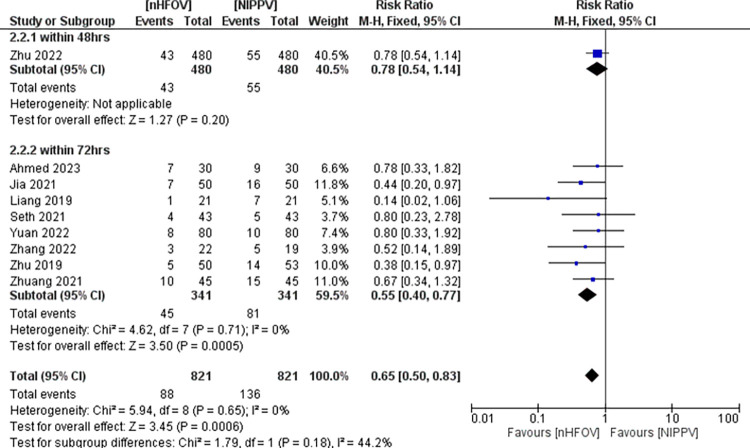
This systematic review included 21 studies and 3294 participants, the majority of whom were preterm. NHFOV compared to nasal continuous positive airway pressure (NCPAP) reduced reintubation within seven days (RR 0.34, 95% CI 0.22 to 0.53) after extubation. It also reduced extubation failure (RR 0.39, 95% CI 0.30 to 0.51) and reintubation within 72 hrs (RR 0.40, 95% CI 0.31 to 0.53), bronchopulmonary dysplasia (RR 0.59, 95% CI 0.37 to 0.94) and pulmonary air leak (RR 0.46, 95% CI 0.27 to 0.79) compared to NCPAP. The rate of reintubation within seven days (RR 0.62, 95% CI 0.18 to 2.14) was similar whereas extubation failure (RR 0.65, 95% CI 0.50 to 0.83) and reintubation (RR 0.68, 95% CI 0.52 to 0.89) within 72 hrs were lower in NHFOV group compared to nasal intermittent positive pressure ventilation. There was no effect on other outcomes. Overall quality of the evidence was low to very low in both comparisons.
NHFOV may reduce the rate of reintubation and extubation failure post-extubation without increasing complications. Majority of the trials were exclusively done in preterm neonates. Further research with high methodological quality is warranted.
无创高频振荡通气(NHFOV)越来越多地被用于减少拔管后对有创通气的需求。
评估与其他无创呼吸支持模式相比,NHFOV 作为新生儿拔管后的呼吸支持的益处和危害。
我们纳入了比较 NHFOV 与新生儿拔管后其他无创模式的随机对照试验。数据来源包括 MEDLINE(通过 PubMed)、Cochrane 对照试验中心注册库、中国国家知识基础设施、世界卫生组织国际临床试验注册平台和临床试验注册处,以及向前和向后引用搜索。研究的方法学质量通过 Cochrane 的偏倚风险工具 1.0 进行评估。
本系统评价纳入了 21 项研究和 3294 名参与者,其中大多数为早产儿。与鼻塞持续气道正压通气(NCPAP)相比,NHFOV 可降低拔管后 7 天内再次插管的发生率(RR 0.34,95%CI 0.22 至 0.53)。它还降低了拔管失败率(RR 0.39,95%CI 0.30 至 0.51)和 72 小时内再次插管率(RR 0.40,95%CI 0.31 至 0.53)、支气管肺发育不良(RR 0.59,95%CI 0.37 至 0.94)和肺空气漏(RR 0.46,95%CI 0.27 至 0.79),与 NCPAP 相比。7 天内再次插管的发生率(RR 0.62,95%CI 0.18 至 2.14)相似,而拔管失败率(RR 0.65,95%CI 0.50 至 0.83)和 72 小时内再次插管率(RR 0.68,95%CI 0.52 至 0.89)较低。总体证据质量在这两种比较中均为低至极低。
与鼻塞间歇正压通气相比,NHFOV 可能降低拔管后再次插管和拔管失败的发生率,而不会增加并发症。大多数试验仅在早产儿中进行。需要进行具有较高方法学质量的进一步研究。