Yunker Madeline, Villafuerte David A, Fall Amary, Norton Julie M, Abdullah Omar, Rothman Richard E, Fenstermacher Katherine Z J, Morris C Paul, Pekosz Andrew, Klein Eili, Mostafa Heba H
Johns Hopkins School of Medicine, Department of Pathology, Division of Medical Microbiology USA.
Department of Emergency Medicine, Johns Hopkins School of Medicine USA.
J Clin Virol. 2024 Oct;174:105718. doi: 10.1016/j.jcv.2024.105718. Epub 2024 Jul 25.
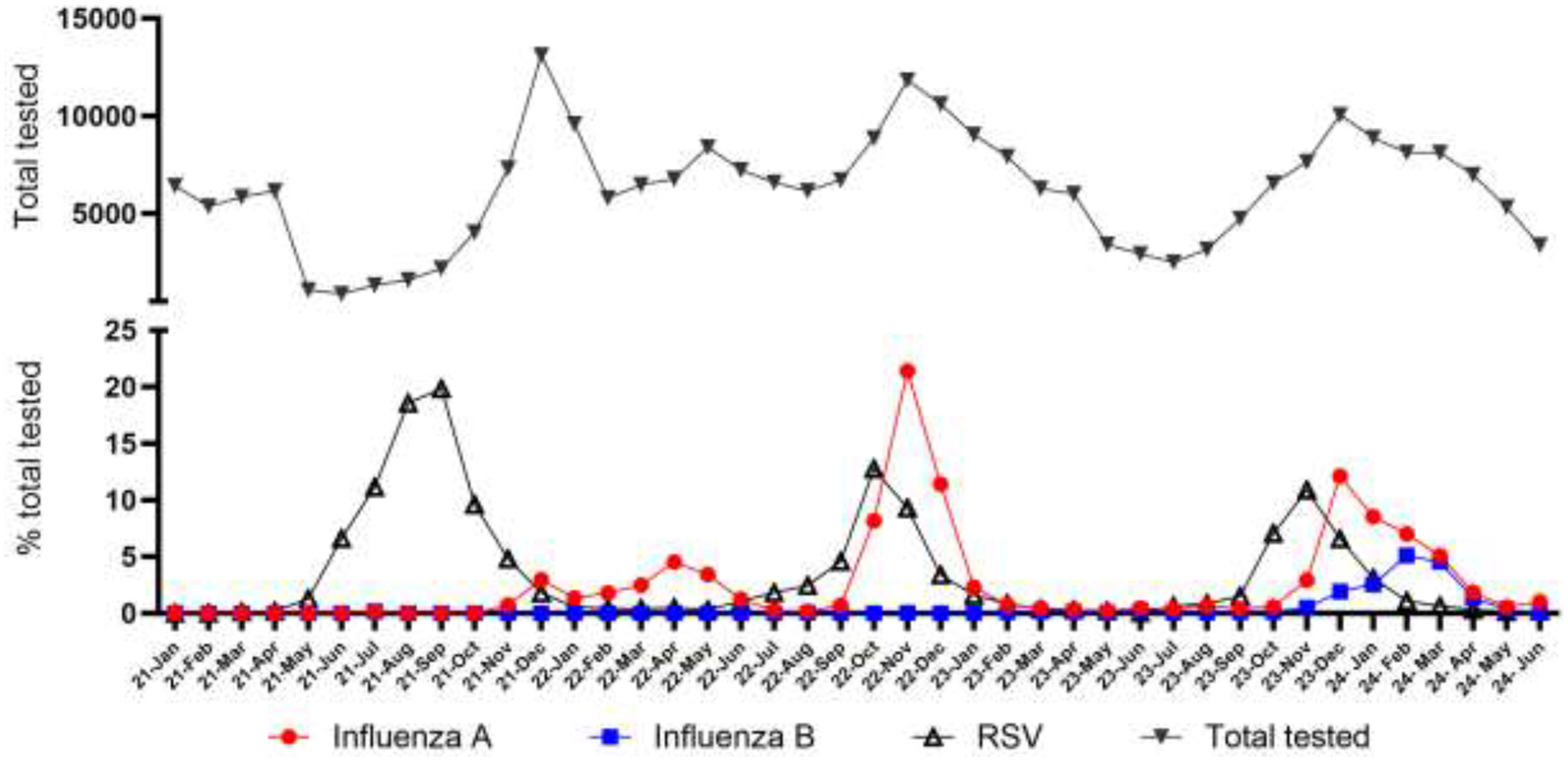
Influenza, a human disease caused by viruses in the Orthomyxoviridae family, is estimated to infect 5% -10 % of adults and 20% -30 % of children annually. Influenza A (IAV) and Influenza B (IBV) viruses accumulate amino acid substitutions (AAS) in the hemagglutinin (HA) and neuraminidase (NA) proteins seasonally. These changes, as well as the dominating viral subtypes, vary depending on geographical location, which may impact disease prevalence and the severity of the season. Genomic surveillance is crucial for capturing circulation patterns and characterizing AAS that may affect disease outcomes, vaccine efficacy, or antiviral drug activities. In this study, whole-genome sequencing of IAV and IBV was attempted on positive remnant clinical samples (587) collected from 580 patients between June 2023 and February 2024 in the Johns Hopkins Health System (JHHS). Full-length HA segments were obtained from 424 (72.2 %) samples. H1N1pdm09 (71.7 %) was the predominant IAV subtype, followed by H3N2 (16.7 %) and IBV-Victoria clade V1A.3a.2 (11.6 %). Within H1N1pdm09 HA sequences, the 6B1A.5a.2a.1 (60.5 %) clade was the most represented. Full-length NA segments were obtained from 421 (71.7 %) samples. Within H1N1pdm09 and IBV, AAS previously proposed to change susceptibility to NA inhibitors were infrequently detected. Phylogeny of HA and NA demonstrated heterogeneous HA and NA H1N1pdm09 and IBV subclades. No significant differences were observed in admission rates or use of supplemental oxygen between different subtypes or clades. Influenza virus genomic surveillance is essential for understanding the seasonal evolution of influenza viruses and their association with disease prevalence and outcomes.
流感是一种由正黏病毒科病毒引起的人类疾病,据估计,每年有5%至10%的成年人和20%至30%的儿童感染流感。甲型流感病毒(IAV)和乙型流感病毒(IBV)每年会在血凝素(HA)和神经氨酸酶(NA)蛋白中积累氨基酸替换(AAS)。这些变化以及占主导地位的病毒亚型因地理位置而异,这可能会影响疾病的流行程度和季节的严重程度。基因组监测对于掌握病毒传播模式以及确定可能影响疾病转归、疫苗效力或抗病毒药物活性的氨基酸替换至关重要。在本研究中,尝试对2023年6月至2024年2月期间在约翰·霍普金斯医疗系统(JHHS)从580名患者中采集的587份阳性剩余临床样本进行IAV和IBV的全基因组测序。从424份(72.2%)样本中获得了全长HA片段。H1N1pdm09(71.7%)是主要的IAV亚型,其次是H3N2(16.7%)和IBV-维多利亚分支V1A.3a.2(11.6%)。在H1N1pdm09 HA序列中,6B1A.5a.2a.1(60.5%)分支最为常见。从421份(71.7%)样本中获得了全长NA片段。在H1N1pdm09和IBV中,很少检测到先前提出的会改变对NA抑制剂敏感性的氨基酸替换。HA和NA的系统发育显示H1N1pdm09和IBV亚分支的HA和NA具有异质性。不同亚型或分支之间在入院率或补充氧气的使用方面未观察到显著差异。流感病毒基因组监测对于了解流感病毒的季节性演变及其与疾病流行程度和转归的关联至关重要。