Neuroscience, Reproductive and Odontostomatological Sciences (NSRO) Department, Federico II University, Naples, Italy.
Biomedicine, Neuroscience and Advanced Diagnostic (BIND) Department, University of Palermo, Palermo, Italy.
J Neurol. 2024 Sep;271(9):6209-6219. doi: 10.1007/s00415-024-12588-7. Epub 2024 Jul 30.
Eculizumab, a complement active antibody, and efgartigimod, an Fc fragment that blocks neonatal Fc receptor, are both approved to treat generalized myasthenia gravis (gMG) patients. The objective of this study is to describe the clinical response to both treatments in a real-life setting.
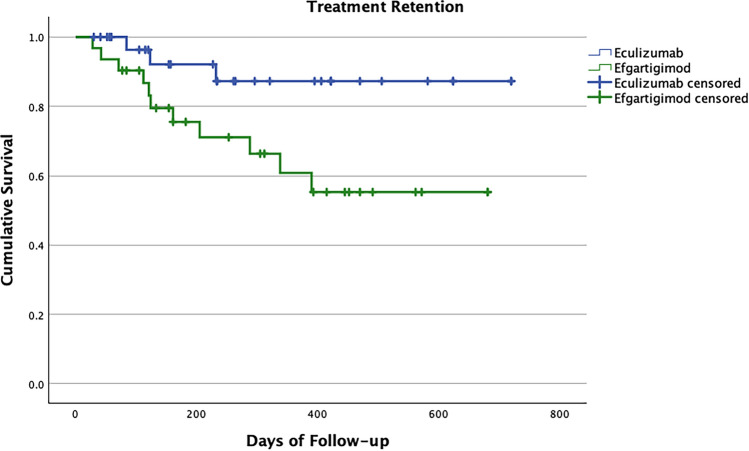
We collected baseline and follow-up clinical data using the Myasthenia Gravis-Activities of Daily Living (MG-ADL), and Quantitative Myasthenia Gravis (QMG). We included 63 patients, 32 treated with eculizumab and 31 with efgartigimod. Of the efgartigimod-treated patients, 22 were anti-acetylcholine receptor antibody-positive (AChR-Ab +) and 9 were AChR-Ab- (3 MuSK-Ab + and 6 seronegative).
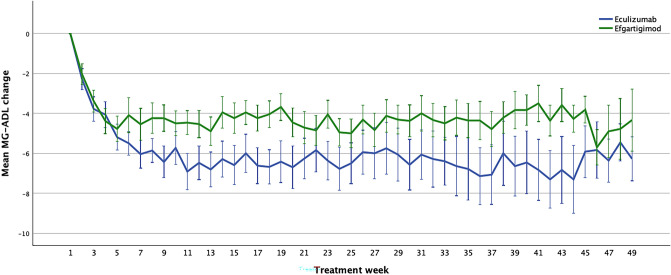
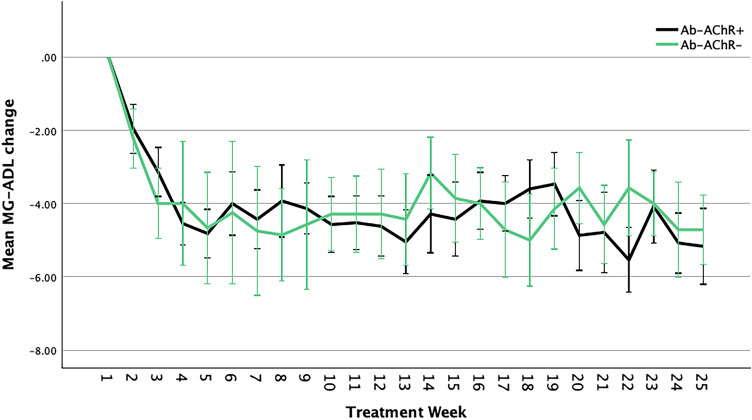
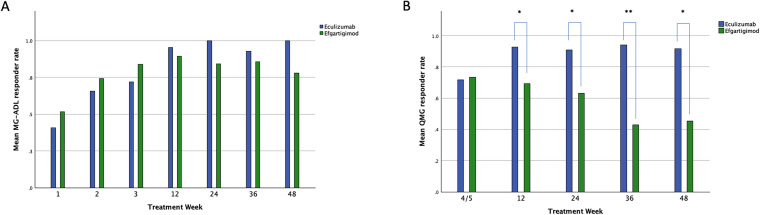
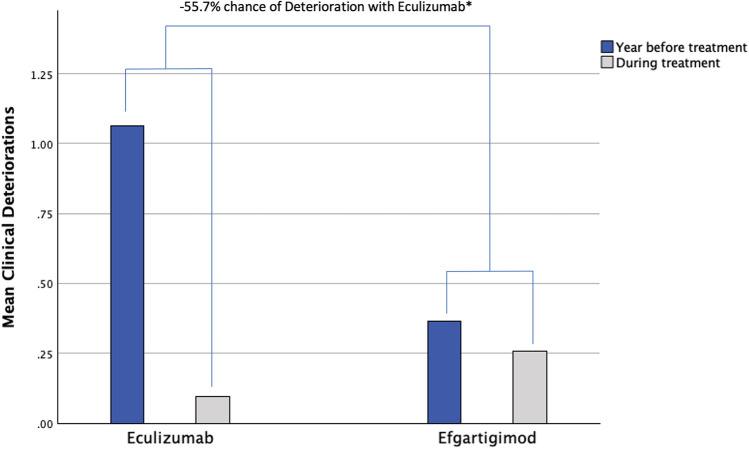
Both treatments showed similar efficacy relative to the MG-ADL scale reduction (p = 0.237). Efgartigimod had a similar effect on both AChR-Ab + and AChR-Ab- (p = 0.280). Eculizumab was superior to efgartigimod relative to the QMG score reduction for the entire dataset (p = 0.003) and was more likely to achieve a clinical response at the QMG compared to efgartigimod (OR 1.373; p = 0.016). Steroid-sparing effect was higher for eculizumab than efgartigimod ( - 16.7 vs - 5.2 mg of the baseline daily dose at follow-up; p = 0.001). Mean speed of prednisone reduction was - 13.1 mg of the daily dose for each month of follow-up for eculizumab-treated patients and - 3.2 for efgartigimod (p = 0.001). We found three serious events, all not related to treatment in the investigator's opinion. One eculizumab-treated patient experienced a severe pneumonia and died despite treatment.
Our study provides evidence that eculizumab and efgartigimod can be used in clinical practice to reduce disability in gMG patients. Eculizumab-treated patients had a higher QMG response and steroid sparing effect. Efgartigimod may offer a more flexible schedule due to its cyclical use, no need for vaccination, and efficacy in AChR-Ab- patients.
依库珠单抗是一种补体活性抗体,依氟鸟氨酸是一种阻断新生儿 Fc 受体的 Fc 片段,均已被批准用于治疗全身性重症肌无力 (gMG) 患者。本研究的目的是描述在真实环境中两种治疗方法的临床反应。
我们使用重症肌无力日常生活活动量表 (MG-ADL) 和定量重症肌无力 (QMG) 收集了 63 名患者的基线和随访临床数据。其中 32 名患者接受依库珠单抗治疗,31 名患者接受依氟鸟氨酸治疗。依氟鸟氨酸治疗的患者中,22 名为乙酰胆碱受体抗体阳性 (AChR-Ab+),9 名为 AChR-Ab- (3 名 MuSK-Ab+和 6 名血清阴性)。
两种治疗方法在 MG-ADL 量表评分降低方面均显示出相似的疗效 (p=0.237)。依氟鸟氨酸对 AChR-Ab+和 AChR-Ab-的疗效相似 (p=0.280)。依库珠单抗在整个数据集的 QMG 评分降低方面优于依氟鸟氨酸 (p=0.003),并且与依氟鸟氨酸相比,更有可能在 QMG 上获得临床反应 (OR 1.373;p=0.016)。与依氟鸟氨酸相比,依库珠单抗的类固醇节约效应更高 (在随访时,与基线每日剂量相比,分别减少了 16.7 和 5.2mg;p=0.001)。依库珠单抗治疗患者的泼尼松剂量每月减少 13.1mg,而依氟鸟氨酸治疗患者的泼尼松剂量每月减少 3.2mg(p=0.001)。我们发现了三个严重事件,根据研究者的意见,均与治疗无关。一名接受依库珠单抗治疗的患者发生严重肺炎,尽管接受了治疗,但仍死亡。
本研究提供了证据表明,依库珠单抗和依氟鸟氨酸可用于临床实践中减少 gMG 患者的残疾。依库珠单抗治疗患者的 QMG 反应和类固醇节约效应更高。依氟鸟氨酸由于其周期性使用、无需接种疫苗以及对 AChR-Ab-患者的疗效,可能提供更灵活的治疗方案。