CITTA - Research Centre for Territory, Transports and Environment, Porto, Portugal.
Department of Civil Engineering, Faculty of Engineering, University of Porto, Rua Dr. Roberto Frias S/N, 4200-465, Porto, Portugal.
Ambio. 2024 Nov;53(11):1599-1617. doi: 10.1007/s13280-024-02052-1. Epub 2024 Jul 30.
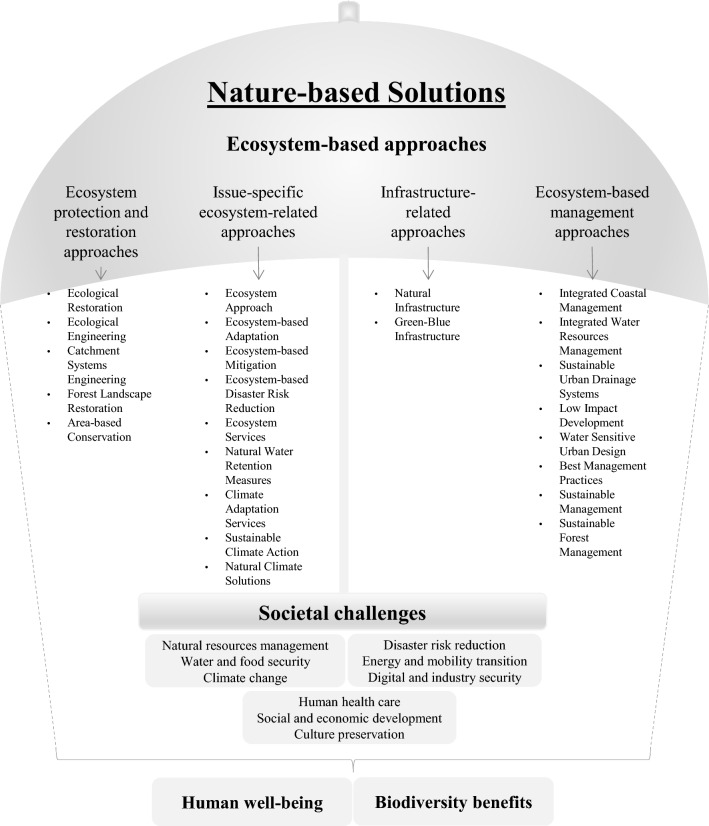
Nature-based solutions (NbSs) are recognised as relevant to spatial planning in addressing societal challenges, although their uptake is limited and fragmented to some case studies, and difficulties emerge from their implementation and operationalisation. The research developed a literature review to investigate how NbS has been considered for its implementation and operationalisation in spatial planning and how NbS has been included across different policy instruments and used to address climate change adaptation (CCA). The results highlighted: Firstly, the review contributed to bridge the gap in NbS implementation and operationalisation by proposing a novel three-dimensional categorisation system to guide the selection of suitable NbS principles to address societal challenges; secondly, this study still revealed gaps in some policy areas, despite the effort to extensively apply NbS across diverse policy instruments to CCA. Overall, the review further emphasises the need for future research focused on monitoring and evaluating NbS's effectiveness to CCA.
基于自然的解决方案(NbS)被认为与解决社会挑战的空间规划相关,尽管它们的应用有限,且局限于一些案例研究,并且在实施和运作方面存在困难。该研究进行了文献综述,以调查 NbS 在空间规划中的实施和运作方式,以及 NbS 如何被纳入不同政策工具并用于应对气候变化适应(CCA)。结果强调:首先,该综述通过提出一种新颖的三维分类系统来填补 NbS 实施和运作的空白,该系统旨在指导选择合适的 NbS 原则来解决社会挑战;其次,尽管努力将 NbS 广泛应用于各种政策工具以应对 CCA,但本研究仍揭示了一些政策领域的差距。总的来说,该综述进一步强调了未来需要关注监测和评估 NbS 对 CCA 的有效性的研究。