Division of Infectious Diseases and Tropical Medicine, Department of Medicine I, Medical University of Vienna, Vienna, Austria.
Section Biomedical Science, Health Sciences, FH Campus Wien University of Applied Sciences, Vienna, Austria.
J Antibiot (Tokyo). 2024 Nov;77(11):757-767. doi: 10.1038/s41429-024-00762-y. Epub 2024 Jul 30.
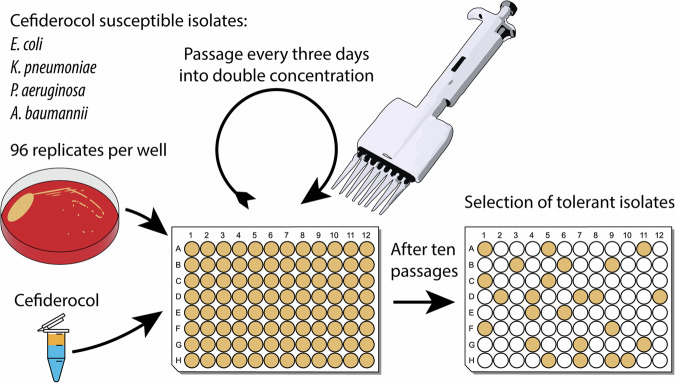
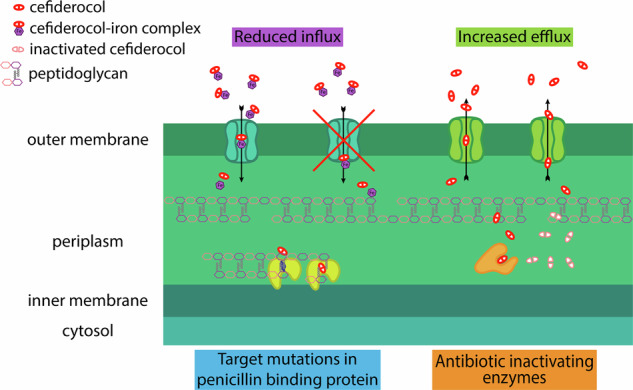
Cefiderocol, a novel siderophore cephalosporin, demonstrates promising in vitro activity against multidrug-resistant Gram-negative bacteria, including carbapenemase-producing strains. Nonetheless, only a few reports are available regarding the acquisition of resistance in clinical settings, primarily due to its recent usage. This study aimed to investigate cefiderocol resistance using an in vitro resistance development model to gain insights into the underlying molecular resistance mechanisms. Cefiderocol susceptible reference strains (Escherichia coli, Klebsiella pneumoniae, Pseudomonas aeruginosa) and a clinical Acinetobacter baumannii complex isolate were exposed to increasing cefiderocol concentrations using a high-throughput resistance development model. Cefiderocol susceptibility testing was performed using broth microdilution. Whole-genome sequencing was employed to identify newly acquired resistance mutations. Our in vitro resistance development model led to several clones of strains exhibiting cefiderocol resistance, with MIC values 8-fold to 512-fold higher than initial levels. In total, we found 42 different mutations in 26 genes, of which 35 could be described for the first time. Putative loss-of-function mutations were detected in the envZ, tonB, and cirA genes in 13 out of 17 isolates, leading to a decrease in cefiderocol influx. Other potential resistance mechanisms included multidrug efflux pumps (baeS, czcS, nalC), antibiotic-inactivating enzymes (ampR, dacB), and target mutations in penicillin-binding-protein genes (mrcB). This study reveals new insights into underlying molecular resistance mechanisms against cefiderocol. While mutations leading to reduced influx via iron transporters was the most frequent resistance mechanism, we also detected several other novel resistance mutations causing cefiderocol resistance.
头孢地尔,一种新型的铁载体头孢菌素,对多种耐药革兰氏阴性菌具有良好的体外活性,包括产碳青霉烯酶的菌株。然而,由于其使用时间较短,目前仅有少数关于临床获得性耐药的报道。本研究旨在通过体外耐药发展模型研究头孢地尔耐药性,以了解潜在的分子耐药机制。使用高通量耐药发展模型,将头孢地尔敏感的参考菌株(大肠埃希菌、肺炎克雷伯菌、铜绿假单胞菌)和临床分离的鲍曼不动杆菌复合体暴露于逐渐增加的头孢地尔浓度下。使用肉汤微量稀释法进行头孢地尔药敏试验。全基因组测序用于鉴定新获得的耐药突变。我们的体外耐药发展模型导致了一些具有头孢地尔耐药性的菌株克隆,其 MIC 值比初始水平高 8 倍至 512 倍。总共在 26 个基因中发现了 42 个不同的突变,其中 35 个可以首次描述。在 17 个分离株中的 13 个中检测到 envZ、tonB 和 cirA 基因的推定功能丧失突变,导致头孢地尔摄取减少。其他潜在的耐药机制包括多药外排泵(baeS、czcS、nalC)、抗生素失活酶(ampR、dacB)和青霉素结合蛋白基因(mrcB)的靶突变。本研究揭示了头孢地尔耐药性的新的分子耐药机制。虽然导致通过铁转运蛋白减少摄取的突变是最常见的耐药机制,但我们也检测到其他几种导致头孢地尔耐药的新耐药突变。