Hara Aki, Lu Eric, Johnstone Laurel, Wei Michelle, Sun Shudong, Hallmark Brian, Watkins Joseph C, Zhang Hao Helen, Yao Guang, Chilton Floyd H
School of Nutritional Sciences and Wellness, College of Agriculture and Life Sciences, The University of Arizona, Tucson, AZ, USA.
Department of Molecular and Cellular Biology, The University of Arizona, Tucson, AZ, USA.
Bioinform Biol Insights. 2024 Jul 30;18:11779322241261427. doi: 10.1177/11779322241261427. eCollection 2024.
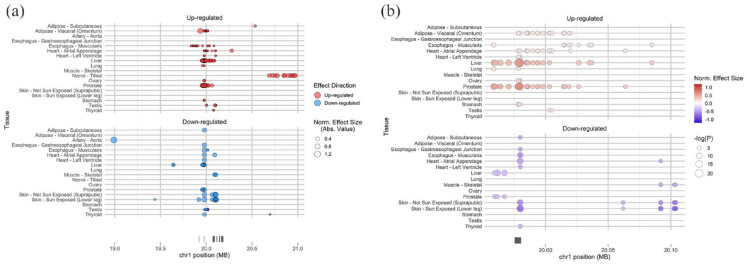
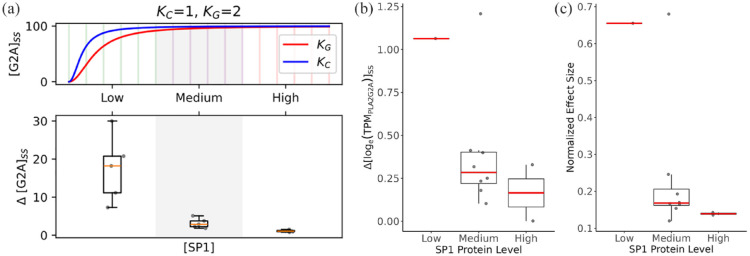
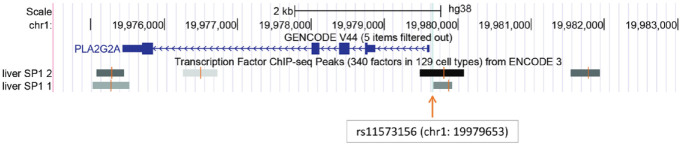
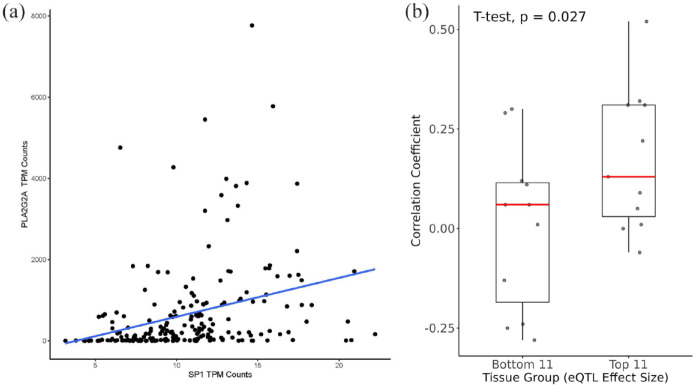
The secreted phospholipase A (sPLA) isoform, sPLA-IIA, has been implicated in a variety of diseases and conditions, including bacteremia, cardiovascular disease, COVID-19, sepsis, adult respiratory distress syndrome, and certain cancers. Given its significant role in these conditions, understanding the regulatory mechanisms impacting its levels is crucial. Genome-wide association studies (GWAS) have identified several single nucleotide polymorphisms (SNPs), including rs11573156, that are associated with circulating levels of sPLA-IIA. The work in the manuscript leveraged 4 publicly available datasets to investigate the mechanism by which rs11573156 influences sPLA-IIA levels via bioinformatics and modeling analysis. Through genotype-tissue expression (GTEx), 234 expression quantitative trait loci (eQTLs) were identified for the gene that encodes for sPLA-IIA, . SNP2TFBS was used to ascertain the binding affinities between transcription factors (TFs) to both the reference and alternative alleles of identified eQTL SNPs. Subsequently, candidate TF-SNP interactions were cross-referenced with the ChIP-seq results in matched tissues from ENCODE. SP1-rs11573156 emerged as the significant TF-SNP pair in the liver. Further analysis revealed that the upregulation of transcript levels through the rs11573156 variant was likely affected by tissue SP1 protein levels. Using an ordinary differential equation based on Michaelis-Menten kinetic assumptions, we modeled the dependence of transcription on SP1 protein levels, incorporating the SNP influence. Collectively, our analysis strongly suggests that the difference in the binding dynamics of SP1 to different rs11573156 alleles may underlie the allele-specific PLA2G2A expression in different tissues, a mechanistic model that awaits future direct experimental validation. This mechanism likely contributes to the variation in circulating sPLA-IIA protein levels in the human population, with implications for a wide range of human diseases.
分泌型磷脂酶A(sPLA)同工型sPLA-IIA与多种疾病和病症有关,包括菌血症、心血管疾病、COVID-19、败血症、成人呼吸窘迫综合征和某些癌症。鉴于其在这些病症中的重要作用,了解影响其水平的调节机制至关重要。全基因组关联研究(GWAS)已经确定了几个单核苷酸多态性(SNP),包括rs11573156,它们与sPLA-IIA的循环水平相关。该手稿中的工作利用了4个公开可用的数据集,通过生物信息学和建模分析来研究rs11573156影响sPLA-IIA水平的机制。通过基因型-组织表达(GTEx),为编码sPLA-IIA的基因确定了234个表达定量性状位点(eQTL)。SNP2TFBS用于确定转录因子(TF)与已确定的eQTL SNP的参考等位基因和替代等位基因之间的结合亲和力。随后,将候选TF-SNP相互作用与来自ENCODE的匹配组织中的ChIP-seq结果进行交叉参考。SP1-rs11573156在肝脏中成为显著的TF-SNP对。进一步分析表明,通过rs11573156变体上调转录水平可能受组织SP1蛋白水平影响。我们使用基于米氏动力学假设的常微分方程,对转录对SP1蛋白水平的依赖性进行建模,并纳入SNP影响。总体而言,我们的分析强烈表明,SP1与不同rs11573156等位基因结合动力学的差异可能是不同组织中等位基因特异性PLA2G2A表达的基础,这一机制模型有待未来直接实验验证。这种机制可能导致人群中循环sPLA-IIA蛋白水平的差异,对广泛的人类疾病具有影响。