Krumholz Harlan M, de Lemos James A, Sattar Naveed, Linetzky Bruno, Sharma Palash, Mast Casey J, Ahmad Nadia N, Bunck Mathijs C, Stefanski Adam
Section of Cardiovascular Medicine, Department of Internal Medicine, Yale School of Medicine, New Haven, Connecticut, USA
Department of Health Policy and Management, Yale School of Public Health, New Haven, Connecticut, USA.
Heart. 2024 Sep 16;110(19):1165-1171. doi: 10.1136/heartjnl-2024-324170.
Treating obesity may be a pathway to prevent and control hypertension. In the SURMOUNT-1 trial in people with obesity or overweight with weight-related complications, 72-week tirzepatide treatment led to clinically meaningful body weight and blood pressure reduction. Post hoc analyses were conducted to further explore the effects of tirzepatide on the pattern of blood pressure reduction and whether the effects were consistent across various subgroups.
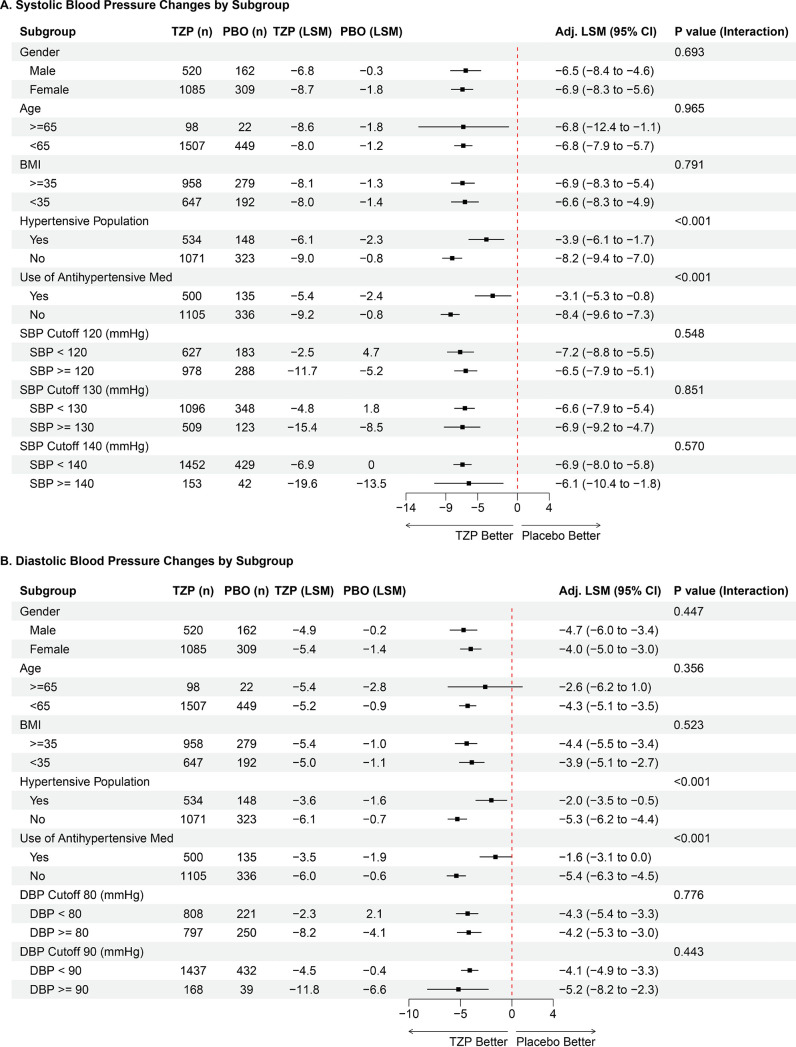
The mixed effect for repeated measure model was used to compare changes in overall blood pressure, across demographic and clinical subgroups, baseline blood pressure subgroups and hypertension categories between SURMOUNT-1 participants randomised to treatment with tirzepatide and placebo. The association between weight changes and blood pressure and adverse events associated with low blood pressure were also evaluated by mediation analysis.
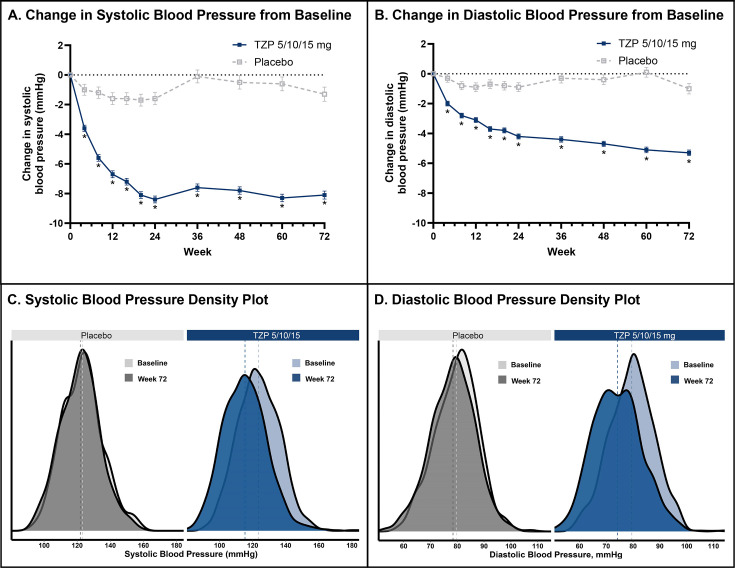
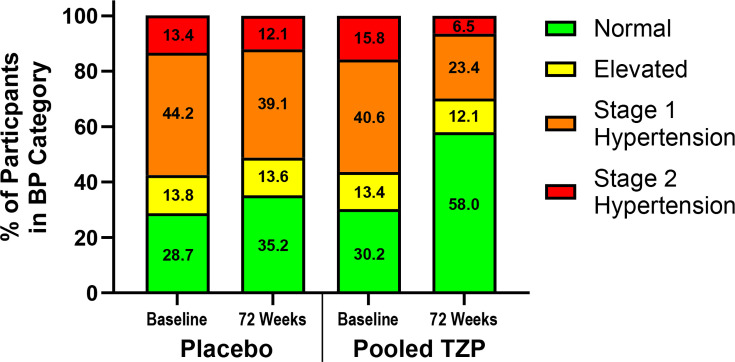
Tirzepatide treatment was associated with a rapid decline in systolic and diastolic blood pressure over the first 24 weeks, followed by blood pressure stabilisation until the end of the observation period, resulting in a significant net reduction by 72 weeks of 6.8 mm Hg systolic and 4.2 mm Hg diastolic blood pressure versus placebo. Participants randomly assigned to any tirzepatide group were more likely than those assigned to placebo to have normal blood pressure at week 72 (58.0% vs 35.2%, respectively). The effects were broadly consistent across baseline blood pressure subgroups, shifting the blood pressure distribution curve to lower blood pressure levels. The mediation analysis indicated that weight loss explained 68% of the systolic and 71% of the diastolic blood pressure reduction. Low blood pressure adverse events were infrequent, but the rate was higher in the tirzepatide group.
In these post hoc analyses, in participants with obesity or overweight, tirzepatide was associated with reduced blood pressure consistently across participant groups primarily via weight loss, with relatively few blood pressure-related adverse events.
NCT04184622.
治疗肥胖可能是预防和控制高血压的一条途径。在一项针对患有肥胖症或超重且伴有体重相关并发症患者的SURMOUNT - 1试验中,72周的替尔泊肽治疗使体重和血压实现了具有临床意义的降低。进行了事后分析,以进一步探究替尔泊肽对血压降低模式的影响,以及这些影响在各个亚组中是否一致。
采用重复测量的混合效应模型,比较SURMOUNT - 1试验中随机接受替尔泊肽治疗和安慰剂治疗的参与者在总体血压、不同人口统计学和临床亚组、基线血压亚组以及高血压类别方面的变化。还通过中介分析评估了体重变化与血压之间的关联以及与低血压相关的不良事件。
替尔泊肽治疗在最初24周内与收缩压和舒张压的快速下降相关,随后血压稳定直至观察期结束,与安慰剂相比,72周时收缩压显著净降低6.8 mmHg,舒张压显著净降低4.2 mmHg。随机分配到任何替尔泊肽组的参与者在第72周时血压正常的可能性高于分配到安慰剂组的参与者(分别为58.0%和35.2%)。这些影响在基线血压亚组中大致一致,将血压分布曲线向更低血压水平移动。中介分析表明,体重减轻解释了收缩压降低的68%和舒张压降低的71%。低血压不良事件很少见,但替尔泊肽组的发生率更高。
在这些事后分析中,在肥胖或超重参与者中,替尔泊肽主要通过体重减轻在各参与者组中均与血压降低相关,且与血压相关的不良事件相对较少。
NCT04184622。