Guo Song, Rasmussen Rikke Holm, Hay-Schmidt Anders, Ashina Messoud, Asuni Ayodeji A, Jensen Jeppe Møller, Holm Anja, Lauritzen Sabrina Prehn, Dorsam Glenn, Hannibal Jens, Georg Birgitte, Kristensen David Møbjerg, Olesen Jes, Christensen Sarah Louise
Department of Neurology, Danish Headache Center, Copenhagen University Hospital - Rigshospitalet Glostrup, Copenhagen, Denmark.
Translational Research Centre (TRACE), Copenhagen University Hospital, Rigshospitalet, Glostrup, Denmark.
J Headache Pain. 2024 Jul 31;25(1):126. doi: 10.1186/s10194-024-01830-2.
Pituitary adenylate cyclase-activating peptide (PACAP) is a neuropeptide pivotal in migraine pathophysiology and is considered a promising new migraine drug target. Although intravenous PACAP triggers migraine attacks and a recent phase II trial with a PACAP-inhibiting antibody showed efficacy in migraine prevention, targeting the PACAP receptor PAC1 alone has been unsuccessful. The present study investigated the role of three PACAP receptors (PAC1, VPAC1 and VPAC2) in inducing migraine-relevant hypersensitivity in mice.
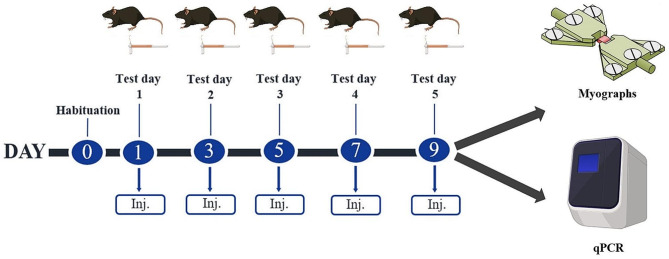
Hindpaw hypersensitivity was induced by repeated PACAP38 injections. Tactile sensitivity responses were quantified using von Frey filaments in three knockout (KO) mouse strains, each lacking one of the PACAP-receptors (N = 160). Additionally, ex vivo wire myography was used to assess vasoactivity of the carotid artery, and gene expression of PACAP receptors was examined by qPCR.
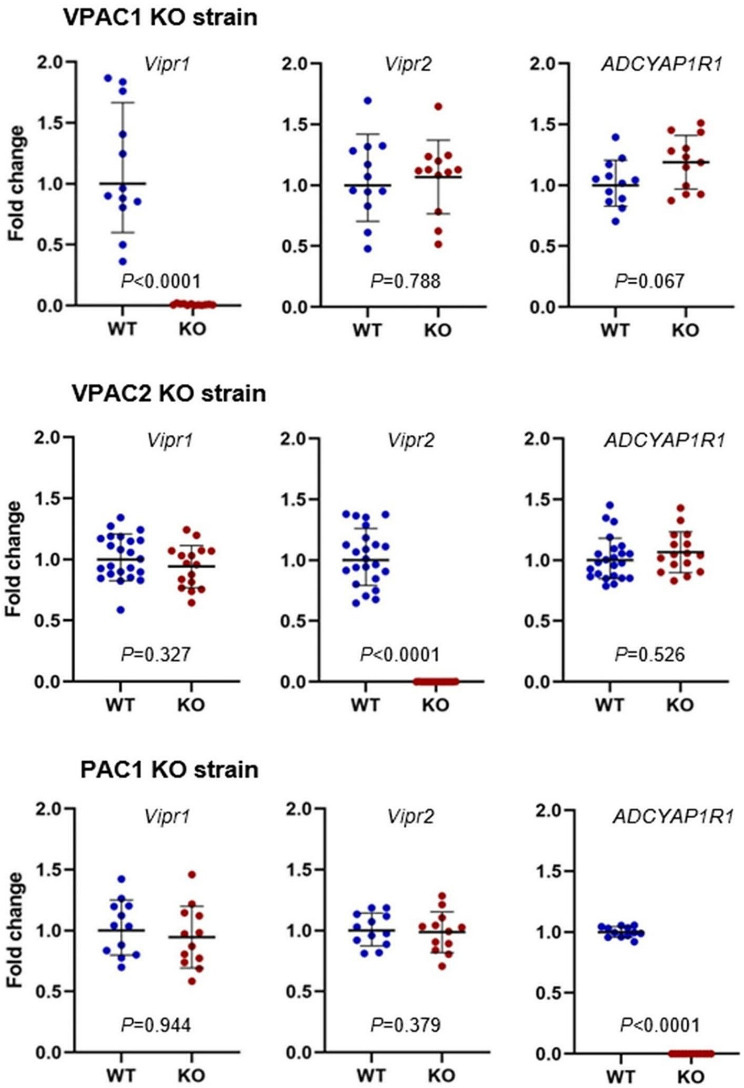
PACAP38 induced hypersensitivity in WT controls (p < 0.01) that was diminished in VPAC1 and VPAC2 KO mice (p < 0.05). In contrast, PAC1 KO mice showed similar responses to WT controls (p > 0.05). Myograph experiments supported these findings showing diminished vasoactivity in VPAC1 and VPAC2 KO mice. We found no upregulation of the non-modified PACAP receptors in KO mice.
This study assessed all three PACAP receptors in a migraine mouse model and suggests a significant role of VPAC receptors in migraine pathophysiology. The lack of hypersensitivity reduction in PAC1 KO mice suggests the involvement of other PACAP receptors or compensatory mechanisms. The results indicate that targeting only individual PACAP receptors may not be an effective migraine treatment.
垂体腺苷酸环化酶激活肽(PACAP)是偏头痛病理生理学中的一种关键神经肽,被认为是一个有前景的新型偏头痛药物靶点。尽管静脉注射PACAP会引发偏头痛发作,并且最近一项使用PACAP抑制抗体的II期试验显示其在预防偏头痛方面有效,但单独靶向PACAP受体PAC1并不成功。本研究调查了三种PACAP受体(PAC1、VPAC1和VPAC2)在诱导小鼠偏头痛相关超敏反应中的作用。
通过重复注射PACAP38诱导后爪超敏反应。使用von Frey细丝在三种基因敲除(KO)小鼠品系中对触觉敏感性反应进行量化,每种品系缺失一种PACAP受体(N = 160)。此外,使用离体钢丝肌动描记法评估颈动脉的血管活性,并通过qPCR检测PACAP受体的基因表达。
PACAP38在野生型(WT)对照组中诱导超敏反应(p < 0.01),在VPAC1和VPAC2基因敲除小鼠中这种超敏反应减弱(p < 0.05)。相比之下,PAC1基因敲除小鼠表现出与野生型对照组相似的反应(p > 0.05)。肌动描记实验支持了这些发现,显示VPAC1和VPAC2基因敲除小鼠的血管活性降低。我们在基因敲除小鼠中未发现未修饰的PACAP受体上调。
本研究在偏头痛小鼠模型中评估了所有三种PACAP受体,并表明VPAC受体在偏头痛病理生理学中起重要作用。PAC1基因敲除小鼠中超敏反应未降低,提示其他PACAP受体或代偿机制的参与。结果表明仅靶向单个PACAP受体可能不是一种有效的偏头痛治疗方法。