Wang Yu-Wen, Yang Xu-Hong, Zheng Xin-Hui, Zhou Gao-Shui, Zhao Xiao-Xia, Zhao Yi-Lan, Wu Shu-Hong
Chengdu University of Traditional Chinese Medicine, Chengdu, Sichuan, China.
Chongqing Beibei District Hospital of Traditional Chinese Medicine, Chongqing, China.
Front Neurol. 2025 Apr 3;16:1548522. doi: 10.3389/fneur.2025.1548522. eCollection 2025.
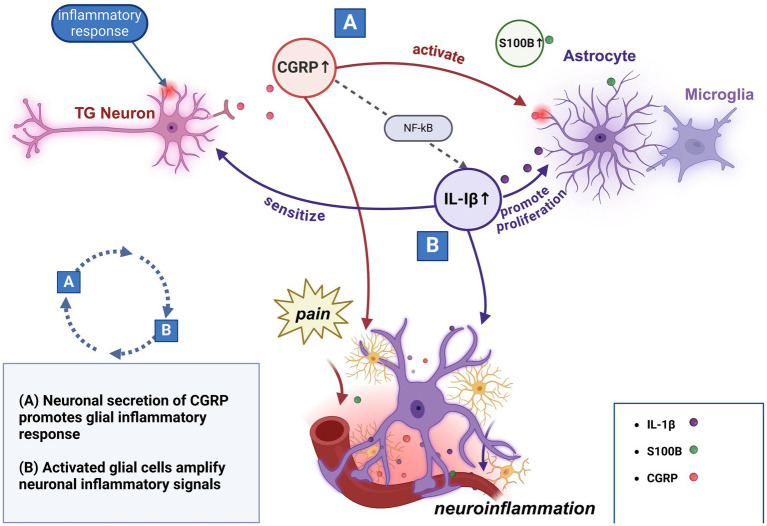
Cluster headache (CH) is often referred to as the 'suicide headache.' Existing research suggests that the activation of the trigeminal-vascular system, increased sensitivity of nerve fibers, and the release and interaction of various neuropeptides and inflammatory mediators may contribute to neurogenic inflammation, which serves as a crucial pathophysiological basis for the development of CH. Additionally, some neuropeptides can modulate neuronal activity related to pain transmission and may increase pain perception by sensitizing central nerves. This review discusses the neuropeptides and inflammatory mediators associated with CH neuroinflammation, focusing on calcitonin gene-related peptide (CGRP), inflammatory cytokines and related signaling pathways, nitric oxide (NO), pituitary adenylate cyclase-activating peptide 38 (PACAP-38), and vasoactive intestinal peptide (VIP), incorporating both preclinical and clinical evidence to provide new insights into potential therapeutic targets for CH.
丛集性头痛(CH)常被称为“自杀性头痛”。现有研究表明,三叉神经血管系统的激活、神经纤维敏感性增加以及各种神经肽和炎症介质的释放与相互作用可能导致神经源性炎症,这是丛集性头痛发病的关键病理生理基础。此外,一些神经肽可调节与疼痛传递相关的神经元活动,并可能通过使中枢神经敏感化来增加疼痛感知。本综述讨论了与丛集性头痛神经炎症相关的神经肽和炎症介质,重点关注降钙素基因相关肽(CGRP)、炎性细胞因子及相关信号通路、一氧化氮(NO)、垂体腺苷酸环化酶激活肽38(PACAP - 38)和血管活性肠肽(VIP),结合临床前和临床证据,为丛集性头痛的潜在治疗靶点提供新见解。