Wu Diana A, Lang Peter, Varghese David, Al-Attar Nawwar, Shaikhrezai Kasra, Zamvar Vipin, Nair Sukumaran
Golden Jubilee National Hospital, Agamemnon Street, Glasgow, G81 4DY, UK.
Royal Infirmary of Edinburgh, 51 Little France Crescent, Old Dalkeith Road, Edinburgh, EH16 4SA, UK.
J Cardiothorac Surg. 2024 Jul 31;19(1):474. doi: 10.1186/s13019-024-02970-x.
With the introduction of transcatheter aortic valve implantation, the role of surgical aortic valve replacement (SAVR) in elderly patients has been called into question. We investigated the short-term outcomes of SAVR in the elderly population.
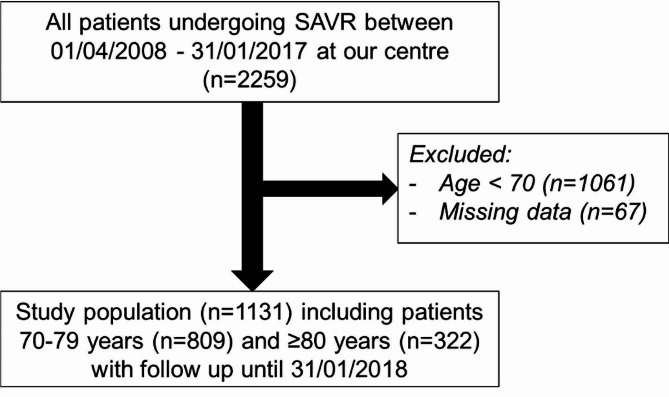
All patients aged ≥ 70 years who underwent isolated SAVR in our centre between 2008 and 2017 were included in the study. Survival at 30 days and 1 year were compared for patients aged 70-79 years (n = 809) versus patients aged ≥ 80 years (n = 322). Factors associated with poorer survival outcomes were identified using multivariable Cox regression analysis.
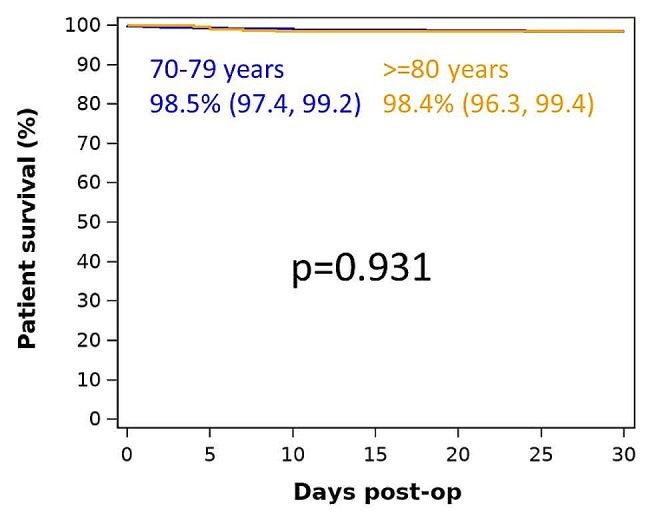
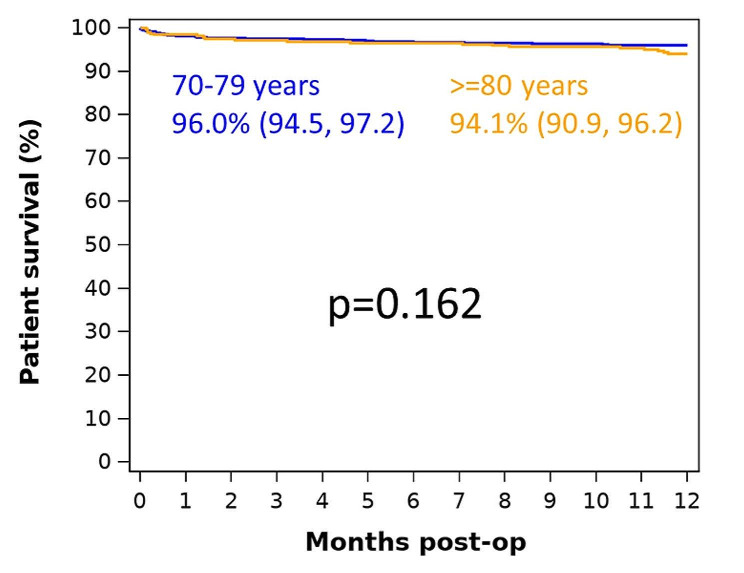
Patients aged 70-79 years and patients aged ≥ 80 years had similar survival rates at 30 days (98.1% vs. 98.4%, p = 0.732) and 1 year (96.0% vs. 94.1%, p = 0.162) post-SAVR. This remained true after multivariable adjustment. Risk factors for 30 day all-cause mortality included insulin dependent diabetes (HR 6.17, 95% CI 1.32-28.92, p = 0.021) and increasing cardiopulmonary bypass time (HR 2.72, 95% CI 1.89-3.91, p < 0.0001). Significant risk factors for 1 year all-cause mortality were New York Heart Association (NYHA) class IV (HR 6.25, 95% CI 1.55-25.24, p = 0.010) and longer cardiopulmonary bypass time (HR 1.94, 95% CI 1.40-2.69, p < 0.0001). Similar results were obtained for cardiac-specific mortality.
Short-term outcomes of SAVR are excellent in elderly patients and age alone is not a predictor of poorer outcomes. However, the increased risk of mortality in patients with insulin-dependent diabetes and those with severe functional impairment (NYHA class IV) should be carefully considered when selecting patients for SAVR in this elderly population.
随着经导管主动脉瓣植入术的引入,外科主动脉瓣置换术(SAVR)在老年患者中的作用受到质疑。我们调查了老年人群中SAVR的短期结果。
纳入2008年至2017年在我们中心接受单纯SAVR的所有年龄≥70岁的患者。比较70 - 79岁患者(n = 809)与≥80岁患者(n = 322)的30天和1年生存率。使用多变量Cox回归分析确定与较差生存结果相关的因素。
70 - 79岁患者和≥80岁患者在SAVR术后30天(98.1%对98.4%,p = 0.732)和1年(96.0%对94.1%,p = 0.162)的生存率相似。多变量调整后依然如此。30天全因死亡率的危险因素包括胰岛素依赖型糖尿病(HR 6.17,95% CI 1.32 - 28.92,p = 0.021)和体外循环时间延长(HR 2.72,95% CI 1.89 - 3.91,p < 0.0001)。1年全因死亡率的显著危险因素是纽约心脏协会(NYHA)IV级(HR 6.25,95% CI 1.55 - 25.24,p = 0.010)和体外循环时间延长(HR 1.94,95% CI 1.40 - 2.69,p < 0.0001)。心脏特异性死亡率也得到了类似结果。
SAVR在老年患者中的短期结果良好,仅年龄并非较差结果的预测因素。然而,在为该老年人群选择SAVR患者时,应仔细考虑胰岛素依赖型糖尿病患者和严重功能障碍(NYHA IV级)患者死亡率增加的风险。