
经皮电刺激神经疗法与经皮耳迷走神经刺激对无痛受试者压力和热痛阈值的联合作用:一项随机交叉试验。
The combined effect of transcutaneous electrical nerve stimulation and transcutaneous auricular vagus nerve stimulation on pressure and heat pain thresholds in pain-free subjects: a randomized cross-over trial.
作者信息
Liebano Richard E, Awad Noura, Bellino Christopher, Bray Katherine, Rosentrater Heidi, Roy Joshua, Tate Camryn
机构信息
Department of Rehabilitation Sciences, University of Hartford, 200 Bloomfield Avenue, West Hartford, CT, 06117, USA.
出版信息
Trials. 2024 Jul 31;25(1):516. doi: 10.1186/s13063-024-08352-x.
BACKGROUND
Transcutaneous electrical nerve stimulation (TENS) is a non-invasive modality that utilizes electrical currents to modulate pain in populations with acute and chronic pain. TENS has been demonstrated to produce hypoalgesic effects in postoperative pain, fibromyalgia, knee osteoarthritis, and healthy subjects. Transcutaneous auricular vagus nerve stimulation (TaVNS) is a non-invasive modality that modulates the vagus nerve by stimulating its auricular branches. The effects of the combination of TENS and TaVNS on producing an analgesic response have not been studied. Considering that TENS and TaVNS both stimulate similar analgesic pathways but through different means of activation, we can hypothesize that a combination of both methods can produce a more pronounced analgesic response. Therefore, the objective of this study is to assess the hypoalgesic effect of a combination of TENS and TaVNS in pain-free subjects.
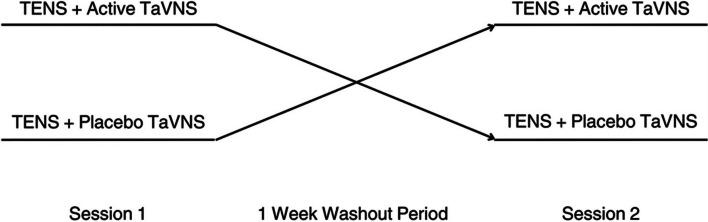
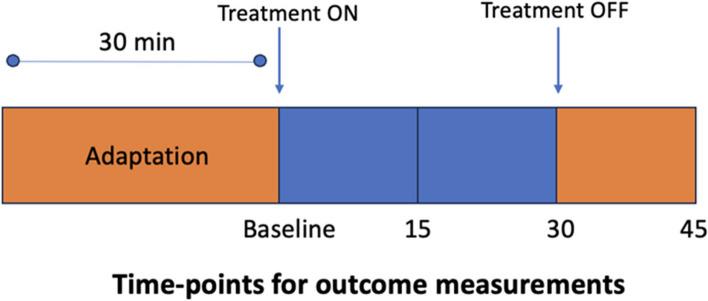
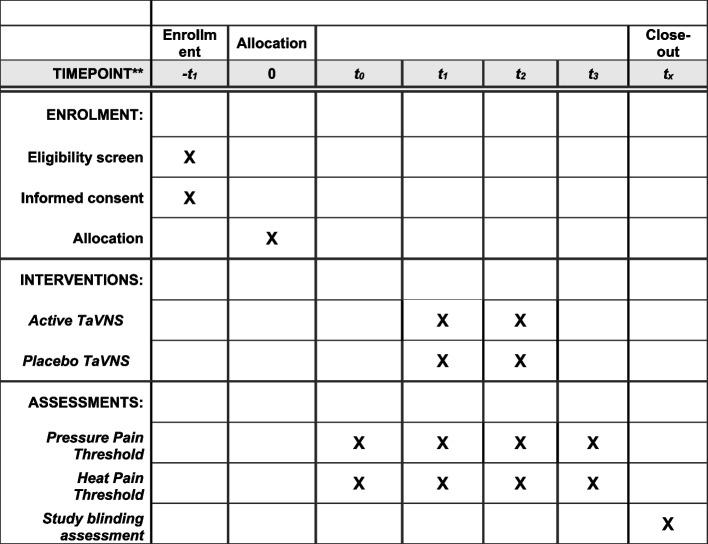
METHODS/DESIGN: The study will be a simple crossover design conducted at the University of Hartford. Subjects will be recruited from the University of Hartford population via oral communication, digital flyers, and posters on campus. Thirty participants will undergo two sessions in a crossover manner with one week in between. During one session, the participants will receive TENS with active TaVNS and the other session will be a placebo procedure (TENS with placebo TaVNS). The order of these sessions will be randomized. Importantly, the pressure pain threshold (PPT) and heat pain threshold (HPT) assessors will be blinded to the treatment category. For active TaVNS, a frequency of 25 Hz will be applied with a pulse duration of 200 µs. For placebo TaVNS, the intensity will be increased to a sensory level and then decreased to 0 mA. High-frequency TENS of 100 Hz will be applied in both sessions, with a pulse duration of 200 µsec, asymmetrical biphasic square waveform, and intensity of maximal tolerance without pain. TENS and TaVNS will be turned on for 30 min after a baseline measurement of outcomes. TENS and TaVNS will then be turned off, but the electrodes will remain on until completion of post-treatment assessment. Pressure pain threshold, heat pain threshold, blood pressure, oxygen saturation, and heart rate will be tested 4 times: Once pre-intervention, once during intervention, once immediately after the intervention, and once 15 min post-intervention. Statistical analysis of the data obtained will consider a significance level of p < 0.05.
DISCUSSION
This study will provide evidence concerning the combined effects of TENS and TaVNS on pain threshold in pain-free participants. Based on the outcomes, a greater understanding of how TENS and TaVNS, when used in conjunction, can modulate pain pathways.
TRIAL REGISTRATION
ClinicalTrials.gov NCT06361381. Registered on 09 April 2024.
背景
经皮电刺激神经疗法(TENS)是一种非侵入性治疗方法,利用电流调节急慢性疼痛患者的疼痛。TENS已被证明在术后疼痛、纤维肌痛、膝骨关节炎以及健康受试者中能产生镇痛效果。经皮耳迷走神经刺激(TaVNS)是一种非侵入性治疗方法,通过刺激耳支来调节迷走神经。TENS与TaVNS联合产生镇痛反应的效果尚未得到研究。鉴于TENS和TaVNS都刺激相似的镇痛途径,但激活方式不同,我们可以推测两种方法联合使用能产生更显著的镇痛反应。因此,本研究的目的是评估TENS与TaVNS联合在无痛受试者中的镇痛效果。
方法/设计:本研究将在哈特福德大学进行简单交叉设计。通过口头交流、数字传单和校园海报从哈特福德大学人群中招募受试者。30名参与者将以交叉方式进行两个疗程,中间间隔一周。在一个疗程中,参与者将接受TENS与有源TaVNS治疗,另一个疗程将采用安慰剂程序(TENS与安慰剂TaVNS)。这些疗程的顺序将随机安排。重要的是,压力痛阈(PPT)和热痛阈(HPT)评估者将对治疗类别不知情。对于有源TaVNS,将施加25Hz的频率,脉冲持续时间为200µs。对于安慰剂TaVNS,强度将增加到感觉水平,然后降至0mA。两个疗程均采用100Hz的高频TENS,脉冲持续时间为200µsec,不对称双相方波,强度为无疼痛的最大耐受强度。在对结果进行基线测量后,TENS和TaVNS将开启30分钟。然后关闭TENS和TaVNS,但电极将保留直至完成治疗后评估。压力痛阈、热痛阈、血压、血氧饱和度和心率将测试4次:干预前一次、干预期间一次、干预后立即一次以及干预后15分钟一次。对获得的数据进行统计分析时将考虑p < 0.05的显著性水平。
讨论
本研究将提供关于TENS与TaVNS联合对无痛参与者痛阈影响的证据。基于研究结果,能更深入了解TENS和TaVNS联合使用时如何调节疼痛通路。
试验注册
ClinicalTrials.gov NCT06361381。于2024年4月9日注册。
 Zotero 插件