Department of Internal Medicine, Seoul National University College of Medicine, Seoul, Korea.
Department of Internal Medicine, Hallym University Dongtan Sacred Heart Hospital, College of Medicine, Hallym University, Hwaseong, Korea.
Endocrinol Metab (Seoul). 2024 Aug;39(4):622-631. doi: 10.3803/EnM.2024.1965. Epub 2024 Aug 1.
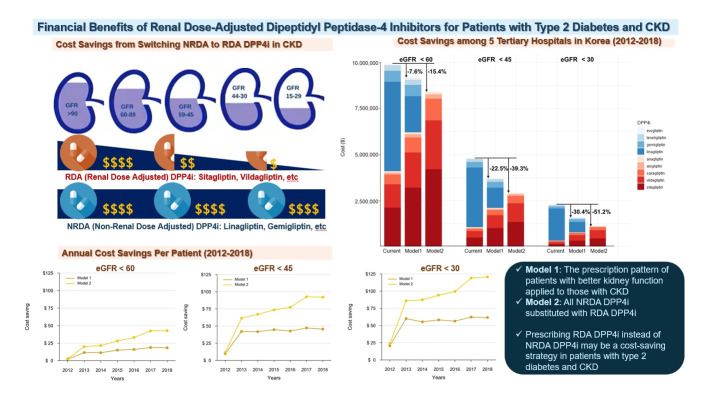
Dipeptidyl peptidase-4 (DPP4) inhibitors are frequently prescribed for patients with type 2 diabetes; however, their cost can pose a significant barrier for those with impaired kidney function. This study aimed to estimate the economic benefits of substituting non-renal dose-adjusted (NRDA) DPP4 inhibitors with renal dose-adjusted (RDA) DPP4 inhibitors in patients with both impaired kidney function and type 2 diabetes.
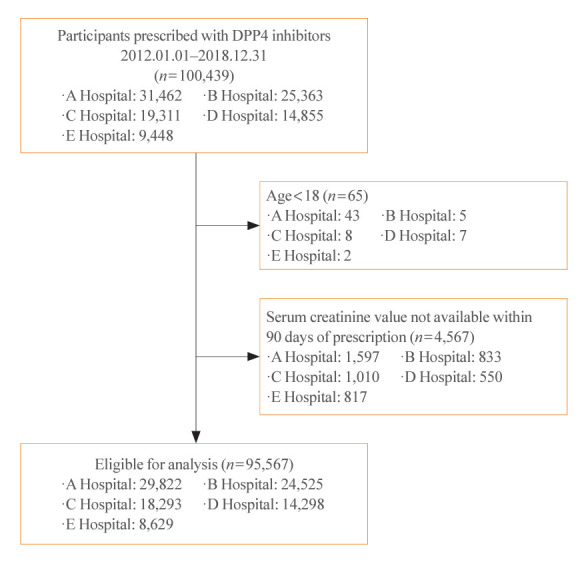
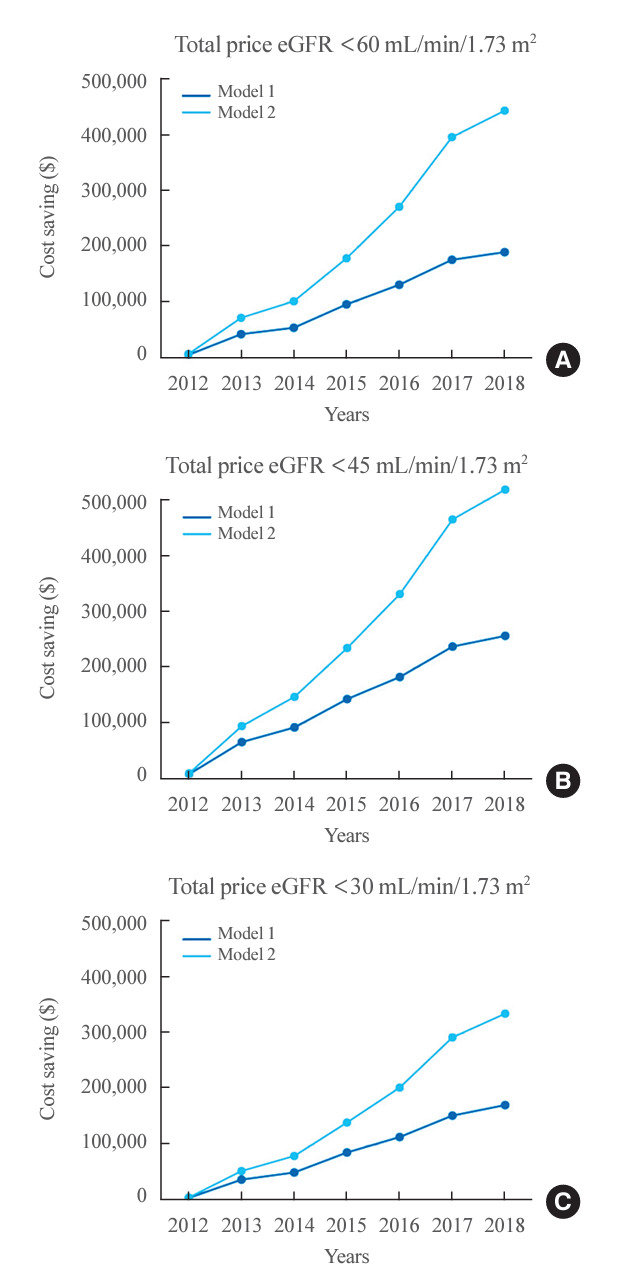
This retrospective cohort study was conducted from January 1, 2012 to December 31, 2018, using data obtained from common data models of five medical centers in Korea. Model 1 applied the prescription pattern of participants with preserved kidney function to those with impaired kidney function. In contrast, model 2 replaced all NRDA DPP4 inhibitors with RDA DPP4 inhibitors, adjusting the doses of RDA DPP4 inhibitors based on individual kidney function. The primary outcome was the cost difference between the two models.
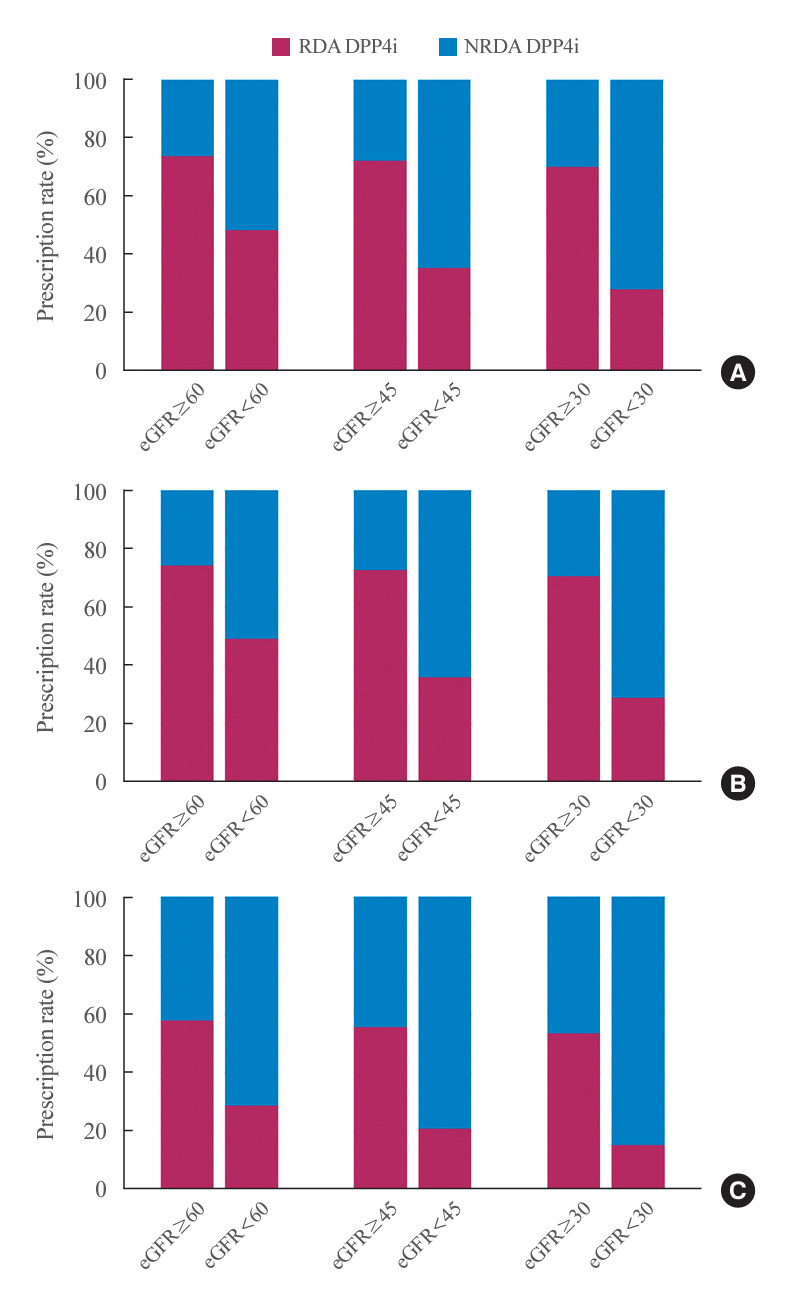
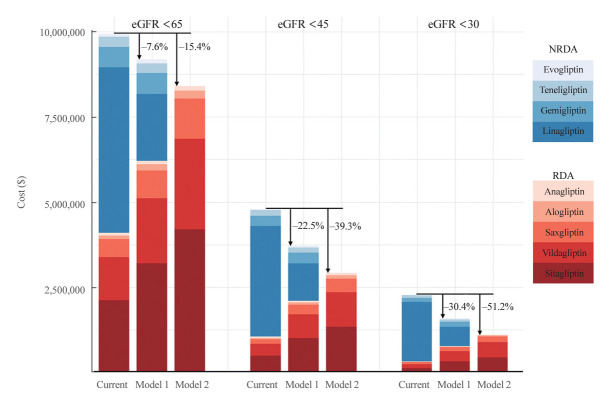
In total, 67,964,996 prescription records were analyzed. NRDA DPP4 inhibitors were more frequently prescribed to patients with impaired kidney function than in those with preserved kidney function (25.7%, 51.3%, 64.3%, and 71.6% in patients with estimated glomerular filtration rates [eGFRs] of ≥60, <60, <45, and <30 mL/min/1.73 m2, respectively). When model 1 was applied, the cost savings per year were 7.6% for eGFR <60 mL/min/1.73 m2 and 30.4% for eGFR <30 mL/min/1.73 m2. According to model 2, 15.4% to 51.2% per year could be saved depending on kidney impairment severity.
Adjusting the doses of RDA DPP4 inhibitors based on individual kidney function could alleviate the economic burden associated with medical expenses.
二肽基肽酶-4(DPP4)抑制剂常用于治疗 2 型糖尿病患者,但对于肾功能受损的患者来说,其费用可能是一个重大障碍。本研究旨在评估在肾功能受损和 2 型糖尿病患者中,用肾剂量调整(RDA)DPP4 抑制剂替代非肾剂量调整(NRDA)DPP4 抑制剂的经济效益。
这是一项回顾性队列研究,于 2012 年 1 月 1 日至 2018 年 12 月 31 日期间在韩国的五家医疗中心的共同数据模型中进行。模型 1 将肾功能正常患者的处方模式应用于肾功能受损患者。相反,模型 2 用 RDA DPP4 抑制剂替代所有 NRDA DPP4 抑制剂,根据个体肾功能调整 RDA DPP4 抑制剂的剂量。主要结果是两种模型之间的成本差异。
共分析了 67964996 份处方记录。与肾功能正常患者相比,NRDA DPP4 抑制剂在肾功能受损患者中更常被开处方(肾小球滤过率[eGFR]≥60、<60、<45 和<30 mL/min/1.73 m2的患者中,分别为 25.7%、51.3%、64.3%和 71.6%)。当应用模型 1 时,eGFR <60 mL/min/1.73 m2 的年成本节约为 7.6%,eGFR <30 mL/min/1.73 m2 的年成本节约为 30.4%。根据模型 2,每年可节省 15.4%至 51.2%,具体取决于肾功能受损的严重程度。
根据个体肾功能调整 RDA DPP4 抑制剂的剂量可以减轻与医疗费用相关的经济负担。