Priyatha Vemparala, Gupta Hemaakshi, Narsapuram Pavani, Ahmed Fatima, Alhussain Haitham, Arfa Ania, Taha Hussain Mohammed, Abyad Eltayeb Adnan Abdelrahman, Abdul Mateen Mohd, Prajjwal Priyadarshi
Internal Medicine, All India Institute of Medical Sciences, Bhubaneswar, Bhubaneswar, IND.
Medicine, American University of the Caribbean, Cupecoy, SXM.
Cureus. 2024 Jul 1;16(7):e63594. doi: 10.7759/cureus.63594. eCollection 2024 Jul.
Head and neck squamous cell carcinoma (HNSCC) represents a group of cancers characterized by diverse origins and changing epidemiological patterns. The significance of high-risk human papillomavirus (HPV) infection in certain HNSCC cases has gained attention for its impact on the disease's behavior. Our current research focused on exploring the importance of using p16 as an HNSCC biomarker, particularly in the context of HPV infection, assessing its value in prognosis, and examining its variation across different tumor locations.
A retrospective analysis was carried out on 100 HNSCC patients from a tertiary care center, with particular attention paid to p16 expression, HPV status, clinic-pathological characteristics, and prognosis. HPV was detected using polymerase chain reaction (PCR) techniques, and p16 expression was evaluated by immunohistochemistry. According to the ethical guidelines outlined in the Declaration of Helsinki, multivariate analysis assessed the prognostic value of p16.
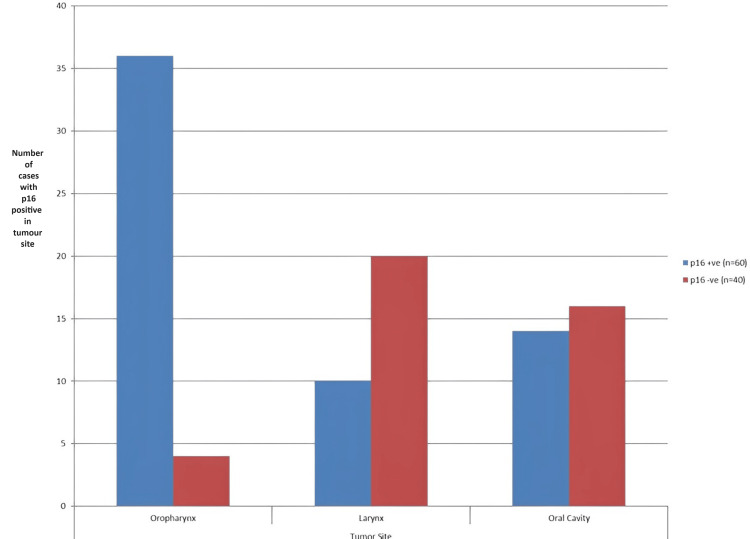
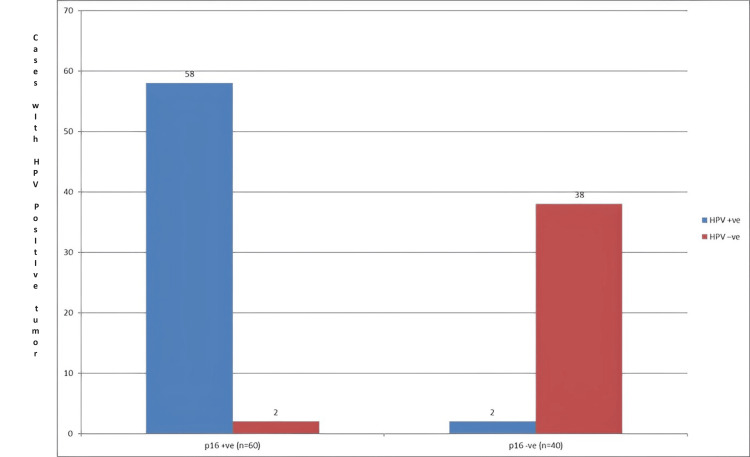
Our analysis demonstrated a significant correlation between HPV status and p16 expression in HNSCC cases. A vast majority of 58 (96.7%) HPV-+ cases exhibited p16 overexpression, contrasting sharply with only two (5%) in the HPV-- group. Patients with tumors that were both p16+ and HPV+ exhibited more favorable overall survival rates. In contrast, those with p16- and HPV- tumors experienced the poorest survival outcomes. Notably, having a p16-- status in HPV+ cases emerged as an independent factor for reduced survival. Additionally, the study revealed distinct variations in p16 expression based on tumor location, particularly within the oropharyngeal area.
The study established that p16 is a dependable indication for the existence of HPV in HNSCC and highlights its significant role as a prognostic factor, particularly in cases that are p16-- yet HPV-+. These findings underscore the importance of adopting site-specific treatment approaches in HNSCC management and contribute to a deeper understanding of p16's role in the disease, thereby aiding in more effective risk assessment and treatment planning.
头颈部鳞状细胞癌(HNSCC)是一组起源多样且流行病学模式不断变化的癌症。高危型人乳头瘤病毒(HPV)感染在某些HNSCC病例中的意义因其对疾病行为的影响而受到关注。我们目前的研究重点是探索使用p16作为HNSCC生物标志物的重要性,特别是在HPV感染的背景下,评估其在预后方面的价值,并研究其在不同肿瘤部位的变化。
对一家三级护理中心的100例HNSCC患者进行回顾性分析,特别关注p16表达、HPV状态、临床病理特征和预后。使用聚合酶链反应(PCR)技术检测HPV,并通过免疫组织化学评估p16表达。根据《赫尔辛基宣言》中概述的伦理准则,多变量分析评估了p16的预后价值。
我们的分析表明,HNSCC病例中HPV状态与p16表达之间存在显著相关性。绝大多数58例(96.7%)HPV阳性病例表现出p16过表达,与HPV阴性组中仅2例(5%)形成鲜明对比。p16阳性且HPV阳性的肿瘤患者总体生存率更高。相比之下,p16阴性且HPV阴性的肿瘤患者生存结果最差。值得注意的是,HPV阳性病例中p16阴性状态是生存降低的独立因素。此外,研究还揭示了基于肿瘤部位的p16表达存在明显差异,特别是在口咽区域。
该研究确定p16是HNSCC中HPV存在的可靠指标,并强调了其作为预后因素的重要作用,特别是在p16阴性但HPV阳性的病例中。这些发现强调了在HNSCC管理中采用特定部位治疗方法的重要性,并有助于更深入地理解p16在该疾病中的作用,从而有助于更有效的风险评估和治疗规划。