Ju Mingyi, Zhang Jiaojiao, Deng Zhuoyuan, Wei Minjie, Ma Lianghua, Chen Ting, Zhao Lin
Department of Pharmacology, School of Pharmacy, China Medical University, Shenyang, China.
Liaoning Key Laboratory of molecular targeted anti-tumor drug development and evaluation; Liaoning Cancer immune peptide drug Engineering Technology Research Center; Key Laboratory of Precision Diagnosis and Treatment of Gastrointestinal Tumors, Ministry of Education, China Medical University, Shenyang, China.
J Immunother Cancer. 2024 Jul 31;12(7):e009345. doi: 10.1136/jitc-2024-009345.
Immune-related adverse events (irAEs), characterized by targeted inflammation, occur in up to 60% of patients with melanoma treated with immune checkpoint inhibitors (ICIs). Evidence proved that the baseline peripheral blood profiles of patients at risk for severe irAEs development paralleled clinical autoimmunity. Interleukin (IL)-23 blockade with risankizumab is recommended for cases that are suffering from autoimmune disease, such as autoimmune colitis. However, currently, the role of IL-23 in irAEs onset and severity remains poorly understood.
The pro-inflammatory cytokines most associated with severe irAEs onset were identified by retrospective analysis based on GSE186143 data set. To investigate the efficacy of prophylactic IL-23 blockade administration to prevent irAEs, refer to a previous study, we constructed two irAEs murine models, including dextran sulfate sodium salt (DSS)-induced colitis murine model and a combined-ICIs-induced irAEs murine model. To further explore the applicability of our findings, murine models with graft-versus-host disease were established, in which Rag2Il2rg mice were transferred with human peripheral blood mononuclear cells and received combined cytotoxic T-lymphocyte associated antigen 4 (CTLA-4) and programmed cell death protein-1 (PD-1) treatment. Human melanoma cells were xenografted into these mice concomitantly.
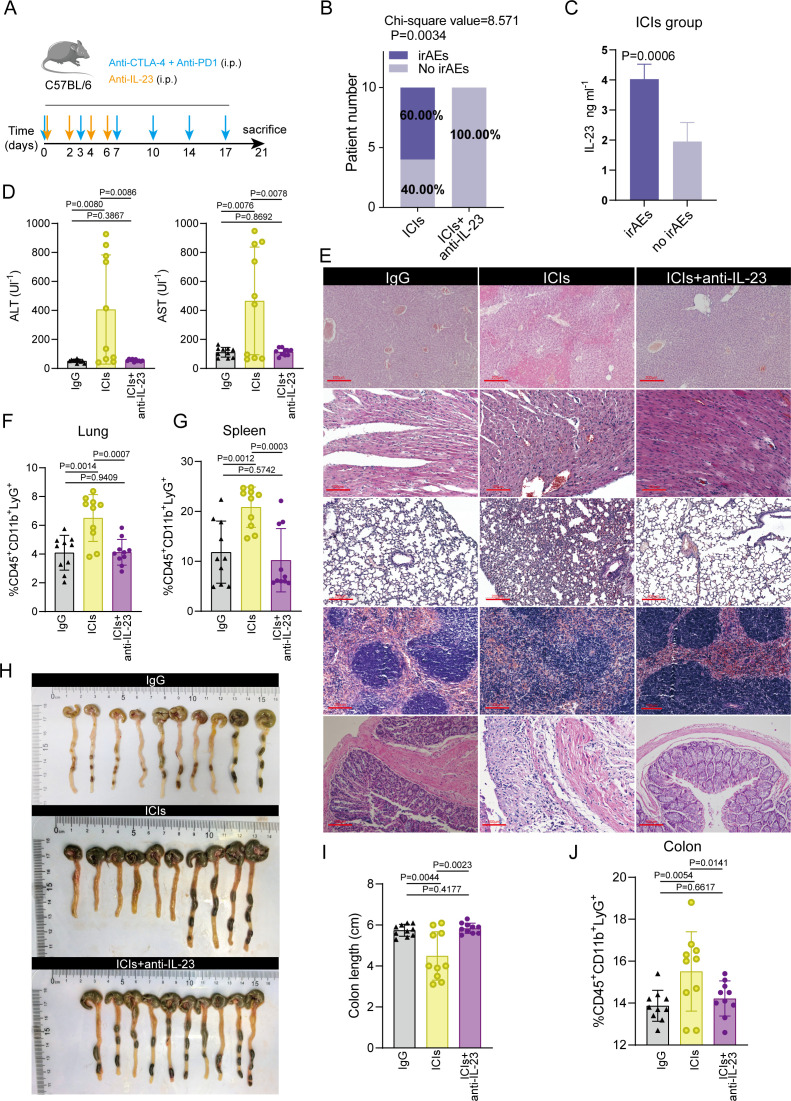
Here we show that IL-23 was upregulated in the serum of patients suffering from irAEs after dual anti-CTLA-4 and anti-PD-1 treatment, and increased as a function of irAEs severity. Additionally, Augmented CD4 Tems may preferentially underlie irAEs onset. Treating mice with anti-mouse IL-23 antibody concomitantly with combined CTLA-4 and PD-1 immunotherapy ameliorates colitis and, in addition, preserves antitumor efficacy. Moreover, in xenografted murine models with irAEs, prophylactic blockade of human IL-23 using clinically available IL-23 inhibitor (risankizumab) ameliorated colitis, hepatitis and lung inflammation, and moreover, immunotherapeutic control of tumors was retained. Finally, we also provided a novel machine learning-based computational framework based on two blood-based features-IL-23 and CD4 Tems-that may have predictive potential for severe irAEs and ICIs response.
Our study not only provides clinically feasible strategies to dissociate efficacy and toxicity in the use of combined ICIs for cancer immunotherapy, but also develops a blood-based biomarker that makes it possible to achieve a straightforward and non-invasive, detection assay for early prediction of irAEs onset.
免疫相关不良事件(irAEs)以靶向炎症为特征,在接受免疫检查点抑制剂(ICIs)治疗的黑色素瘤患者中发生率高达60%。有证据表明,有发生严重irAEs风险的患者的基线外周血特征与临床自身免疫情况相似。对于患有自身免疫性疾病(如自身免疫性结肠炎)的病例,推荐使用瑞莎珠单抗阻断白细胞介素(IL)-23。然而,目前IL-23在irAEs发生和严重程度中的作用仍知之甚少。
基于GSE186143数据集,通过回顾性分析确定与严重irAEs发生最相关的促炎细胞因子。为了研究预防性给予IL-23阻断剂预防irAEs的效果,参考之前的一项研究,我们构建了两种irAEs小鼠模型,包括葡聚糖硫酸钠(DSS)诱导的结肠炎小鼠模型和联合ICIs诱导的irAEs小鼠模型。为了进一步探索我们研究结果的适用性,建立了移植物抗宿主病小鼠模型,将人外周血单个核细胞移植到Rag2Il2rg小鼠体内,并给予联合细胞毒性T淋巴细胞相关抗原4(CTLA-4)和程序性细胞死亡蛋白1(PD-1)治疗。同时将人黑色素瘤细胞异种移植到这些小鼠体内。
我们发现,在接受双重抗CTLA-4和抗PD-1治疗后发生irAEs的患者血清中,IL-23上调,并随irAEs严重程度增加。此外,增强的CD4 Tem可能是irAEs发生的主要原因。在联合CTLA-4和PD-1免疫治疗的同时用抗小鼠IL-23抗体治疗小鼠,可改善结肠炎,此外,还能保留抗肿瘤疗效。此外,在有irAEs的异种移植小鼠模型中,使用临床可用的IL-23抑制剂(瑞莎珠单抗)预防性阻断人IL-23,可改善结肠炎、肝炎和肺部炎症,而且,肿瘤的免疫治疗控制得以保留。最后,我们还提供了一个基于两种血液特征——IL-23和CD4 Tem的新型机器学习计算框架,该框架可能对严重irAEs和ICIs反应具有预测潜力。
我们的研究不仅提供了在联合使用ICIs进行癌症免疫治疗时分离疗效和毒性的临床可行策略,还开发了一种基于血液的生物标志物,使得实现一种直接、非侵入性的检测方法来早期预测irAEs的发生成为可能。